


Introduction
Google Search is changing faster than it has in years.
For a long time, searching on Google meant entering a keyword or short phrase, receiving a list of webpages and opening different results to find the information you needed.
That model is still important, but Google AI Search is creating a more conversational way to explore information.
Instead of asking several separate questions, users can increasingly ask detailed questions, explore a topic through follow-up questions and interact with AI-generated responses.
At the center of this transformation is Google AI Mode.
Google describes AI Mode as its most powerful AI search experience. It allows users to ask questions using text, voice or images, explore information from multiple web sources and continue with follow-up questions. Google says AI Mode can also break complex questions into subtopics and search for information on those subtopics simultaneously.
For users, this could make research faster and more conversational.
For website owners, however, it raises an important question:
What happens to website visibility when Google can answer more questions directly inside Search?
In this guide, we’ll explain Google AI Mode in 2026, how it works, how it differs from AI Overviews, what it means for SEO and websites, and where the future of Google Search could be heading.
What Is Google AI Mode?
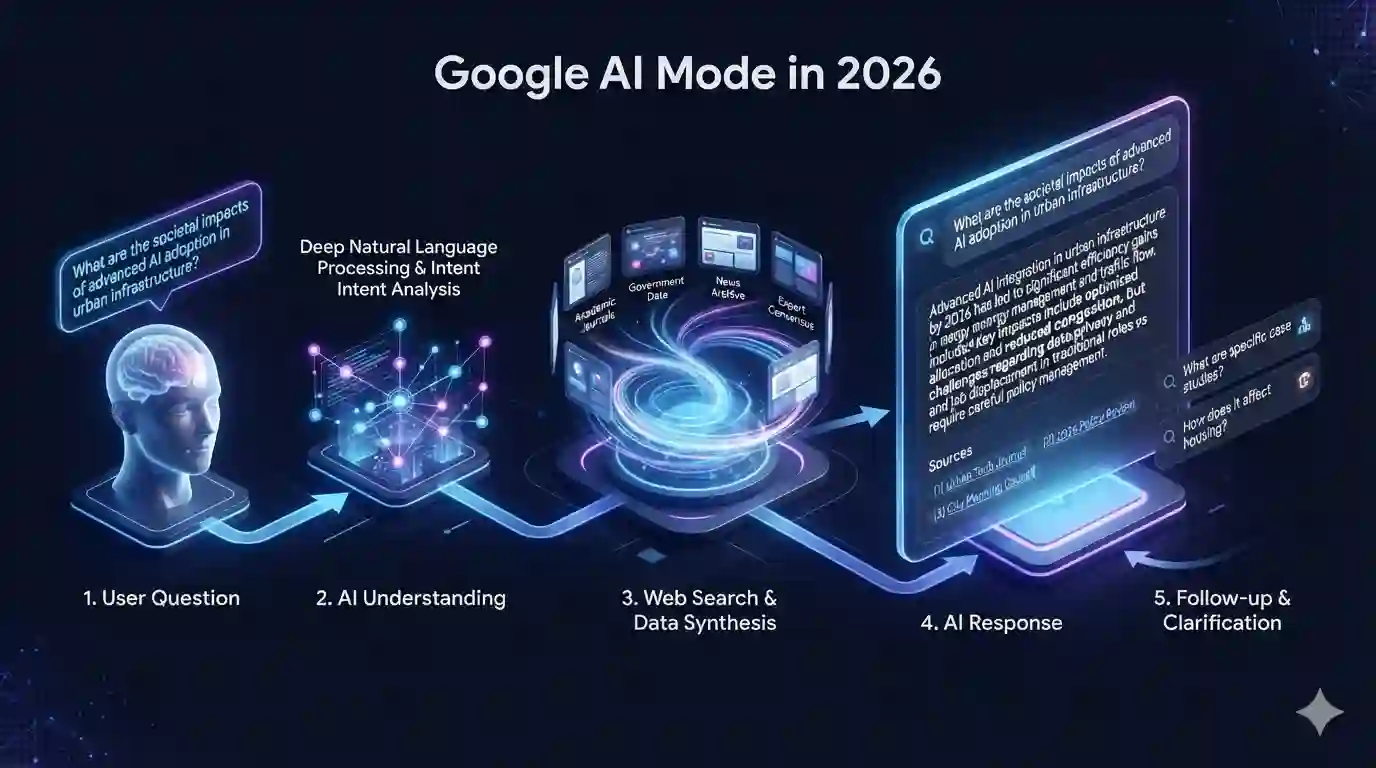
Google AI Mode is an AI-powered search experience within Google Search designed to help users explore complex questions through conversational interactions.
Rather than relying only on a traditional list of search results, AI Mode can provide an AI-generated response and allow users to continue asking questions about the same topic.
Google’s current documentation says users can ask questions with text, voice or images, receive AI-powered responses, ask follow-up questions and explore information from a range of web sources.
This makes AI Mode particularly interesting for searches that require more than a simple fact.
For example, a traditional search might be:
“best AI writing tools”
A more conversational AI Mode query could be:
“What are the best AI writing tools for a small marketing agency, and which ones are easiest for a five-person team to use?”
The second question contains considerably more context.
That’s one reason AI-powered Google Search is becoming more conversational.
How Google AI Mode Works
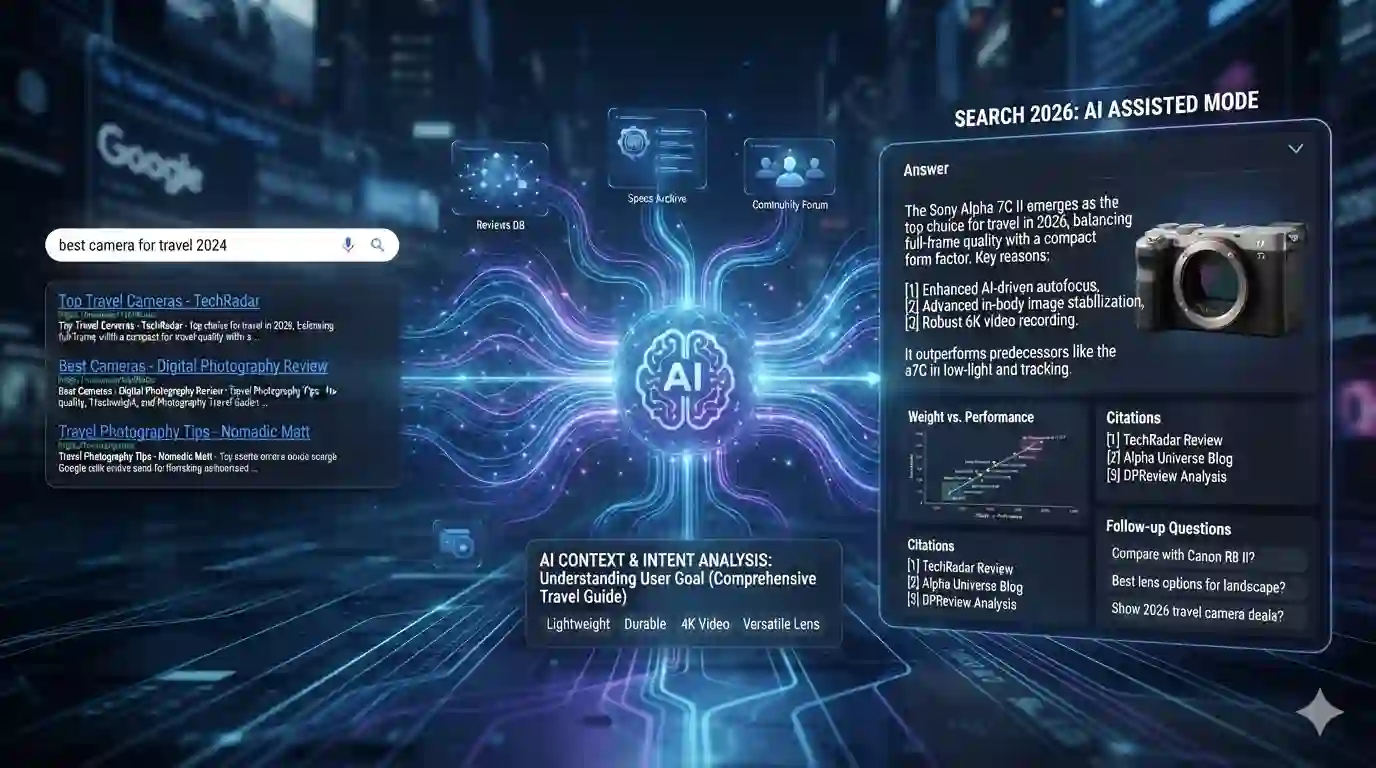
Understanding how Google AI Mode works doesn’t require knowing every detail of Google’s internal systems.
Google says AI Mode can break a complex question into multiple subtopics and search for those subtopics simultaneously. This approach allows the system to explore a broader range of information before generating a response.
A simplified version of the process looks like this:
User asks a question
↓
AI interprets the request
↓
Complex question may be divided into subtopics
↓
Google Search retrieves relevant information
↓
AI synthesizes information
↓
AI-generated response + useful web links
↓
User asks follow-up questions
This is different from simply matching a few keywords to webpages.
Google also emphasizes that AI Mode relies on Google’s understanding of web information and can provide links to web content. In situations where the system doesn’t have sufficient confidence in the quality or helpfulness of an AI response, Google says it may instead provide a set of web links.
That distinction is important.
AI Mode does not mean websites have disappeared from Google Search.
The information ecosystem still depends heavily on the web.
Google AI Mode in 2026: What’s New?
Google’s AI search experience has continued evolving rapidly.
Google introduced AI Mode as an experimental search experience in 2025 and subsequently expanded its capabilities, languages and availability.
By 2026, Google has continued integrating newer Gemini models and additional AI capabilities into Search.
In January 2026, Google announced updates bringing Gemini 3 to AI Overviews and describing a more seamless conversational Search experience.
Google also introduced Personal Intelligence capabilities for AI Mode, allowing eligible users to connect certain Google content and receive more personalized responses.
The exact availability of features can vary by country, language, account and product tier, so users should check Google’s current documentation for their location.
Google AI Mode vs AI Overviews
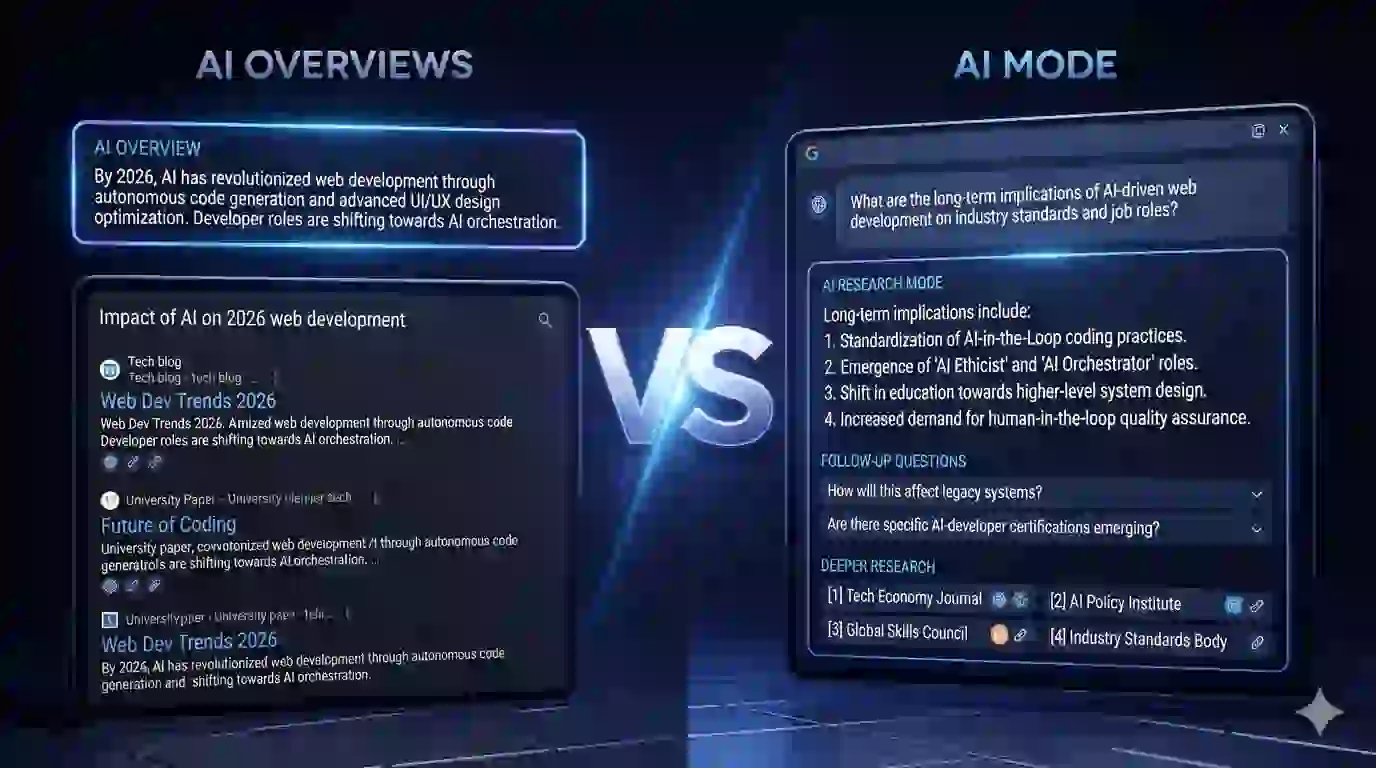
One of the most common questions is:
What’s the difference between Google AI Overview vs AI Mode?
Although they are closely related, they serve somewhat different experiences.
| AI Overviews | Google AI Mode |
|---|---|
| AI-generated information can appear within the Search results experience | Dedicated AI-powered Search experience |
| Useful for getting a quick AI-generated overview | Designed for deeper exploration |
| Can provide supporting web links | Supports ongoing follow-up questions |
| Works alongside traditional Search | Provides a more conversational experience |
| Good for understanding a question quickly | Better suited to complex, multi-part exploration |
Google says AI Mode expands what AI Overviews can do with more advanced reasoning and interaction capabilities. It can also break questions into subtopics and search them simultaneously.
Think of it this way:
AI Overview:
“Give me a useful overview.”
AI Mode:
“Let’s explore this topic together.”
The distinction may evolve as Google continues integrating AI throughout Search.
Why Is Google Adding AI to Search?
There are several reasons Google is moving toward AI-powered Search.
1. People Ask More Complex Questions
Search queries are not always simple keywords.
Users may want comparisons, explanations, recommendations and multi-step research.
AI can make these questions easier to express naturally.
2. Search Is Becoming Conversational
Instead of searching:
“AI agents”
then:
“AI agents business”
then:
“AI agents examples”
a user can potentially ask a sequence of related questions within one AI Mode conversation.
Google explicitly supports follow-up questions in AI Mode.
3. Users Want Faster Research
Researching a complicated subject can require opening many webpages.
An AI-powered interface can help summarize information and point users toward relevant sources.
That doesn’t eliminate the need to verify important information, but it can reduce some of the initial research effort.
4. Search Is Becoming Multimodal
Modern search isn’t limited to typed words.
Google has expanded AI Mode to support questions involving images, and Google has described multimodal capabilities powered by Gemini and Lens.
That means a user can increasingly combine:
- Text
- Images
- Voice
- Follow-up questions
within a single search experience.
5. User Expectations Are Changing
People are becoming accustomed to conversational AI.
They expect software to understand context instead of requiring a perfectly optimized keyword every time.
Google Search is adapting to those expectations.
What Can You Use Google AI Mode For?
The best way to understand AI Mode is through practical examples.
Research
You might ask:
“Explain the difference between RAG and AI agents and give me practical business examples.”
Instead of searching several short queries separately, the user can start with one detailed question and continue from there.
Comparisons
For example:
“Compare the best AI writing tools for a small business and explain which features matter most.”
The user can then ask:
“Which one is easiest for beginners?”
The conversational format makes the research process more interactive.
Learning
You could ask:
“Explain generative AI to a beginner, then give me three real-world examples.”
Follow-up questions can continue from the original context.
Planning
For example:
“Create a seven-day learning plan for someone who wants to learn AI automation.”
The user can then ask for changes based on their needs.
Visual Search
AI Mode also supports multimodal interactions.
Google has described AI Mode capabilities that allow users to ask questions about images, using technologies including Lens and Gemini to understand visual information.
This expands the concept of search beyond simply typing keywords.
Google AI Mode and Personalization
One of the more interesting developments in Google AI Search is personalization.
Google announced Personal Intelligence for AI Mode in January 2026. The feature can use certain connected Google information to provide more tailored responses for eligible users.
For example, a search experience that understands relevant personal context could potentially provide recommendations that are more specific to an individual’s circumstances.
However, personalization also makes privacy and user control increasingly important.
Google says AI Mode personalization can be controlled through Search settings, and users can correct or clarify responses when personalization gets something wrong.
This highlights an important principle:
More personalized AI can be more useful, but users need meaningful control over the information being used.
Google AI Mode and Voice Search
Search is also becoming more conversational through voice.
Google introduced Search Live, a voice-based experience that allows users to have a back-and-forth conversation with Search.
This creates another shift in search behavior.
Instead of typing:
“best laptop for video editing”
a user might simply ask:
“I’m looking for a laptop for video editing. What should I look for?”
Conversational interfaces make longer questions feel more natural.
This is one reason the future of Google Search may involve a much greater combination of text, voice, images and conversational interaction.
What Does Google AI Mode Mean for Websites?
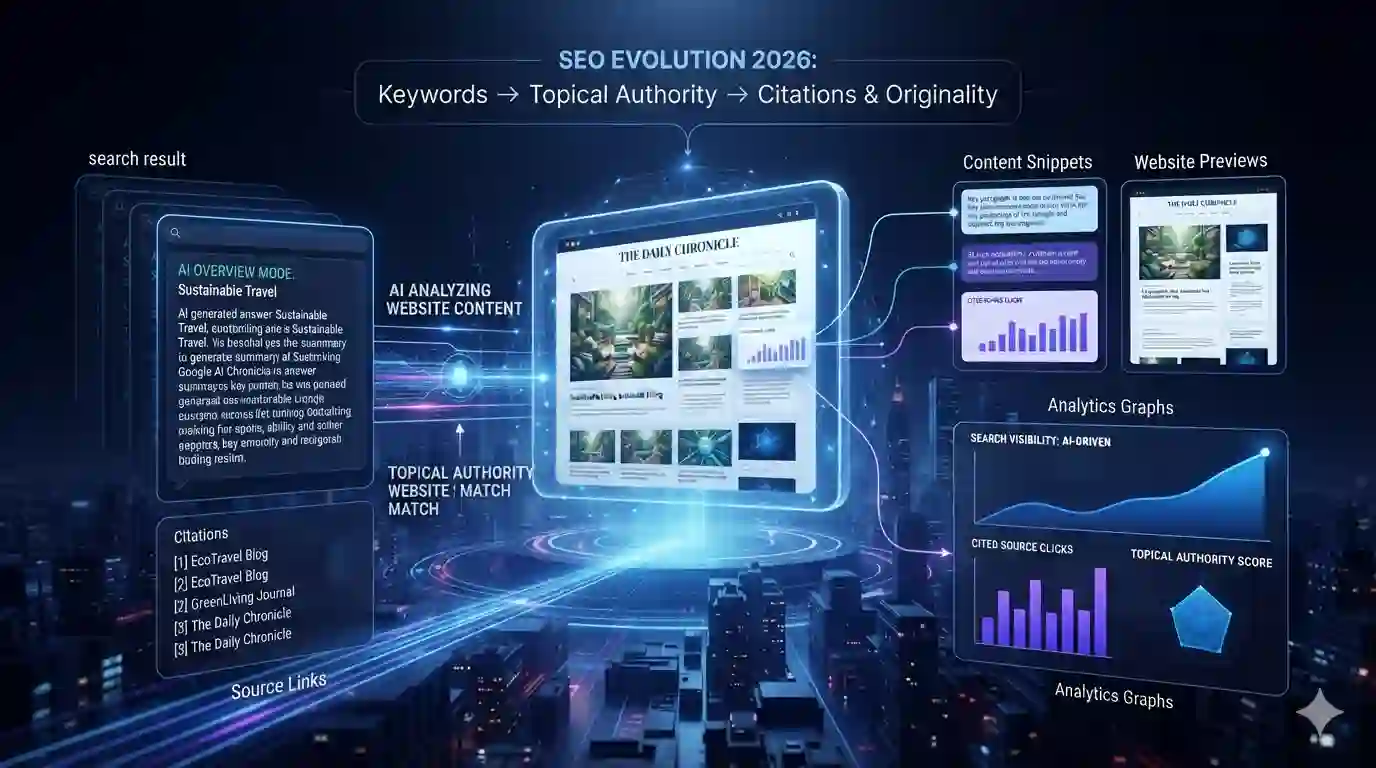
This is where things become particularly important for website owners.
Traditional search has generally followed this model:
Search query
↓
Search results
↓
Website ranking
↓
User clicks
AI-powered Search introduces another possibility:
Search query
↓
AI-generated response
↓
Sources and links
↓
User decides whether to explore further
This can change how websites think about organic visibility.
A website might not only compete for a traditional ranking.
Its content may also become a source that an AI-powered search experience uses or references.
That doesn’t mean every website will automatically receive less traffic.
The impact can vary by:
- Query type
- Search intent
- Industry
- Content quality
- Search experience
- User behavior
Some searches may be satisfied directly in Google, while others may encourage users to explore deeper sources.
Will Google AI Mode Reduce Website Traffic?
This is one of the biggest concerns among publishers.
The honest answer is:
It can change traffic patterns, but the impact won’t necessarily be identical for every website.
If a user receives enough information directly from an AI-generated answer, they may not need to click a webpage for certain simple queries.
But AI-generated answers can also introduce users to websites and sources that they might not otherwise discover.
For publishers, the goal should therefore be broader than simply:
“Get a higher ranking.”
Instead, think about:
- Being discoverable
- Being useful
- Being trustworthy
- Providing original information
- Building brand recognition
- Creating content worth exploring
Website owners should monitor their own data rather than assuming AI Mode will automatically increase or destroy traffic.
Track:
- Organic impressions
- Organic clicks
- Click-through rate
- Branded searches
- Referral traffic
- Conversions
- Engagement
Does Google AI Mode Replace SEO?
No.
This is one of the most important points for website owners.
The rise of AI-powered Google Search doesn’t mean traditional SEO suddenly becomes irrelevant.
Websites still need strong foundations.
That includes:
- Crawlability
- Indexing
- Mobile usability
- Site architecture
- Internal linking
- Helpful content
- Clear page titles
- Descriptive headings
- Fast performance
- Accessible pages
AI Mode still relies on information from the web, and Google says its AI Mode uses Google’s understanding of web information and high-quality web content to support responses.
So rather than abandoning SEO, website owners should think about combining:
Traditional SEO + high-quality content + AI-search awareness
Google AI Mode and Generative Engine Optimization
This is where our previous article becomes important.
Generative Engine Optimization (GEO) is focused on preparing content for an environment where AI systems generate or synthesize answers.
Traditional SEO asks:
“How can my webpage appear prominently in search results?”
GEO asks:
“How can my information become useful and understandable within AI-generated search experiences?”
Our guide to Generative Engine Optimization (GEO) explains this concept in detail and provides practical strategies for creating content for the evolving AI-search environment.
The two approaches shouldn’t be treated as enemies.
The strongest strategy is usually:
Technical SEO
Useful content
Topical authority
Clear structure
Original information
AI-search visibility
How Website Owners Should Prepare for Google AI Mode
If you’re running a website in 2026, there are several practical steps you can take.
1. Answer Real Questions
Don’t create content just because a keyword exists.
Understand what users actually want to know.
Then answer the question clearly.
2. Build Topical Authority
Instead of publishing one article about AI search, create a connected content ecosystem.
For example:
- AI Search in 2026
- Google AI Mode
- Generative Engine Optimization
- ChatGPT Search
- AI Search vs Traditional Search
- How to Optimize Content for AI Search
Connect the articles naturally.
3. Use Clear Headings
A good article should be easy to scan.
Use descriptive H2 and H3 headings that tell readers exactly what each section covers.
4. Cite Reliable Sources
When discussing Google’s products, use Google’s official documentation where possible.
Don’t rely entirely on third-party summaries when the original source is available.
5. Add Original Analysis
Generic AI content is becoming easier to create.
Your advantage is original value.
Add:
- Testing
- Screenshots
- Examples
- Data
- Expert opinions
- Comparisons
- Practical experiences
6. Improve Internal Linking
Connect related content.
For example, Future AI Insider can connect its articles about AI Search, GEO, AI agents and AI tools.
This helps readers move naturally through the website.
7. Keep Content Updated
AI search is changing quickly.
Review important articles regularly.
Update outdated:
- Product features
- Prices
- Availability
- Model information
- Statistics
- Screenshots
8. Strengthen Author Information
Clearly identify who created the content.
An AI-focused publication should make its editorial process and authorship easy to understand.
9. Maintain Technical SEO
Don’t let the excitement around AI make you forget the basics.
Your website still needs to be:
- Fast
- Crawlable
- Mobile-friendly
- Secure
- Well structured
- Properly indexed
10. Don’t Chase “AI Ranking Tricks”
Be careful with anyone claiming:
“Do these three things and Google AI Mode will definitely cite you.”
There is no guaranteed shortcut.
Google’s systems are complex and continually evolving.
Focus on producing genuinely useful information instead.
Google AI Mode vs ChatGPT Search
Google isn’t the only company changing how people search.
ChatGPT also provides web search within its conversational AI experience.
That creates an interesting comparison.
| Google AI Mode | ChatGPT Search |
|---|---|
| Built into Google Search | Built into ChatGPT |
| Strong connection to Google’s Search ecosystem | AI-first conversational environment |
| Designed for web search and exploration | Designed around conversation and AI assistance |
| Supports follow-up questions | Supports conversational follow-up |
| Uses Google’s search infrastructure | Combines ChatGPT with web search |
| Google ecosystem | OpenAI ecosystem |
Neither experience is automatically better for every situation.
The best choice depends on what the user is trying to accomplish.
If you’re interested in comparing the wider AI ecosystems, our ChatGPT vs Gemini 2026 guide explores the differences between these major AI platforms. Also, you can read our 25 Best AI Tools to Try in 2026 guide.
Google AI Mode vs Traditional Google Search
The biggest difference isn’t simply that one uses AI and the other doesn’t.
Google has used AI and machine learning throughout its Search systems for years.
The more significant change is the user experience.
Traditional search often encourages users to:
Enter query → scan results → choose websites → research
AI Mode can allow:
Ask question → receive AI response → ask follow-up → explore sources → continue researching
This makes Search feel less like a directory and more like an interactive research assistant.
However, the traditional results page remains valuable, particularly when users want to find a specific website, compare original sources or browse multiple results themselves.
The Future of Google Search

The future of Google Search may be less about short keywords and more about natural interaction.
We can already see a progression:
Keywords
↓
Questions
↓
Conversations
↓
Research
↓
Recommendations
↓
Actions
This could eventually bring Search and AI agents closer together.
Instead of simply asking:
“Where can I find the best option?”
a future AI system may increasingly help with:
“Find the best option, compare it with alternatives and help me complete the next step.”
Google has already explored agentic capabilities within AI Mode, including experiments designed to help users complete tasks.
This doesn’t mean every search will become an autonomous action.
But it shows the direction in which AI-powered Search can evolve.
For a deeper look at this broader shift, our article on AI agents in 2026 explores how AI systems are moving beyond simple responses toward more complex task-oriented workflows.
What Businesses Should Do Now
Businesses shouldn’t wait for the future of Google Search to arrive before adapting.
Start with the basics.
Create useful content
Answer questions customers actually ask.
Build topical authority
Cover important topics comprehensively.
Publish original insights
Don’t simply rewrite competitors.
Strengthen your brand
Make your business recognizable and trustworthy.
Create comparison content
Help potential customers make informed decisions.
Update important pages
Don’t allow valuable content to become outdated.
Monitor search performance
Watch your Search Console and analytics data for changes.
The goal isn’t to “beat AI.”
The goal is to make your website a valuable information source in an AI-powered search ecosystem.
Frequently Asked Questions
What is Google AI Mode?
Google AI Mode is an AI-powered Search experience that allows users to ask questions, receive AI-generated responses, explore information from web sources and continue with follow-up questions. Google says AI Mode can break complex questions into subtopics and search them simultaneously.
Is Google AI Mode free?
Availability and features can vary by location, account and product. Google provides current access information through its Search documentation, so users should check what is available in their region.
What is the difference between AI Mode and AI Overviews?
AI Overviews provide AI-generated information within Google Search, while AI Mode is designed as a deeper, more conversational AI search experience with follow-up questions and broader exploration.
Does Google AI Mode replace traditional SEO?
No. Traditional SEO remains important. Websites still need to be crawlable, indexable, technically sound and filled with useful content.
Can websites rank in Google AI Mode?
There is no separate public “AI Mode ranking formula” that guarantees inclusion. Website owners should focus on high-quality, useful, accessible and trustworthy content while maintaining strong traditional SEO.
Will AI Mode eliminate website traffic?
Not necessarily. Some searches may be answered directly, while other AI experiences can direct users toward sources and websites. The impact will vary by query, industry and user behavior.
Final Verdict
Google AI Mode is more than another Google Search feature.
It represents a broader change in how people interact with information.
Instead of entering a few keywords and scanning a list of webpages, users can increasingly ask detailed questions, use images or voice, explore topics conversationally and continue with follow-up questions.
Google’s AI-powered Search is also becoming more capable of handling complex queries and connecting information from multiple sources.
For users, that could mean faster and more natural research.
For website owners, it means the definition of search visibility is expanding.
Ranking still matters.
But so do:
Useful information.
Original content.
Clear structure.
Reliable sources.
Topical authority.
Brand recognition.
And increasingly, the ability to provide information that is useful within an AI-powered search environment.
The smartest strategy isn’t to abandon SEO for AI.
It’s to build a website that works well for both humans and modern search systems.
Because the future of Google Search isn’t simply about finding webpages.
It’s increasingly about understanding questions, exploring information and helping people accomplish something with what they discover.