
Artificial intelligence is beginning to move beyond screens. Instead of only answering questions, writing code, or generating images, AI systems are increasingly being connected to machines that can see, move, manipulate objects, and respond to the physical world. This shift is often called Physical AI.
From industrial robots sorting packages to humanoid machines learning tasks through demonstrations, the goal is to give machines a more flexible understanding of their surroundings. Advances in multimodal models, sensors, simulation, robotics hardware, and real-world training are bringing this vision closer to practical use.
But a convincing demonstration is not the same as a dependable product. Real workplaces are unpredictable, safety matters, and a robot must perform consistently enough to justify its cost. This guide explains how Physical AI works, where it is being used in 2026, what humanoid robots can realistically do, and what businesses should evaluate before deploying them.
What is Physical AI?
Physical AI describes AI systems that perceive and interact with the physical environment through machines such as robots, autonomous vehicles, drones, and industrial equipment. A conventional chatbot mainly processes digital inputs and produces digital outputs. A Physical AI system must connect its decisions to actions in the real world.
That requires several capabilities working together: perception to understand the environment, reasoning and planning to choose an action, control systems to execute movement, and feedback to determine whether the action worked. The system may need to adapt when an object is moved, a person enters its path, or an unexpected obstacle appears.
How Physical AI works
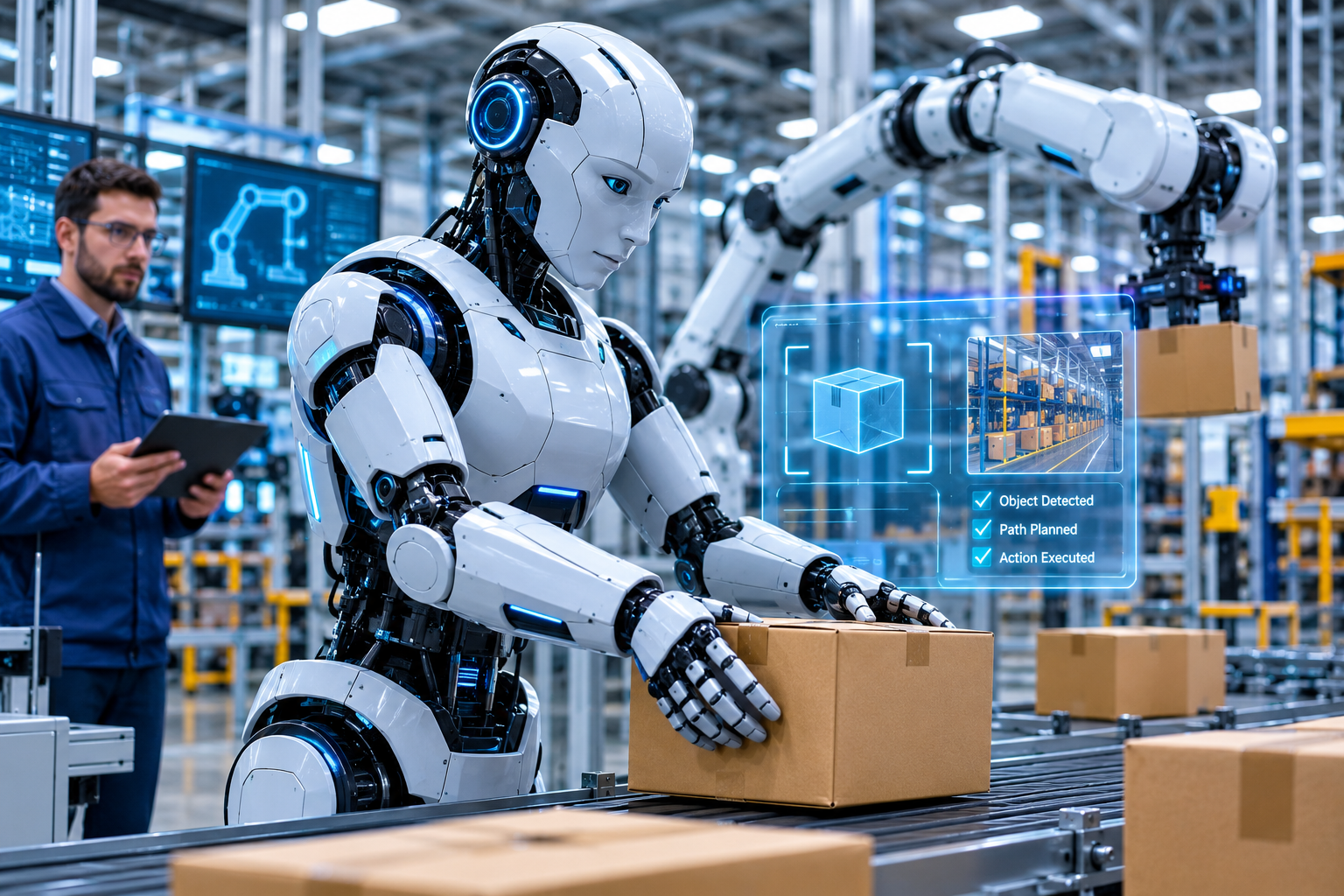
A Physical AI robot combines software and hardware in a continuous loop. Cameras, depth sensors, lidar, microphones, force sensors, and joint encoders can provide information about the world and the robot’s own position. AI models interpret some of that information, while motion planners and lower-level controllers translate a task into safe movements.
- Perception: Cameras and other sensors detect objects, people, surfaces, distances, and changes in the environment.
- Scene understanding: Models identify what is happening and connect objects with their context, such as recognising a parcel on a conveyor.
- Planning: The system selects a sequence of steps to achieve a goal while considering obstacles, constraints, and safety.
- Action: Motors, grippers, wheels, or robotic arms carry out the planned movement.
- Feedback: Sensors check the result so the robot can correct its movement or try another approach.
This loop is more difficult than generating a text response. A robot’s actions can damage equipment or injure people, and small perception errors can produce large physical consequences. Reliable systems therefore combine learned models with conventional robotics, control engineering, safety limits, and human supervision.
The role of vision-language-action models
One important research direction is the vision-language-action (VLA) model. A VLA model connects visual observations and natural-language instructions with robot actions. For example, a person might ask a robot to pick up a red container and place it on a shelf. The model must relate the instruction to what the cameras observe and help produce an appropriate action sequence.
VLA systems are not a magic replacement for robot engineering. They need suitable training data, calibrated sensors, capable actuators, and robust control. Their promise is that robots may generalise across more tasks and instructions instead of requiring a separate hand-coded program for every variation.
Researchers are also exploring world models: systems that learn representations of how environments change when an agent takes an action. In robotics, this could help a machine predict the consequences of moving an object, opening a drawer, or navigating around an obstacle. Simulation can provide large volumes of practice, while real-world data helps close the gap between simulated and actual environments.
Humanoid robots: why the interest is growing
Humanoid robots are designed with a human-like body plan, often including a torso, two arms, hands, and two legs. Their form factor is attractive because many buildings, tools, workstations, and storage systems were designed for people. A robot that can use existing spaces and equipment may reduce the need to redesign an entire workplace.
However, a human-like shape does not automatically make a robot useful. Walking, balancing, manipulating flexible objects, handling fragile items, and recovering from mistakes are all demanding engineering problems. A specialised wheeled robot or fixed robotic arm may be cheaper, faster, and more reliable for a narrow task.
In 2026, the most credible near-term opportunities for humanoids are structured industrial and logistics environments where tasks can be clearly defined and performance measured. General-purpose home robots remain a much harder challenge because homes contain varied objects, changing layouts, pets, children, and countless unusual situations.
Where Physical AI is being used in 2026
Manufacturing and assembly
Factories already use industrial robots for welding, painting, packaging, and repeatable assembly. Physical AI can make automation more adaptable by helping systems recognise variations, inspect components, handle less predictable objects, and coordinate with people. High-volume production lines remain attractive because tasks are repetitive and the financial benefits can be measured.
Warehousing and logistics
Warehouses offer practical applications such as parcel sorting, tote movement, pallet handling, inventory scanning, and order fulfilment. Autonomous mobile robots can transport goods, while robotic arms and emerging humanoid systems may handle selected picking and manipulation tasks. The difficult cases often involve mixed packages, damaged items, clutter, and exceptions that do not match the normal workflow.
Healthcare and assisted living
Robots can support logistics inside hospitals, move supplies, disinfect spaces, and assist with certain repetitive tasks. Physical assistance involving patients requires a much higher standard of safety, reliability, privacy, and clinical oversight. It is important not to confuse a research prototype with a clinically validated medical device.
Agriculture and outdoor operations
Farms can use robotics for crop monitoring, targeted spraying, harvesting assistance, and autonomous movement through fields. Outdoor environments create challenges such as changing light, mud, weather, irregular terrain, and biological variation. AI perception can help, but machines still need durable hardware and reliable operation under real conditions.
Inspection, construction, and hazardous work
Robots can inspect infrastructure, map sites, monitor industrial facilities, and enter some environments that are dangerous for people. Drones and tracked robots are often more suitable than humanoids for these jobs. The value comes from reducing human exposure to hazards while collecting consistent information.
Physical AI versus traditional robotics
Traditional industrial automation is often programmed for a defined environment and a narrow set of tasks. It can be extremely fast and reliable when conditions remain stable. Physical AI aims to add more flexible perception, learning, and decision-making so machines can cope with a wider range of situations.
| Area | Traditional robotics | Physical AI |
|---|---|---|
| Task definition | Usually tightly programmed | Can interpret broader goals and context |
| Environment | Often structured and controlled | Aims to handle more variation |
| Learning | Typically requires explicit reprogramming or tuning | Can use demonstrations and data-driven adaptation |
| Strength | Speed and repeatability on known tasks | Potential flexibility across tasks and objects |
| Challenge | Limited adaptability outside its programmed scope | Reliability, safety, cost, and generalisation |
These approaches are not mutually exclusive. Many practical systems will combine conventional automation with AI perception and planning. A fixed robot arm may use an AI vision model to identify an object, then rely on a deterministic controller to execute a carefully validated movement.
Why simulation and real-world data matter
Training a robot entirely through trial and error in a real factory would be slow, expensive, and potentially dangerous. Simulation allows developers to generate scenarios, test control policies, and expose systems to rare events without risking physical equipment. Synthetic data can also help vary lighting, object positions, and environmental conditions.
Simulation is not identical to reality. Materials deform, friction varies, sensors are noisy, and objects may behave differently from their simulated versions. This difference is often called the sim-to-real gap. Strong development programmes combine simulation with demonstrations, carefully collected real-world data, testing, and ongoing evaluation after deployment.
The biggest challenges holding Physical AI back
- Reliability: Robots must complete tasks repeatedly, not just succeed in a staged demonstration.
- Safety: Machines working near people need risk assessment, emergency stops, protective systems, and clear operating boundaries.
- Cost and return on investment: Hardware, integration, maintenance, downtime, and supervision all affect the business case.
- Dexterity: Manipulating cables, soft packaging, tools, and irregular objects remains difficult.
- Data quality: Robots need diverse, accurate examples of physical tasks and failure conditions.
- Security: Connected robots can introduce cyber risks involving software updates, remote access, sensors, and operational networks.
- Workforce integration: Organisations need training, maintenance skills, process redesign, and clear accountability.
Recent industry analysis reinforces the difference between a demonstration and deployment. IDC’s coverage of the 2026 World Robot Conference describes progress toward complete task workflows, while noting that stability, cost, return on investment, and operations remain hurdles to broad enterprise rollout. Read IDC’s analysis of Physical AI deployment.
Reporting from Reuters in November 2026 also highlights the race to give robots stronger real-world understanding, while noting that reliable performance across unfamiliar workplaces remains difficult. Read the Reuters report on the race to build smarter robots.
How businesses should evaluate a Physical AI robot
Businesses should begin with a specific operational problem rather than buying a humanoid robot because it attracts attention. Identify a repetitive, costly, physically demanding, or hazardous task and measure how it is currently performed. Then compare robotic options against the actual workflow.
- Define the task, acceptable error rate, throughput, and operating hours.
- Measure the current labour, equipment, safety, and downtime costs.
- Test the robot in the real environment, including unusual objects and failure cases.
- Calculate total cost of ownership, including integration, maintenance, software, energy, and human supervision.
- Check safety standards, cybersecurity controls, vendor support, and responsibility for incidents.
- Start with a limited pilot and set measurable criteria before scaling.
For companies already adopting AI software, robotics is another stage in the automation journey. Our guides to AI automation in 2026 and AI agents versus AI assistants explain how digital systems can coordinate tasks and workflows. The same discipline—clear permissions, monitoring, evaluation, and human escalation—matters when AI begins acting in the physical world.
What comes next for Physical AI?
Progress is likely to come from the combination of better models, lower-cost sensors, improved actuators, more capable hands, simulation, and larger datasets of physical interaction. The strongest early products may not be general-purpose humanoids. They may be specialised machines that perform a narrow task safely and economically, then gradually gain flexibility.
Over time, robots may become easier to teach through demonstrations and natural-language instructions. They may also work as coordinated fleets, sharing maps and task information across a facility. But each step toward greater autonomy will need robust testing, security, and oversight.
Frequently asked questions
What is the difference between Physical AI and robotics?
Robotics is the engineering field concerned with machines that sense, move, and act. Physical AI adds AI-based perception, learning, and decision-making to help robots operate in more varied environments. Many real systems combine both approaches.
Are humanoid robots ready for everyday use?
Some humanoid robots are being tested in controlled industrial and research settings, but dependable general-purpose use in homes and unpredictable environments remains challenging. Capabilities vary significantly by robot and task.
What is a vision-language-action model?
A VLA model connects visual input and language instructions with actions a robot can take. It helps a system relate what it sees to a requested task, while robot controllers and safety systems handle physical execution.
Will Physical AI replace human workers?
Automation can change job tasks and reduce demand for some repetitive or hazardous activities, while increasing demand for technicians, engineers, safety specialists, and robot operators. The impact depends on the industry, economics, deployment scale, and how organisations manage workforce transitions.
Which industries will adopt Physical AI first?
Manufacturing, warehousing, logistics, inspection, and some agricultural operations are strong early candidates because many tasks are measurable and can be carried out in defined environments. Healthcare and homes require additional safety and reliability advances.
The bottom line
Physical AI is an important next step in artificial intelligence: machines are moving from interpreting digital information toward acting in the physical world. The technology has real potential in factories, warehouses, agriculture, inspection, and other settings, but broad adoption will depend on reliability, safety, affordability, and measurable results.
The most meaningful progress will not be measured by how human-like a robot looks or how impressive a short video appears. It will be measured by whether the machine can complete useful work consistently, safely, and at a cost that makes sense.