

Introduction
Search is changing.
For years, website owners focused primarily on traditional SEO: choosing keywords, building backlinks, optimizing title tags and trying to reach the top of Google’s organic results.
Those fundamentals still matter. But in 2026, another layer has become increasingly important: AI search optimization.
Google Search now includes AI-powered experiences such as AI Overviews and AI Mode, while platforms such as ChatGPT and Gemini can provide conversational answers that summarize information from multiple sources.
Google has also continued moving Search toward a more conversational experience. In January 2026, Google announced that users could move directly from an AI Overview into an AI Mode conversation for follow-up questions.
That creates a new question for website owners:
How do you make your website useful not only for traditional search rankings, but also for AI-generated answers?
This is where Generative Engine Optimization (GEO) and AI search optimization become important.
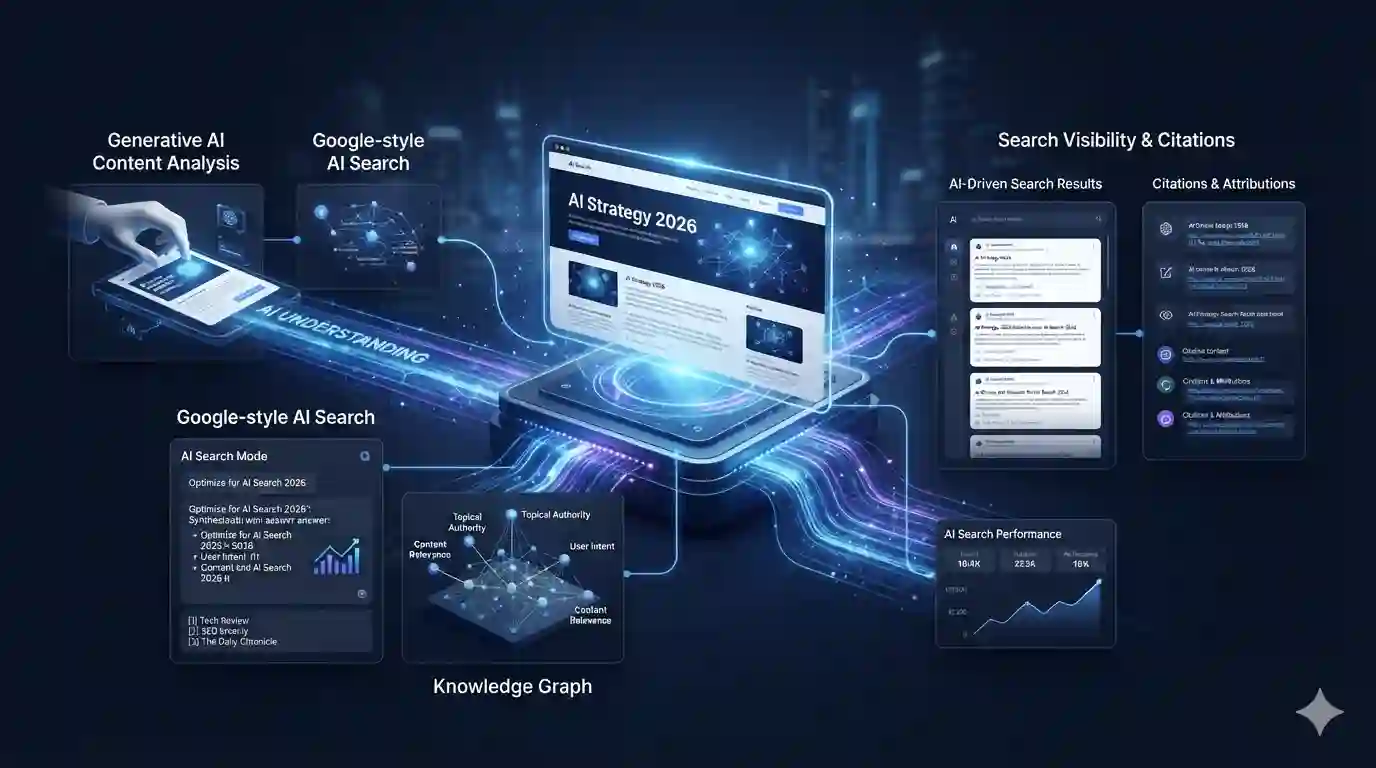
In this guide, we’ll explain how to optimize your website for AI search in 2026, what AI systems are looking for, how to structure content, and what you can do to improve your chances of being discovered, cited or referenced by AI-powered search experiences.
What Is AI Search Optimization?
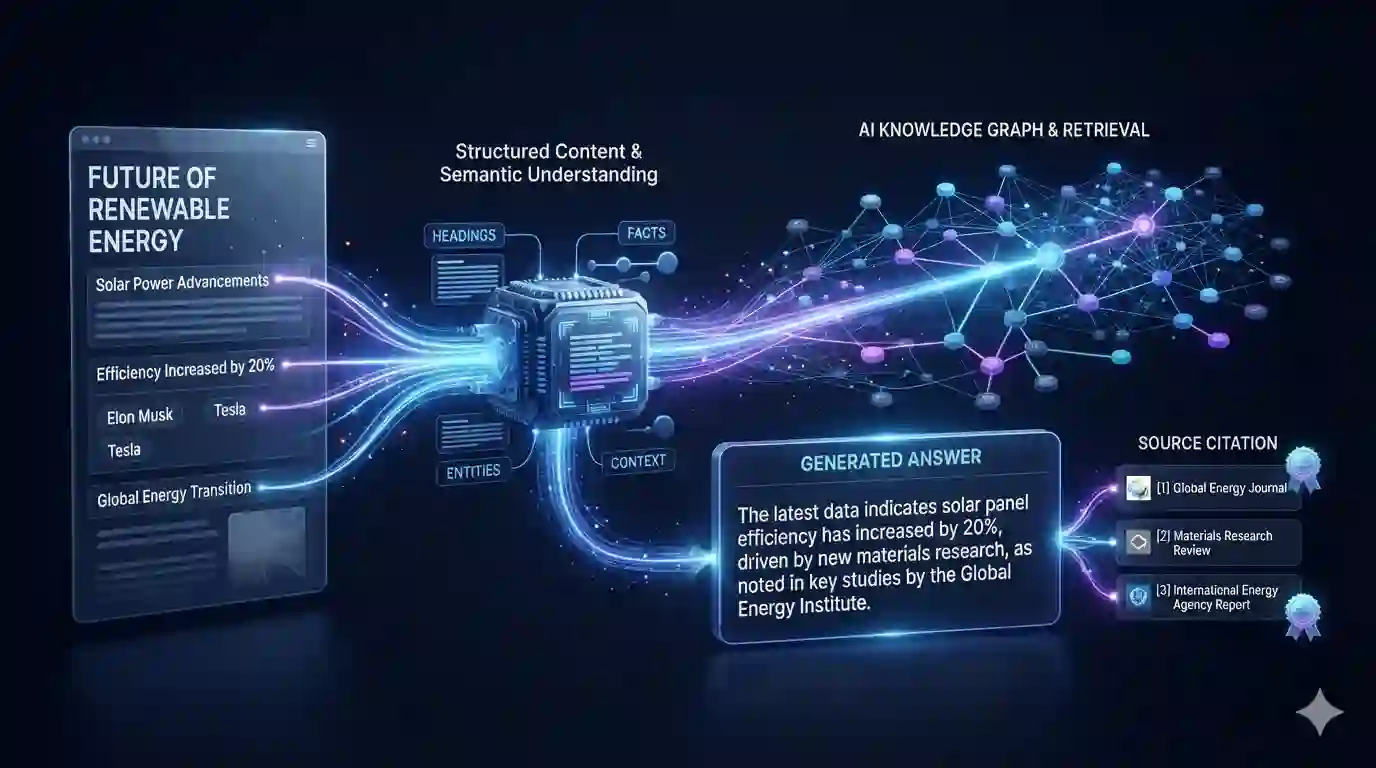
AI search optimization is the process of creating and structuring website content so that it can be easily discovered, understood, evaluated and potentially referenced by AI-powered search systems.
Traditional SEO generally focuses on helping search engines understand:
- What your page is about
- Which keywords it targets
- How authoritative your website is
- How relevant your page is to a query
AI search adds another dimension.
AI systems may need to understand:
- The exact question your content answers
- Whether your information is clearly supported
- How different concepts relate to each other
- Whether your website provides useful original information
- Which parts of your page can support a generated answer
This doesn’t mean traditional SEO is dead.
Instead, AI search optimization builds on traditional SEO.
Your goal should be to create content that works for both humans and search systems.
AI Search vs Traditional Search
Traditional search typically presents users with a list of results.
A user searches for:
“Best AI tools for small businesses”
They may receive:
- Website A
- Website B
- Website C
- Website D
The user then visits several pages and compares the information.
AI search changes the interaction.
An AI-powered search system may interpret the question, retrieve information from multiple sources and provide a synthesized response with links or citations.
Google’s AI Search developments are designed around making it easier to explore complex questions through conversational interactions. Google has described AI Mode as a way to handle deeper and more complex searches rather than simply returning a traditional list of links.
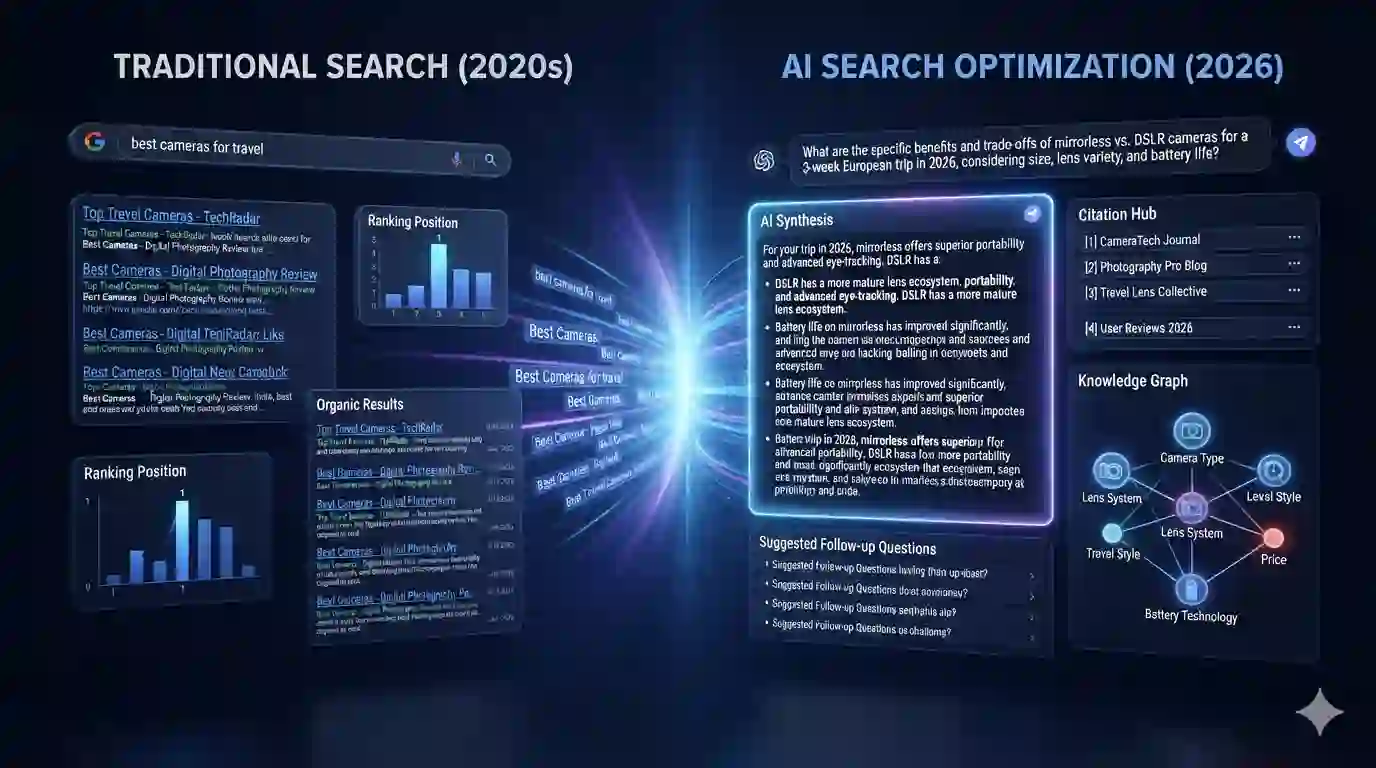
This means your website has two opportunities:
Traditional visibility
Your page ranks in conventional search results.
AI visibility
Your information may become part of an AI-generated response or be surfaced as a supporting source.
Why AI Search Optimization Matters in 2026
AI search is becoming a major part of how people discover information.
Google reported in May 2026 that AI Mode had surpassed one billion monthly users and that queries were growing rapidly.
At the same time, research into AI-generated search results suggests that AI systems do not necessarily select exactly the same sources that appear in traditional rankings.
A 2026 study comparing Google Search and AI-generated search experiences found substantial differences in the sources retrieved for traditional search and AI-generated answers.
This has an important implication:
Ranking in traditional search is valuable, but understanding how AI systems discover and use information is becoming increasingly important too.
1. Create Content That Directly Answers Questions
One of the easiest ways to improve AI search visibility is to make your content extremely clear.
Instead of writing an article that takes 500 words to reach the answer, answer the main question early.
For example:
What is AI search optimization?
Then immediately provide a concise definition.
After that, expand with:
- examples
- explanations
- benefits
- limitations
- practical steps
This structure helps readers quickly understand the topic.
It also creates clearly defined passages that can potentially answer specific queries.
A useful structure is:
Question → Direct answer → Explanation → Example → Additional detail
This works especially well for:
- tutorials
- comparisons
- definitions
- how-to guides
- product reviews
- technical explanations
2. Use Clear Question-Based Headings
AI search optimization doesn’t mean stuffing every heading with keywords.
Instead, use headings that reflect the questions your audience actually asks.
For example:
Instead of:
AI Search Strategies
Try:
How Can You Optimize a Website for AI Search?
Instead of:
GEO Benefits
Try:
Why Is Generative Engine Optimization Important in 2026?
This creates a clear semantic relationship between the heading and the content underneath it.
3. Build Topic Clusters
One article rarely establishes strong topical authority by itself.
Your website should create a network of related articles.
For example, Future AI Insider can build an AI Search cluster around:
Pillar article
AI Search in 2026: How Google, ChatGPT and AI Are Changing the Way We Search
Then supporting articles:
- Google AI Mode in 2026
- AI Search Optimization 2026
- Generative Engine Optimization (GEO)
- AI Agents in 2026
- ChatGPT Review 2026
- ChatGPT vs Gemini 2026
- Best AI Tools 2026
This creates contextual relationships between your articles.
For example, when discussing GEO, link naturally to your article about Generative Engine Optimization.
When discussing Google AI Mode, link to your Google AI Mode in 2026 article.
When discussing ChatGPT, link to your ChatGPT Review 2026 article.
This is much stronger than randomly inserting links.
4. Write for Humans First
One of the biggest mistakes in AI search optimization is trying to write specifically for machines.
Don’t.
Your content should be useful to a real person.
Avoid:
- keyword stuffing
- repetitive sentences
- unnatural headings
- excessive use of exact-match keywords
- generic AI-generated filler
- paragraphs that say very little
Instead, focus on:
Clarity + accuracy + usefulness + original information.
Google’s own Search guidance emphasizes creating helpful, reliable, people-first content rather than content primarily created to manipulate rankings.
5. Add Original Information
This is one of the most important strategies for Future AI Insider.
AI systems can already generate generic explanations.
So your website needs to provide something beyond generic explanations.
For example, instead of:
AI tools can improve productivity.
Create:
Our AI Productivity Test
Test five AI tools on the same workflow and document:
- time required
- output quality
- ease of use
- pricing
- limitations
- best use case
Now you have original information.
Other possibilities include:
- screenshots
- original comparisons
- experiments
- benchmark results
- interviews
- expert commentary
- original charts
- case studies
- first-hand testing
This type of content gives your website something genuinely useful to contribute.
6. Make Important Facts Easy to Verify
When writing about AI tools, companies, products or major developments, make your claims easy to verify.
For example:
Weak:
Google recently made AI Search much better.
Better:
Google announced in January 2026 that Gemini 3 would power AI Overviews and that users could continue directly into AI Mode for follow-up questions.
The second version gives readers a clear factual statement and a source.
This is particularly important for AI-related content because product capabilities and AI models change rapidly.
7. Use Authoritative External Sources
Don’t be afraid to link externally.
Good outbound sources can strengthen the usefulness of an article.
For Future AI Insider, prioritize sources such as:
- Google Search Central
- OpenAI
- Microsoft
- Anthropic
- official research papers
- universities
- reputable research organizations
For this article, Google’s official Search announcements are especially useful because they document how Google’s AI Search products are changing.
Important: Don’t add outbound links just to have outbound links.
Use them where they genuinely help the reader verify information or learn more.
8. Optimize Content for Conversational Queries
People increasingly ask AI systems complete questions rather than short keyword phrases.
Traditional query:
AI SEO
Conversational query:
How can I optimize my website so AI search engines understand and recommend my content?
Your article should naturally answer both.
Include sections such as:
What is AI search optimization?
How does AI search work?
How do I optimize my website for AI search?
What is GEO?
Can traditional SEO help with AI search?
How can a website improve its AI visibility?
These questions can naturally match the way users interact with conversational search.
9. Structure Important Information Clearly
Use formatting that makes your content easy to understand.
For example:
AI Search Optimization Checklist
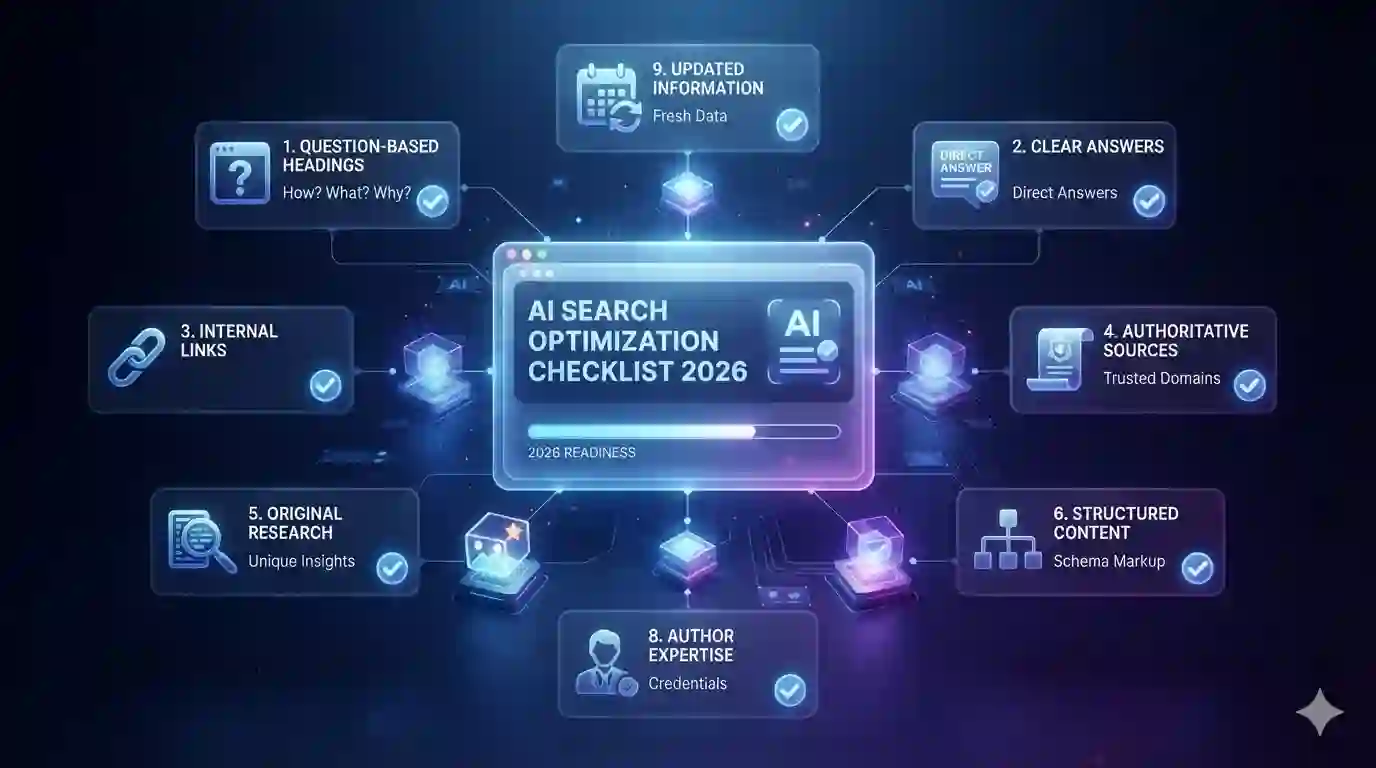
- Clear page title
- Strong introduction
- Direct answers
- Descriptive headings
- Short paragraphs
- Relevant internal links
- Author information
- Supporting sources
- Original examples
- Updated information
- Useful images
- Clear conclusion
You can also use tables where comparison is genuinely useful.
For example:
| Traditional SEO | AI Search Optimization |
|---|---|
| Keyword targeting | Question and intent targeting |
| Ranking pages | Being understood and referenced |
| SERP visibility | AI answer visibility |
| Backlinks | Authority and supporting evidence |
| Search snippets | Answer-ready content |
Remember that these approaches aren’t competitors.
The strongest strategy combines them.
10. Strengthen Your Internal Linking
Internal linking is particularly important for your AI Search content cluster.
For example, Future AI Insider already has several relevant resources.
Recommended internal links
Anchor: AI Search in 2026
Link to:
/ai-search-in-2026/
Recommended placement
Use it in the section:
AI Search vs Traditional Search
Example:
To understand the broader shift from traditional search to conversational discovery, read our guide to AI Search in 2026, where we examine how Google, ChatGPT and other AI systems are changing the way people find information.
Anchor: Google AI Mode in 2026
Link to:
/google-ai-mode-in-2026/
Use it in the section discussing Google’s AI search experience.
Example:
Google’s move toward conversational discovery is particularly visible in Google AI Mode in 2026, which allows users to explore more complex questions through an AI-powered search experience.
Anchor: Generative Engine Optimization
Link to your GEO article:
/generative-engine-optimization-geo/
Use it in this section.
Example:
This broader approach is closely connected to Generative Engine Optimization, or GEO, which focuses on improving how content can be discovered and represented by generative AI systems.
Anchor: AI agents in 2026
Link to:
/ai-agents-2026/
Use near the conclusion when discussing the future of search.
Anchor: ChatGPT Review 2026
Link to:
/chatgpt-review-2026/
Use in a section discussing conversational AI platforms.
11. Don’t Forget Traditional SEO
AI search optimization doesn’t replace SEO.
Your website should still have:
- optimized titles
- descriptive URLs
- strong meta descriptions
- proper headings
- internal links
- crawlable content
- optimized images
- mobile-friendly design
- fast performance
- good user experience
- trustworthy information
Think of it this way:
SEO helps search engines discover and rank your content.
AI search optimization helps AI systems understand and potentially use your content in conversational answers.
The two strategies overlap heavily.
12. Optimize Your Images
Images are another opportunity to make your articles more useful.
For every important image:
Use descriptive filenames
Instead of:
IMG_1234.jpg
Use:
ai-search-optimization-2026.jpg
Add descriptive ALT text
Example:
ALT:AI search optimization strategy showing how websites can improve visibility in Google AI Mode and generative search
Don’t stuff keywords into every ALT attribute.
Describe what the image actually shows.
13. Keep Your Content Updated
AI search changes extremely quickly.
An article that is accurate in January 2026 may become outdated later in the year.
For AI-related content, consider adding:
Last Updated: August 2026
Then review the article periodically.
Check:
- product names
- model names
- features
- pricing
- availability
- official documentation
- screenshots
- links
- statistics
This is particularly important for articles about Google AI Mode, ChatGPT, Gemini and other rapidly evolving platforms.
14. Measure More Than Google Rankings
Traditional SEO reporting often focuses on:
- rankings
- impressions
- clicks
- CTR
For AI search, also watch for:
- branded searches
- referral traffic from AI platforms
- mentions of your website
- pages receiving unusual direct traffic
- engagement with informational articles
- conversions from informational content
AI search visibility can be harder to measure than traditional rankings, so don’t judge your entire strategy by one metric.
Can You Guarantee That AI Will Cite Your Website?
No.
There is no legitimate SEO technique that guarantees ChatGPT, Google AI Mode, Gemini or another AI system will cite a particular website.
AI systems can select different sources depending on the query, retrieval process and context.
Research published in 2026 has also found that AI-generated search experiences can select sources differently from traditional Google results.
That’s why the right strategy isn’t:
“How do I trick AI into citing me?”
It’s:
“How do I become a genuinely useful, authoritative source that AI systems and human readers can trust?”
That’s a much more sustainable strategy.
AI Search Optimization Checklist for 2026
Before publishing an article, use this checklist:
Content
☐ Does the article answer a specific search intent?
☐ Is the answer provided clearly?
☐ Are important questions covered?
☐ Does the article contain useful examples?
☐ Is there original information?
SEO
☐ Primary keyword used naturally
☐ SEO-friendly title
☐ Meta description
☐ Short URL
☐ H1/H2/H3 structure
☐ Internal links
☐ Relevant external sources
AI Search
☐ Conversational questions included
☐ Important facts clearly explained
☐ Claims supported where appropriate
☐ Definitions are easy to extract
☐ Content is organized logically
☐ Author information is clear
Media
☐ Original featured image
☐ Supporting images
☐ Descriptive filenames
☐ Useful ALT text
Technical
☐ Mobile-friendly
☐ Fast loading
☐ HTTPS
☐ Indexable
☐ Included in sitemap
The Future of AI Search Optimization

Search is moving toward a more conversational and interactive model.
Google’s 2026 Search developments demonstrate this direction. Google has connected AI Overviews with follow-up conversations in AI Mode and has also introduced more agentic capabilities into Search.
That doesn’t mean traditional search disappears.
Instead, the search experience is becoming layered.
A user might:
- Ask Google a question.
- Receive an AI-generated overview.
- Ask a follow-up question.
- Explore supporting sources.
- Visit a website.
- Compare information with another AI system.
- Eventually make a decision.
For publishers and website owners, this means the goal is no longer simply:
“Rank #1.”
The bigger goal is:
“Be discoverable, understandable, useful and trustworthy throughout the search journey.”
Final Thoughts
AI search optimization is becoming an important extension of modern SEO.
The fundamentals remain familiar: create useful content, understand search intent, build authority, optimize your website and make information accessible.
But AI-powered search introduces another consideration.
Your content needs to be structured so that both humans and intelligent search systems can understand it.
For Future AI Insider, this represents a major opportunity.
By building connected content around AI Search, Google AI Mode, GEO, AI agents, ChatGPT, Gemini and AI tools, you can develop a focused topical ecosystem instead of publishing unrelated AI articles.
The websites that succeed in AI search won’t necessarily be the ones using the most keywords.
They’ll be the ones providing the clearest answers, strongest evidence and most useful original information.