

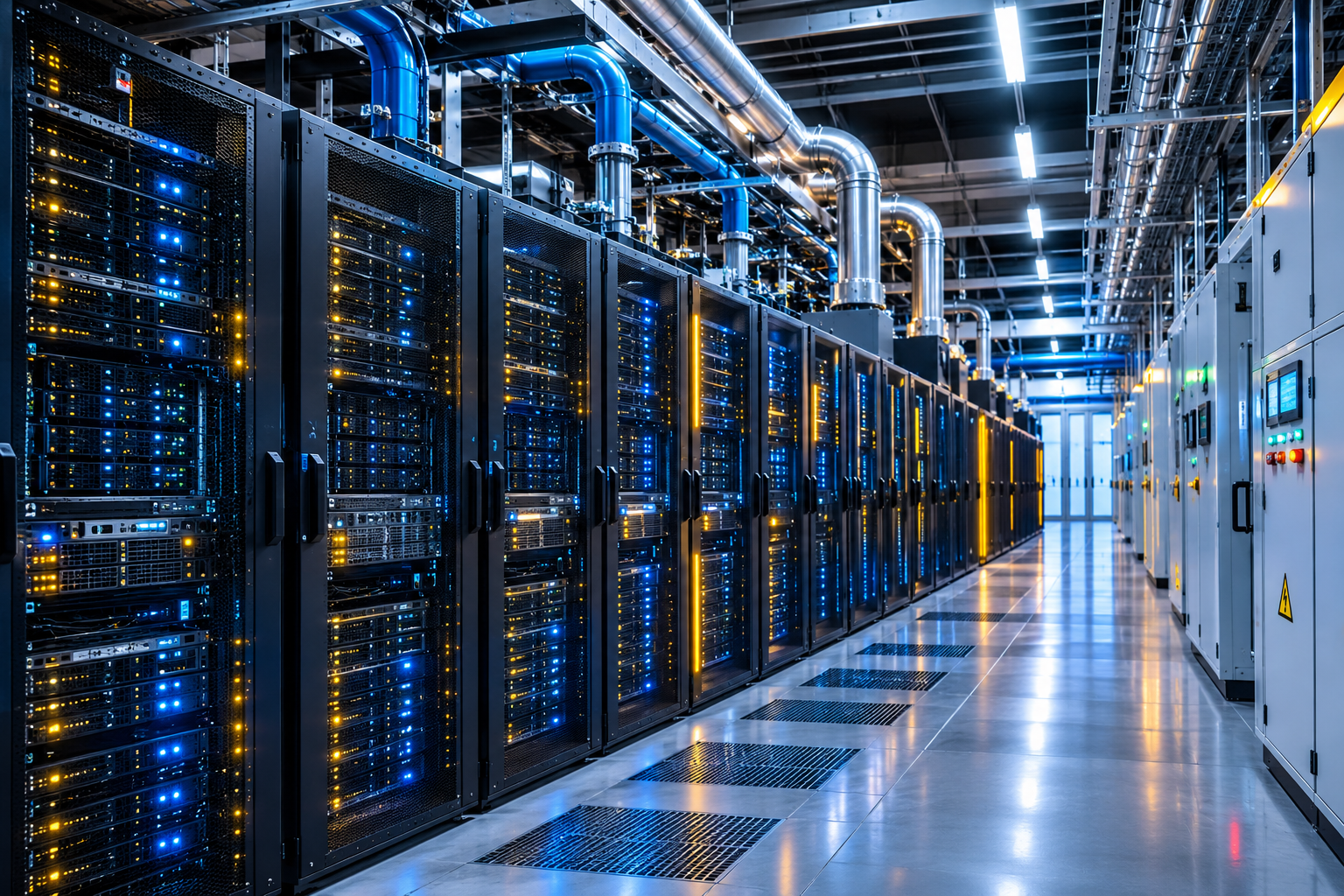
Artificial intelligence is often discussed in terms of models, chatbots, and software. Yet behind every AI answer, generated image, and autonomous agent is a physical system: servers, accelerators, networking equipment, cooling systems, and a reliable supply of electricity. In 2026, that infrastructure is becoming one of the most important parts of the AI economy.
Modern AI data centers are not simply larger versions of traditional server rooms. They are being designed for dense clusters of GPUs and other AI accelerators, fast interconnects, high-capacity power delivery, and increasingly sophisticated thermal management. These facilities are changing how utilities plan electricity networks, how chipmakers design hardware, and how technology companies think about the cost of AI.
This guide explains how AI data centers work, why their energy demand is rising, which cooling and chip technologies matter, and what operators can do to make AI infrastructure more efficient and resilient.
What is an AI data center?
An AI data center is a facility built or adapted to run the computing workloads behind artificial intelligence. It may train large models using thousands of accelerators, serve inference requests to millions of users, or support enterprise AI systems that process documents, images, audio, video, and business data.
Its core components include:
- AI accelerators: GPUs and specialised processors that perform the parallel calculations required by machine-learning models.
- High-bandwidth memory: Fast memory that keeps model parameters and data close to the processors.
- Networking: High-speed switches, optical links, and interconnects that allow large clusters to work together.
- Power systems: Transformers, switchgear, uninterruptible power supplies, backup generation, and distribution equipment.
- Cooling: Air handling, heat exchangers, pumps, and liquid-cooling loops that remove heat from densely packed hardware.
- Storage and security: Systems that store training data, model files, customer information, and operational records.
Why AI data center energy demand is growing
AI workloads can require far more computing power than conventional web hosting or basic database services. Training a frontier model involves large clusters operating for extended periods, while inference demand grows as people and businesses use AI products throughout the day. Video generation, complex reasoning, and agentic workflows can also require substantially more computation than a short text prompt.
The International Energy Agency reported in April 2026 that global data-center electricity consumption increased by 17% in 2025, while electricity use at AI-focused data centers rose even faster. Its analysis says overall data-center electricity consumption could roughly double by 2030, with AI-focused demand growing at a faster rate. These are projections, not guaranteed outcomes: efficiency improvements, project delays, power availability, and adoption patterns will all influence the result. Read the IEA’s 2026 update on data-center electricity use.
It is important to distinguish total electricity consumption from local grid impact. A data center may represent a modest share of global electricity use but still create a major new load for the town, substation, or transmission corridor where it is built. Local constraints can delay projects and increase pressure on electricity planning.
The power bottleneck: grids, transformers, and backup systems
AI infrastructure needs more than a large electricity contract. Operators need a grid connection capable of delivering substantial power continuously, equipment that can safely distribute it, and backup systems that protect workloads from interruptions. Transformers, switchgear, cables, and high-voltage equipment can have long procurement and installation lead times.
The IEA’s 2026 report on powering AI identifies grid connections, electrical equipment, advanced chips, and high-bandwidth memory among the constraints affecting data-center expansion. It also notes that the rapid pace of construction can collide with slower planning, permitting, and electricity-system processes. Explore the IEA’s Powering Artificial Intelligence analysis.
For operators, this means power planning must begin early. They may need to evaluate multiple sites, coordinate with utilities, phase construction, and design flexible loads. Battery energy storage can help manage short interruptions and rapid changes in demand, although it does not replace the need for a dependable long-term electricity supply.
AI chips and high-density server racks
AI processors are becoming more powerful, but the performance of a data center depends on the entire system. Accelerators need memory bandwidth, fast communication between servers, efficient software, and power delivery that can handle high-density racks. A bottleneck in any one of these areas can limit the performance of the whole cluster.
High-density racks also concentrate heat in a small physical area. That changes facility design: traditional room-level air conditioning may not be sufficient for the most demanding deployments. Operators increasingly evaluate direct-to-chip liquid cooling, rear-door heat exchangers, and other approaches that move heat away from processors more effectively.
Liquid cooling: why it matters for AI infrastructure
Air cooling moves heat using fans and conditioned air. It remains useful and can be effective for many workloads, but moving enough air through very dense server racks can require significant energy and careful airflow design. Liquid cooling uses a fluid to capture heat closer to the components that produce it.
Common approaches include direct-to-chip cooling, where cold plates transfer heat from processors into a liquid loop, and immersion cooling, where compatible hardware is placed in a specialised dielectric fluid. Rear-door heat exchangers can also remove heat from server exhaust before it enters the room.
Liquid cooling is not a universal plug-and-play solution. Facilities must consider leak detection, maintenance skills, water and fluid management, equipment compatibility, redundancy, and the design of heat-rejection systems. The best choice depends on rack density, climate, energy prices, available water, and the operator’s reliability requirements.
Water use and environmental sustainability
Energy is only one part of the environmental discussion. Some data centers use water directly in evaporative cooling systems, while others rely more heavily on air cooling or closed-loop liquid systems. Water consumption varies by climate, cooling design, facility utilisation, and the source of electricity. A facility’s local water impact can matter more to a community than a global industry average.
Responsible planning should assess water availability at the proposed site, seasonal stress, discharge requirements, and the full lifecycle of cooling equipment. Operators should report meaningful metrics and avoid presenting renewable-energy purchases as a complete answer to every environmental concern. Electricity source, water use, equipment manufacturing, and local grid effects all matter.
Can renewable energy power AI data centers?
Renewable electricity is an important part of the solution, and technology companies are signing power-purchase agreements and exploring new energy supply arrangements. However, matching a data center’s demand with clean electricity around the clock is more complicated than buying an annual quantity of renewable certificates. Solar and wind output varies, and data centers need reliable power every hour.
A stronger strategy combines clean-energy procurement with grid investment, storage, demand flexibility, efficient hardware, and transparent reporting. Depending on the market, firm low-carbon sources such as nuclear power or geothermal energy may also contribute. The practical mix will differ by region and by the reliability requirements of each facility.
How AI can make data centers more efficient
AI is not only increasing demand for computing; it can also help operate infrastructure more efficiently. Machine-learning systems can analyse sensor data, identify unusual cooling behaviour, forecast equipment failures, and optimise workloads. Operators can use these insights to improve utilisation and reduce wasted energy, provided the monitoring systems are tested and governed properly.
- Workload scheduling: Move flexible jobs to times or locations where electricity is cleaner or less constrained.
- Cooling optimisation: Adjust pumps, fans, and temperature setpoints using real-time operating data.
- Predictive maintenance: Detect early signs of equipment degradation before failures occur.
- Model efficiency: Use quantisation, smaller models, caching, and efficient inference techniques to reduce unnecessary computation.
- Hardware utilisation: Improve scheduling so expensive accelerators spend less time idle.
These techniques connect infrastructure planning with the wider AI ecosystem. For a related look at how smaller models can run locally, see our guide to small language models and on-device AI. For practical automation examples, read AI automation in 2026 and our overview of AI productivity tools and workflows.
What AI data centers mean for businesses
For businesses adopting AI, data-center expansion can improve access to capable models and cloud services, but it also makes infrastructure choices more important. Organisations should compare cloud AI services with private deployments, consider data residency and security obligations, and estimate the cost of repeated inference at scale.
Not every workload needs a frontier-scale model. Smaller language models, retrieval systems, caching, and task-specific models can often deliver useful results with lower latency and resource requirements. Businesses can also combine hosted models with local processing for sensitive or repetitive tasks. Our article on AI agents versus AI assistants explains how different AI workflows affect system design.
What to watch in 2027 and beyond
Several developments will shape the next phase of AI infrastructure:
- More efficient accelerators: Better performance per watt and improved memory systems could reduce the energy required for a given task.
- Advanced cooling: Liquid cooling and heat-reuse systems may become more common as rack densities rise.
- Grid-aware data centers: Flexible workloads, storage, and better coordination with utilities could help facilities integrate into electricity systems.
- Regional diversification: Operators will weigh power availability, connectivity, regulation, climate, and data-sovereignty requirements when choosing locations.
- Greater transparency: Communities and regulators are likely to demand clearer reporting on energy, water, emissions, and local infrastructure costs.
Frequently asked questions
Why do AI data centers use so much electricity?
AI training and inference rely on large numbers of specialised processors, memory systems, and high-speed networks. These components consume electricity, and additional power is needed for cooling, power conversion, storage, and other facility systems.
Are AI data centers worse for the environment than traditional data centers?
AI-focused facilities can have higher power density and more demanding cooling requirements, but environmental impact depends on utilisation, hardware efficiency, electricity sources, cooling design, and local water conditions. A well-designed facility running efficient workloads on cleaner power may have a lower impact per unit of useful computation.
What is the difference between air cooling and liquid cooling?
Air cooling uses fans and conditioned air to remove heat. Liquid cooling transfers heat through a fluid loop, often closer to the processor. Liquid systems can handle high heat loads more effectively in some designs, but they add plumbing, monitoring, and maintenance requirements.
Can renewable energy meet AI data center demand?
Renewables can supply a growing share of electricity, but continuous operation requires careful matching of supply and demand. Storage, grid upgrades, flexible workloads, and firm low-carbon generation can help close the gap when wind or solar output is low.
Will AI data centers keep expanding?
Demand is likely to keep growing, but the pace will depend on AI adoption, model efficiency, financing, chip availability, electricity connections, permitting, and community acceptance. Announced projects do not always become operational facilities.
The bottom line
AI data centers are becoming strategic infrastructure for the digital economy. Their future will not be decided by processor performance alone: electricity access, cooling, water stewardship, networking, software efficiency, and responsible site planning will matter just as much. The strongest AI infrastructure will deliver more useful computation while using energy and resources intelligently.
For more coverage of emerging infrastructure and AI technology, explore the latest guides in our Future Technology and AI News sections.