


Google AI Mode is a conversational search experience designed for questions that need more exploration than a short keyword search. It can generate an answer, connect related information and let users ask follow-up questions without starting a completely new search each time.
For users, this can make research and comparisons more fluid. For publishers, it raises practical questions about source visibility, website visits and the role of traditional search optimization. This guide explains what Google AI Mode does, how it differs from AI Overviews and what website owners can—and cannot—control.
What is Google AI Mode?
Google AI Mode is an AI-powered experience within Google Search for exploratory questions, comparisons and multi-step research. Instead of presenting only a conventional list of links, it can generate a response with supporting links and allow the user to continue the investigation through follow-up questions.
It is part of Google Search, not a separate web index that replaces the wider search ecosystem. Features and availability can differ by country, language, account and device. For the current product explanation, consult Google Search Help: Get AI-powered responses with AI Mode.
How Google AI Mode works
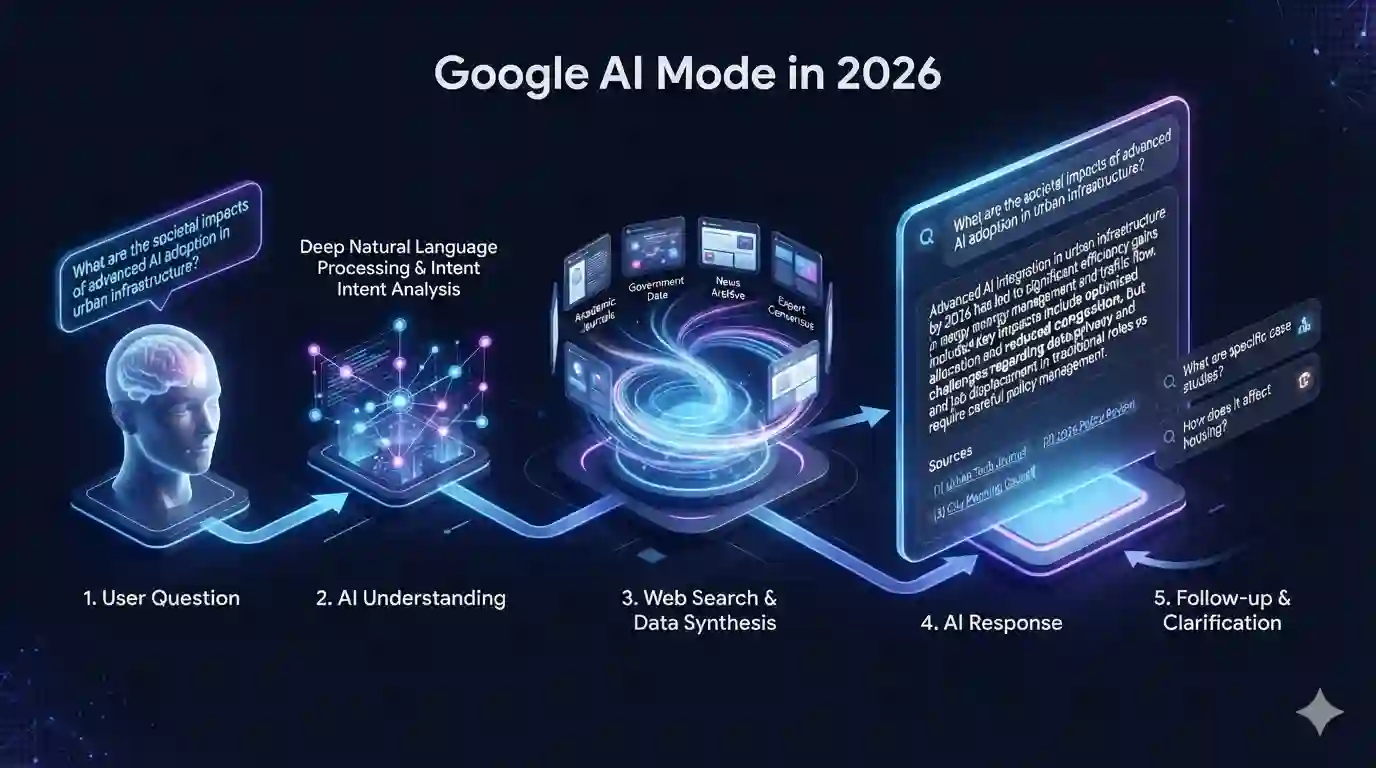
Google describes a technique called query fan-out in which a complex question can be explored through multiple related searches or subtopics. The system can gather information from different sources and assemble a response that helps the user explore the question.
A simplified view of the experience is:
- Interpret the question: Understand the topic, constraints and context of the user’s request.
- Explore related searches: Break a broad question into subtopics when useful.
- Retrieve information: Find relevant pages and other information sources.
- Generate a response: Present a synthesized answer with links or other search features where available.
- Continue the conversation: Let the user ask follow-up questions and refine the exploration.
This is a high-level explanation, not a complete description of Google’s proprietary systems. Retrieval and presentation can change as the product develops.
Google AI Mode vs AI Overviews

| Feature | AI Overviews | AI Mode |
|---|---|---|
| Where it appears | As an AI-generated feature within eligible Search results | As a dedicated conversational search experience |
| Typical use | Quick context or a summary alongside search results | More exploratory questions and follow-up research |
| Interaction | Usually part of a results page | Designed for continued conversational exploration |
| Links | May show links to supporting sources | Can provide links and further search paths |
The two experiences are related but serve different interaction patterns. Their exact presentation and availability can evolve, so check Google’s current documentation rather than relying on old screenshots.
What can people use AI Mode for?
Researching a complicated topic
A user can begin with a broad question, ask for clarification and explore related aspects in follow-up prompts. This can be useful when learning a subject that would otherwise require several separate searches.
Comparing products or options
Users may ask for a comparison based on criteria such as features, intended use or constraints. Important purchasing decisions should still involve opening original product pages, checking current specifications and reviewing independent evidence.
Learning and planning
Conversational search can help people build an overview, identify questions they have not considered and find sources for deeper reading. It should be treated as a starting point rather than a substitute for expert advice in high-stakes situations.
Exploring visual or multimodal questions
Depending on availability and the current product experience, Google may support ways to use images or other context in a search. Check the live feature set for your region and device; do not assume every capability is available to every account.
What does Google AI Mode mean for websites?
AI Mode changes how some people interact with search results. A user may receive a useful summary before deciding whether to visit a source. At the same time, links can give publishers an opportunity to be discovered by people who want more detail, original reporting or a direct service.
It is too early to assume that every site will gain or lose traffic in the same way. The effect depends on the topic, query, audience, product behavior and whether the generated response creates a reason to visit the source.
Does Google AI Mode replace SEO?
No. Google says its existing SEO best practices remain relevant for AI features in Search and that there are no additional technical requirements or special optimizations needed to appear in AI Overviews or AI Mode. See Google Search Central’s guidance for AI features and your website.
Website owners should continue to focus on useful content, crawlability, accurate metadata, internal links, accessible pages and a good user experience. There is no special markup that guarantees a citation in AI Mode.
How publishers should prepare for AI Mode
1. Answer the central question clearly
Explain the subject near the beginning of the page. Readers should understand what the article covers without having to navigate through a long introduction.
2. Add original reporting and analysis
Bring something distinctive: first-hand testing, original data, expert explanation, meaningful comparisons or practical examples. A rewritten version of information already available everywhere offers limited value.
3. Use accurate sources
Link to official documentation, primary research and direct announcements for claims about products or technical features. Check that a source actually supports the statement beside it.
4. Organize the page for readers
Use descriptive headings, tables when they improve comparison, and concise explanations. Avoid repeating the same keyword or question in every section.
5. Maintain strong technical foundations
Make sure important pages can be crawled, return the right status code, use correct canonical URLs and work on mobile. Structured data should accurately describe visible page content.
6. Build a useful topic cluster
Connect related coverage with meaningful internal links. Our guides to AI search in 2026 and AI search optimization explore the wider search shift and its implications for publishers.
7. Track real outcomes
Monitor Search Console impressions and clicks, relevant referral traffic, conversions and engagement. Avoid treating a few manual AI Mode searches as a reliable measure of overall visibility.
Google AI Mode vs ChatGPT Search
Both experiences let people ask questions conversationally and explore information with AI assistance, but they are different products. Google AI Mode is integrated into Google Search, while ChatGPT Search is a search experience within ChatGPT. Their interfaces, retrieval systems, source presentation, availability and product features are not identical.
For a broader comparison of AI search products, see our AI search guide. When comparing answers, open the cited sources and check whether they support the claims rather than judging only the generated wording.
What website owners should do now
- Keep important pages accessible to search crawlers.
- Publish accurate, original and people-first information.
- Make authorship, publisher identity and editorial responsibility clear.
- Use descriptive titles, headings and internal links.
- Maintain accurate structured data where appropriate.
- Update time-sensitive information when it genuinely changes.
- Measure traffic and business outcomes instead of chasing unverified AI ranking scores.
The future of Google Search
Search is likely to continue combining traditional results, AI-generated summaries and conversational exploration. The exact balance will change as Google tests features and responds to user behavior. Publishers should stay informed, but avoid rebuilding their entire strategy around short-term speculation.
The most durable approach is to create information that is worth finding: clear explanations, original insight, reliable sourcing and pages that work well for people.
Google AI Mode SEO: what website owners can measure
There is no reliable setting that guarantees a page will appear as a source in Google AI Mode. Website owners can, however, strengthen the foundations that make content useful and accessible: publish original information, explain claims with evidence, keep pages technically crawlable, use descriptive titles and headings, and make important details easy to locate. These practices support a sound SEO strategy even when a particular AI search feature changes.
Measure outcomes that your analytics and search reporting can actually show, such as organic impressions, clicks, landing-page engagement, conversions and the performance of relevant topic clusters. Treat changes in AI search visibility as one possible influence rather than assuming every traffic movement was caused by AI Mode. For practical content improvements, see our guide to AI search optimization and GEO strategies.
Frequently asked questions
What is Google AI Mode?
It is a conversational AI-powered search experience in Google Search that can answer complex questions, provide supporting links and support follow-up exploration.
What is the difference between AI Mode and AI Overviews?
AI Overviews appear as a generated feature within eligible search results, while AI Mode is designed as a more interactive search experience for continued exploration.
How does Google AI Mode work?
Google describes using techniques such as query fan-out to explore related searches, retrieve information and generate a response. The full system is proprietary and may change.
Can AI Mode make mistakes?
Yes. Generated answers can be incomplete or inaccurate. Check important claims against the linked source material and other reliable evidence.
Does Google AI Mode replace traditional SEO?
No. Google says its existing SEO best practices remain relevant to AI features. Useful content and technical accessibility still matter.
Will AI Mode reduce website traffic?
Its effect will vary by query and site. Some users may find an answer without clicking, while others may visit sources for deeper information or services. Monitor your own data.
Can a website guarantee appearing in AI Mode?
No. There is no guaranteed inclusion method or special markup that forces a page to be cited.




3 thoughts on “Google AI Mode in 2026: Powerful Search Changes Explained”