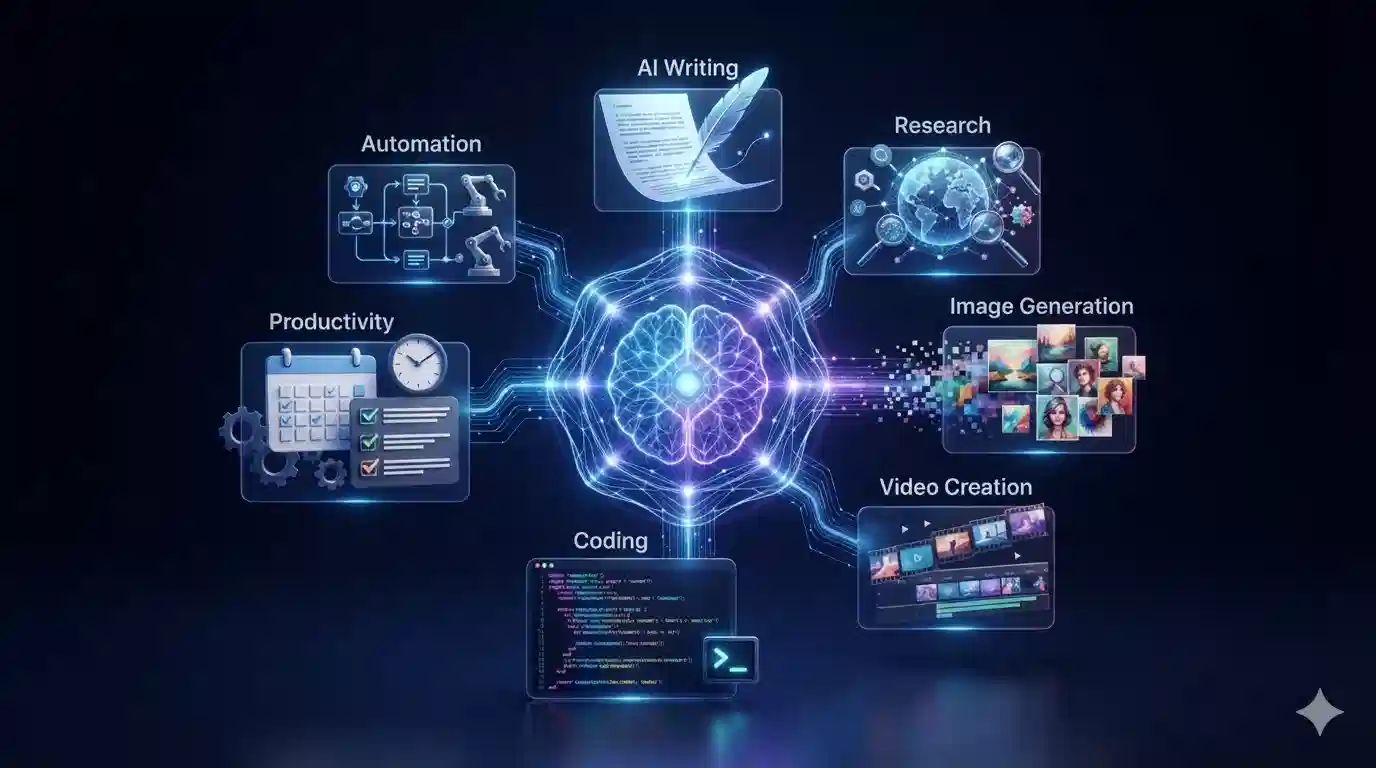


Artificial intelligence is moving beyond simple chatbots.

10 Best AI Agents for Business in 2026: Businesses are increasingly using AI systems that can research information, write content, analyze data, interact with software and complete multi-step tasks with less human intervention.
These systems are commonly called AI agents.
If you’re new to the technology, our guide to AI agents in 2026 explains how autonomous AI is changing the way people and businesses work.
Unlike traditional chatbots that primarily respond to individual prompts, AI agents can be designed to pursue a goal, use connected tools and continue working through multiple steps. Zapier describes an agent as software that takes a goal, plans the steps needed to reach it and uses tools to carry them out.
This makes AI agents particularly interesting for businesses.
Instead of asking AI to simply write an email, a company could potentially use an agent to research a lead, update a CRM, prepare a follow-up and notify a salesperson.
In software development, agents can work through codebases, run tests and prepare changes for human review. OpenAI says Codex is being used across enterprise software-development workflows and is expanding into other business tasks such as reports, lead qualification and product-feedback routing.
So, which AI agents are worth considering in 2026?
We’ve selected 10 platforms and tools based on their business use cases, integrations, automation capabilities and current agentic features.
What Are AI Agents for Business?
AI agents for business are software systems that can perform tasks or workflows on behalf of people and organizations.
A typical business agent combines several components:
- An AI model for reasoning
- Access to relevant business information
- Tools and software integrations
- Instructions or objectives
- Memory or context
- Rules and permissions
- Human oversight when necessary
For example, a customer-support agent might receive a support request, identify the customer’s account, look up relevant information, determine the appropriate response and escalate the issue if it requires human intervention.
That’s significantly different from simply asking an AI chatbot:
“Write a customer-support response.”
The first approach focuses on completing a workflow.
The second focuses on generating an answer.
Why Are AI Agents Becoming Important for Businesses?
The biggest reason is simple:
Businesses have thousands of repetitive workflows.
Employees spend time:
- Reading emails
- Updating spreadsheets
- Researching prospects
- Creating reports
- Moving information between applications
- Answering repetitive questions
- Reviewing documents
- Writing routine communications
- Checking databases
- Managing tickets
AI agents can potentially automate portions of these processes.
OpenAI reports that its own employees increasingly use Codex for longer-running tasks, including work outside traditional software development. The company says that by May 2026, more than 70% of users were asking Codex to complete tasks that would take a person more than an hour.
At the same time, enterprise platforms such as Microsoft 365 Copilot and Salesforce Agentforce are integrating agents directly into business applications and workflows.

10 Best AI Agents for Business in 2026
1. OpenAI Codex
Best for: Software development, technical workflows and increasingly broader business automation
Codex is one of the strongest examples of the transition from AI-assisted work toward agentic work.
Rather than simply generating snippets of code, Codex can work through larger engineering tasks, including features, refactoring, migrations and other software-development work. OpenAI describes Codex as a coding agent designed for end-to-end engineering tasks and multi-agent workflows.
The Codex ecosystem has also expanded beyond developers.
OpenAI says non-developers such as analysts, marketers, researchers and operators are increasingly using Codex for tasks involving automation, structured analysis and other technical work.
Why businesses should consider Codex
- Strong coding capabilities
- Multi-agent workflows
- Background tasks
- Software-development automation
- Large-codebase support
- Business and enterprise deployments
OpenAI has also introduced team-oriented Codex options, including Codex-only seats for some ChatGPT Business and Enterprise customers.
Best for: Technology companies, software teams, developers and businesses with technical workflows.
2. Microsoft 365 Copilot Agents
Best for: Businesses already using Microsoft 365
Microsoft has a major advantage in business AI because many organizations already use Microsoft products every day.
Microsoft 365 Copilot is increasingly incorporating agents that can connect business applications and help users take action without leaving Copilot. Microsoft’s 2026 roadmap describes agent experiences connecting Copilot with applications such as Dynamics 365 and partner tools.
This makes Microsoft particularly interesting for organizations already invested in:
- Word
- Excel
- Teams
- Outlook
- SharePoint
- Dynamics
- Power Platform
Potential business applications
- Sales assistance
- Document workflows
- Customer information
- Internal knowledge
- Data analysis
- Employee productivity
- Business-process automation
Best for: Microsoft-centric organizations.
3. Google Gemini and Gemini-Based Agents
Best for: Businesses operating heavily within Google’s ecosystem
Google’s Gemini ecosystem is another major player in the agentic AI race.
For businesses already using Google’s productivity and cloud services, the ability to connect AI with business information and workflows can be particularly valuable.
Gemini’s broader evolution toward agentic experiences reflects the industry’s move from AI that simply generates content toward AI that can help users complete tasks.
This makes Google particularly relevant for organizations using:
- Google Workspace
- Google Cloud
- Gmail
- Google Drive
- Google Docs
- Google Sheets
Potential use cases
- Research
- Document analysis
- Data workflows
- Productivity
- Business intelligence
- Customer interactions
- Software development
Best for: Businesses deeply invested in Google’s ecosystem.
4. Zapier Agents
Best for: No-code business automation
If your business uses many different applications, Zapier is one of the most interesting choices.
Zapier says its agent platform can connect with 9,000+ apps, allowing AI agents to work across a company’s technology stack.
This is particularly useful for businesses that don’t want to build custom integrations from scratch.
For example, an agent could potentially work across:
Lead → CRM → Email → Spreadsheet → Slack
rather than operating inside only one application.
Potential use cases
- Lead qualification
- Customer support
- Email processing
- Content workflows
- Data enrichment
- Sales automation
- Internal operations
Zapier has also introduced AI Guardrails designed to detect issues such as sensitive data, prompt injection attempts and other risks within workflows.
Best for: Small businesses, marketing teams, operations teams and companies wanting no-code automation.
5. Salesforce Agentforce
Best for: Sales, CRM and customer service
Salesforce has positioned Agentforce as a major component of its broader “agentic enterprise” strategy.
The platform is particularly interesting for organizations already using Salesforce because agents can work with customer and business data within the CRM environment.
Salesforce has continued expanding Agentforce across customer service, commerce and back-office operations during 2026. Its Agentforce Operations product is designed to help agents coordinate processes involving tasks such as data verification, approvals and compliance workflows.
Salesforce has also expanded Agentforce into commerce, including shopper, buyer and merchant agents.
Potential applications
- Customer service
- Sales
- Lead management
- Commerce
- Marketing
- Back-office operations
- Data management
Best for: Medium and large businesses already using Salesforce.
6. Claude Code and Claude Cowork
Best for: Technical teams and knowledge workers
Anthropic’s Claude ecosystem has increasingly moved toward agentic workflows.
Claude Code is particularly relevant for software development, while Cowork focuses on broader computer-based work.
These tools are useful for businesses that want AI to work with files, code, applications and longer-running tasks rather than simply answer questions.
Potential applications include:
- Coding
- Research
- Document processing
- Data analysis
- Technical tasks
- Knowledge work
Zapier’s 2026 enterprise AI-agent comparison also highlights Claude Code and Cowork as tools for agentic desktop and coding workflows.
Best for: Technical organizations and knowledge workers.
7. Perplexity
Best for: AI-powered research
Research is one of the strongest use cases for AI agents.
Businesses constantly need to research:
- Competitors
- Markets
- Customers
- Products
- Industries
- Trends
- Potential partners
AI-powered research systems can significantly reduce the time required to gather and organize information.
Perplexity is particularly well known for search-oriented AI workflows and can be useful for businesses that need fast research and source discovery.
Potential business applications
- Market research
- Competitive research
- Industry research
- Content research
- Lead research
- Fact discovery
Best for: Researchers, marketers, analysts and content teams.
8. Replit Agent
Best for: Building applications with AI
Replit Agent is particularly interesting for startups, entrepreneurs and smaller teams that want to build software without handling every part of the development process manually.
Instead of simply asking an AI model to write code, an agentic coding environment can help move from an idea toward an actual working application.
Potential uses include:
- Prototypes
- Internal tools
- Websites
- MVPs
- Business dashboards
- Automation tools
This can be especially useful for small companies that don’t have large development teams.
Best for: Startups, entrepreneurs and small development teams.
9. Lindy
Best for: Personal and business assistant workflows
Lindy focuses on AI assistants that can help with tasks such as email, scheduling and other recurring workflows.
Zapier’s 2026 enterprise AI-agent comparison highlights Lindy as an agent designed around email, scheduling and proactive assistance.
For a small business owner, this type of agent can be useful for reducing the amount of repetitive administrative work.
Potential applications include:
- Email management
- Scheduling
- Follow-ups
- Administrative work
- Customer communication
- Personal productivity
Best for: Entrepreneurs, executives and small businesses.
10. ChatGPT Workspace Agents
Best for: General-purpose business tasks
ChatGPT has evolved significantly beyond simple question-and-answer interactions.
OpenAI’s agentic direction includes systems capable of browsing, coding, using tools and completing longer tasks.
For businesses already using ChatGPT, workspace-oriented agent capabilities can potentially provide a familiar interface for research and task completion.
The key advantage is flexibility.
A company may use AI for:
- Research
- Writing
- Data analysis
- Coding
- Business planning
- Document processing
- Automation
Best for: Businesses looking for a broad general-purpose AI platform.
If you’re looking beyond autonomous agents, our guide to the best AI tools in 2026 covers additional solutions for writing, research, productivity and creative work.
Comparison: Best AI Agents for Business
| AI Agent | Best For | Ideal Business |
|---|---|---|
| OpenAI Codex | Coding & technical work | Software companies |
| Microsoft Copilot Agents | Microsoft workflows | Microsoft 365 businesses |
| Google Gemini | Google ecosystem | Google Workspace businesses |
| Zapier Agents | Automation | SMBs & operations teams |
| Salesforce Agentforce | CRM & sales | Sales organizations |
| Claude Code/Cowork | Technical & knowledge work | Tech teams |
| Perplexity | Research | Researchers & marketers |
| Replit Agent | App development | Startups |
| Lindy | Email & scheduling | Entrepreneurs |
| ChatGPT Agents | General AI work | Almost any business |
Which AI Agent Is Best for Small Businesses?
Small businesses usually don’t need the most complicated enterprise AI platform.
Instead, they should focus on tools that are:
- Easy to deploy
- Affordable
- Flexible
- Easy to integrate
- Simple to monitor
- Useful for existing workflows
For many small businesses, Zapier Agents can be attractive because of its large integration ecosystem and no-code approach.
ChatGPT can be useful as a general-purpose AI platform.
Lindy may be useful for email and scheduling.
Replit Agent can be valuable for entrepreneurs who need to build internal tools or prototypes.
The best option ultimately depends on the workflow rather than the brand name.
AI Agents for Marketing
Marketing teams are among the biggest potential beneficiaries of AI agents.
An AI marketing workflow could potentially:
- Research a topic
- Analyze competitors
- Generate content ideas
- Create an outline
- Draft content
- Create social media variations
- Organize campaign information
- Prepare performance reports
However, human review remains important.
AI should assist with research and execution without removing editorial judgment entirely.
For Future AI Insider, for example, an AI agent could potentially help research a topic while a human editor checks facts, sources and final writing.
AI Agents for Sales
Sales teams deal with repetitive information-heavy tasks.
AI agents can potentially help with:
- Lead qualification
- Prospect research
- CRM updates
- Follow-up emails
- Meeting preparation
- Customer research
- Sales summaries
Salesforce is particularly focused on this area through Agentforce, while Zapier can connect agents to CRM and other business applications.
The biggest opportunity is not necessarily eliminating salespeople.
It is reducing the administrative work that prevents salespeople from actually selling.
AI Agents for Customer Support
Customer support is another strong use case.
An agent could potentially:
- Understand a customer’s request
- Retrieve account information
- Search a knowledge base
- Suggest a solution
- Update a ticket
- Escalate complicated cases
Salesforce has continued expanding Agentforce specifically into customer service and support, including a Help Agent launched in June 2026.
The most effective systems will likely combine automation with human escalation.
Simple questions can be automated.
Complex or sensitive situations can go to a human.
AI Agents for Research
Research agents can help businesses collect and organize large amounts of information.
For example:
“Research the top five competitors in our market and prepare a report.”
An agent could potentially:
- Search the web
- Collect information
- Compare companies
- Organize findings
- Create a report
But businesses should verify important facts before making decisions based on AI-generated research.
This is particularly important when information is changing quickly.
AI Agents for Software Development
Coding is currently one of the clearest examples of agentic AI.
Instead of:
“Write a function.”
developers can increasingly delegate larger tasks.
For example:
“Investigate this bug, fix it, run the tests and prepare the changes for review.”
OpenAI says Codex is being used across software-development workflows including code review, testing, incident response and work across large repositories.
This doesn’t eliminate developers.
Instead, developers increasingly become supervisors, reviewers and architects of AI-assisted work.
AI Agents for Business Automation
Traditional automation is excellent when a workflow is predictable.
For example:
New form submission → Add customer to CRM → Send email
But some workflows aren’t that simple.
An AI agent could potentially determine:
- What information is relevant
- Which application to use
- What action should happen next
- Whether the case requires human intervention
This creates a powerful combination:
Traditional automation + AI reasoning + human oversight
Zapier’s current agent platform is built around this type of combination, allowing agents to work across thousands of applications while incorporating controls and human-in-the-loop approvals.
If you’re deciding between the two major general-purpose AI platforms, read our ChatGPT vs Gemini 2026 comparison for a deeper look at their differences.
Are AI Agents Safe for Businesses?
This is one of the most important questions.
AI agents can access business information and potentially perform actions.
That means organizations need to think carefully about:
Permissions
What is the agent allowed to access?
Authentication
Which accounts can it use?
Human approval
Which actions require a person to approve them?
Monitoring
Can the business see what the agent did?
Data security
Where does sensitive information go?
Auditability
Can the company investigate an action later?
OpenAI’s own guidance on deploying Codex emphasizes technical boundaries, access controls, human approval for higher-risk actions and telemetry for auditing agent behavior.
Zapier has also introduced guardrails for detecting sensitive information and prompt-injection attempts in automated workflows.
The lesson is straightforward:
Don’t give an AI agent unlimited access just because it can use a tool.
Start with the minimum permissions required for the task.
How to Choose the Right AI Agent for Your Business
Before choosing an AI agent, ask these questions.
1. What problem are you solving?
Don’t start with:
“Which AI agent is the best?”
Start with:
“Which business process is wasting the most time?”
That’s a much better starting point.
2. What applications does your business use?
If your company runs on Microsoft 365, Microsoft agents may make sense.
If you’re deeply invested in Salesforce, Agentforce may be more appropriate.
If you use dozens of different applications, Zapier could be attractive.
3. How much autonomy do you need?
Not every task needs a fully autonomous agent.
Sometimes the best solution is:
AI suggests → Human approves → Automation executes
4. What happens when the agent makes a mistake?
You need a recovery process.
Ask:
- Can the action be reversed?
- Is a human notified?
- Is the action logged?
- Can permissions be restricted?
5. What does it cost?
Don’t only consider the subscription price.
Also consider:
- API usage
- Integration costs
- Implementation
- Employee training
- Monitoring
- Human review
- Security
The cheapest AI tool isn’t necessarily the cheapest solution.
AI Agents vs Traditional Automation
The two technologies shouldn’t necessarily compete.
They can work together.
Traditional automation
Best for:
- Predictable workflows
- Fixed rules
- Repetitive tasks
- Structured data
AI agents
Best for:
- Variable workflows
- Research
- Decision support
- Unstructured information
- Multi-step tasks
The strongest approach
Many businesses may eventually use:
Automation for predictable work
AI agents for flexible work
Humans for judgment
That’s a much more realistic model than trying to make every process autonomous.
Are AI Agents Worth It in 2026?
For the right business process, they can be.
But businesses shouldn’t adopt agents simply because they’re fashionable.
Start with a measurable problem.
For example:
“Our sales team spends 10 hours every week researching leads.”
Then test an agent.
Measure:
- Hours saved
- Accuracy
- Cost
- Conversion rate
- Employee satisfaction
- Number of errors
If the results are positive, expand the workflow.
This approach reduces risk and makes the business case easier to understand.
The Future of Business AI Agents
The biggest change may not be one particular AI agent.
It may be the emergence of teams of AI agents.
Imagine a business where:
Research Agent
finds information.
↓
Sales Agent
qualifies leads.
↓
Content Agent
creates campaign material.
↓
Analytics Agent
measures performance.
↓
Human Manager
reviews the results and makes decisions.
This is already becoming a direction explored by AI and automation platforms. Zapier, for example, has described agent-to-agent collaboration where specialized agents can hand work to one another.
The future may therefore be less about having one AI assistant and more about coordinating multiple specialized AI workers.
Final Verdict
AI agents are quickly becoming one of the most important developments in business technology.
The best AI agent for your company isn’t necessarily the one with the most impressive demonstration.
It’s the one that solves a real problem.
AI agents are only one part of the broader transformation covered in our guide to the biggest AI trends shaping 2026.
For software development, OpenAI Codex is a strong choice.
For Microsoft-based organizations, Microsoft Copilot agents can be a natural fit.
For Google-centric businesses, Gemini is worth considering.
For cross-platform automation, Zapier Agents stand out.
For CRM and customer operations, Salesforce Agentforce is particularly relevant.
For research, coding and knowledge work, tools such as Perplexity and Claude can be valuable depending on the workflow.
And for startups, Replit Agent can make application development more accessible.
The key is to start small.
Find one repetitive workflow.
Give the agent limited access.
Measure the results.
Then expand.
The businesses that get the most value from AI agents won’t necessarily be the ones that automate everything.
They’ll be the ones that understand which work should be automated, which work needs human judgment and where AI can connect the two.
Frequently Asked Questions
What are the best AI agents for business in 2026?
Some of the leading options include OpenAI Codex, Microsoft Copilot agents, Google Gemini, Zapier Agents, Salesforce Agentforce, Claude, Perplexity, Replit Agent, Lindy and ChatGPT’s agentic capabilities.
What is the best AI agent for a small business?
There isn’t one universal winner. Zapier Agents can be attractive for small businesses that need cross-platform automation, while ChatGPT, Lindy and Replit Agent can be useful for different workflows.
Can AI agents automate business tasks?
Yes. AI agents can be used for tasks such as research, lead qualification, customer support, coding, data processing, reporting and workflow automation.
Are AI agents better than chatbots?
They serve different purposes. Chatbots are generally optimized for conversational interaction, while AI agents are designed to complete multi-step tasks and use tools toward a goal.
Are AI agents safe?
They can be deployed safely with appropriate permissions, monitoring, security controls and human approval. Businesses should avoid giving agents unnecessary access to sensitive systems.
Can AI agents replace employees?
AI agents can automate certain tasks and change how employees work, but complete job replacement depends on the role and business process. In many cases, AI is more useful as a productivity and automation layer.
What is the cheapest AI agent for business?
Pricing changes frequently and depends on usage, integrations and features. Businesses should compare the total cost of the workflow rather than just the advertised subscription price.
How do I start using AI agents in my business?
Choose one repetitive workflow, define a measurable goal, select an appropriate agent, give it limited permissions and test its performance before expanding its responsibilities.