
Artificial intelligence is entering a new phase.
For years, most people interacted with AI through a simple pattern:
Ask → Receive an answer → Ask again.
That model is changing.
In 2026, AI agents are increasingly designed to do more than generate responses. They can plan tasks, use tools, interact with software, analyze information and work through multi-step processes with less human intervention.
OpenAI describes agentic AI as a shift from short chatbot interactions toward delegated, long-horizon tasks where agents can orchestrate tools, interact with environments and iterate toward solutions.
Google is pursuing a similar direction. At Google I/O 2026, the company highlighted a shift from AI tools that primarily help people write toward agents that can help people act, alongside new agentic experiences across its products.
So what exactly are AI agents, and why are they becoming one of the biggest AI trends shaping 2026?
Let’s take a closer look.
What Are AI Agents?
An AI agent is a software system that can use artificial intelligence to pursue a goal through multiple steps rather than simply responding to a single prompt.
A traditional chatbot might answer:
“Write a marketing plan for my business.”
An AI agent could potentially take that instruction further by:
- Researching the market
- Analyzing competitors
- Creating a strategy
- Drafting content
- Organizing the information
- Using connected tools
- Reporting the results
The important difference is action.
Instead of simply producing text, an agent can be designed to interact with tools and environments to accomplish a larger objective.
This doesn’t mean today’s AI agents can reliably perform every task without supervision. In many real-world situations, humans still need to review outputs, approve important actions and monitor the system.
AI Agents vs Traditional Chatbots
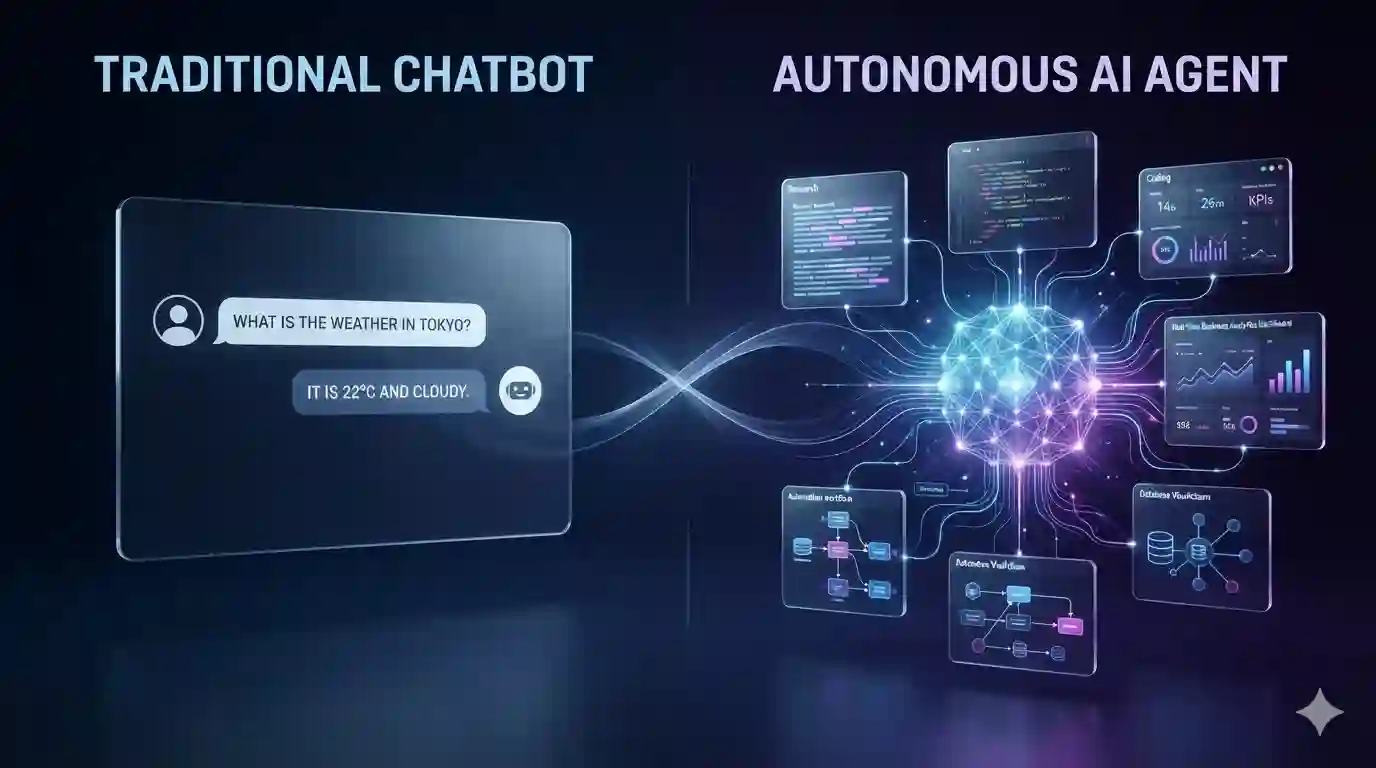
The difference becomes easier to understand when you compare the two approaches.
| Feature | Traditional Chatbot | AI Agent |
|---|---|---|
| Answers questions | Yes | Yes |
| Generates text | Yes | Yes |
| Plans multiple steps | Limited | Stronger |
| Uses external tools | Sometimes | Often |
| Performs actions | Limited | Designed for it |
| Works autonomously | Limited | More autonomous |
| Handles long workflows | Limited | Designed for longer tasks |
| Human supervision | Usually | Still important |
| Goal-oriented execution | Limited | Core capability |
A chatbot primarily responds.
An AI agent is designed to work toward a goal.
That distinction is becoming increasingly important.
Why AI Agents Are Exploding in 2026
Several developments are pushing AI agents forward.
1. Better AI reasoning
Modern AI systems are becoming better at breaking complex problems into smaller steps.
Instead of immediately generating an answer, an agent can potentially:
Understand → Plan → Execute → Check → Adjust
This makes AI much more useful for complicated workflows.
2. Better tool integration
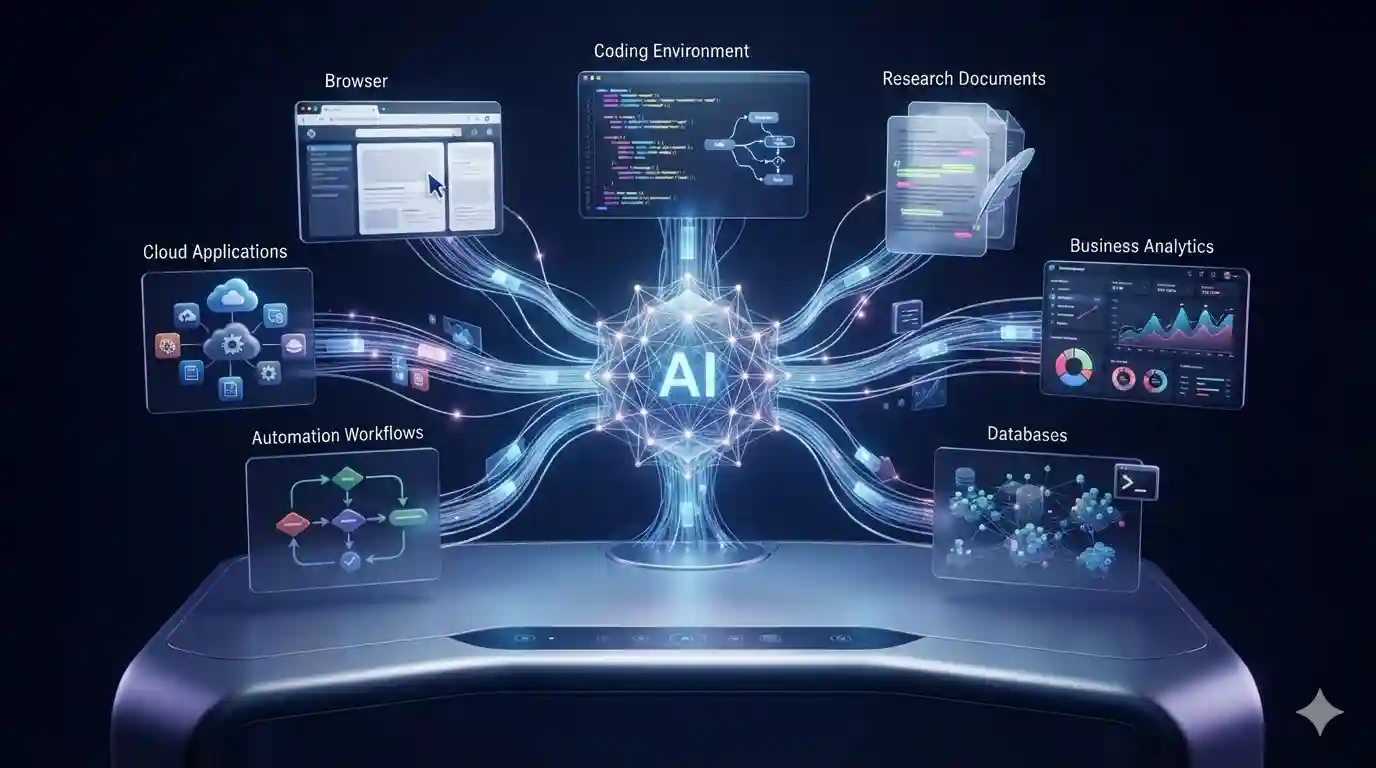
AI agents become more useful when they can interact with external tools.
These can include:
- Web browsers
- Databases
- APIs
- Code repositories
- Business software
- Spreadsheets
- Email systems
- Cloud services
- Internal company systems
The AI model provides the reasoning, while tools allow the agent to actually do things.
3. Coding agents are becoming mainstream

Software development is one of the clearest examples.
OpenAI’s Codex has evolved toward agentic software development, with agents able to work on features, refactoring, migrations and other engineering tasks. OpenAI says Codex is also designed for multi-agent workflows and background tasks.
This represents a major shift from:
“Write this function.”
toward:
“Build this feature and test it.”
That is a much larger task.
AI Agents for Software Development
Coding may be one of the first areas where AI agents have a significant impact.
A coding agent can potentially help with:
- Creating features
- Fixing bugs
- Refactoring code
- Writing tests
- Reviewing pull requests
- Updating dependencies
- Investigating errors
- Documentation
- Code migrations
OpenAI says more than 5 million people were using Codex each week by June 2026, with usage expanding beyond traditional software development into research, analysis and automation.
At the same time, research into agentic coding shows why human oversight remains important. A recent study of more than one million reviewed pull requests found that AI-agent involvement can improve review efficiency in some adoption patterns, but those efficiency gains did not automatically translate into better review quality.
The lesson is simple:
AI agents can accelerate software development, but faster does not automatically mean better.
AI Agents for Business
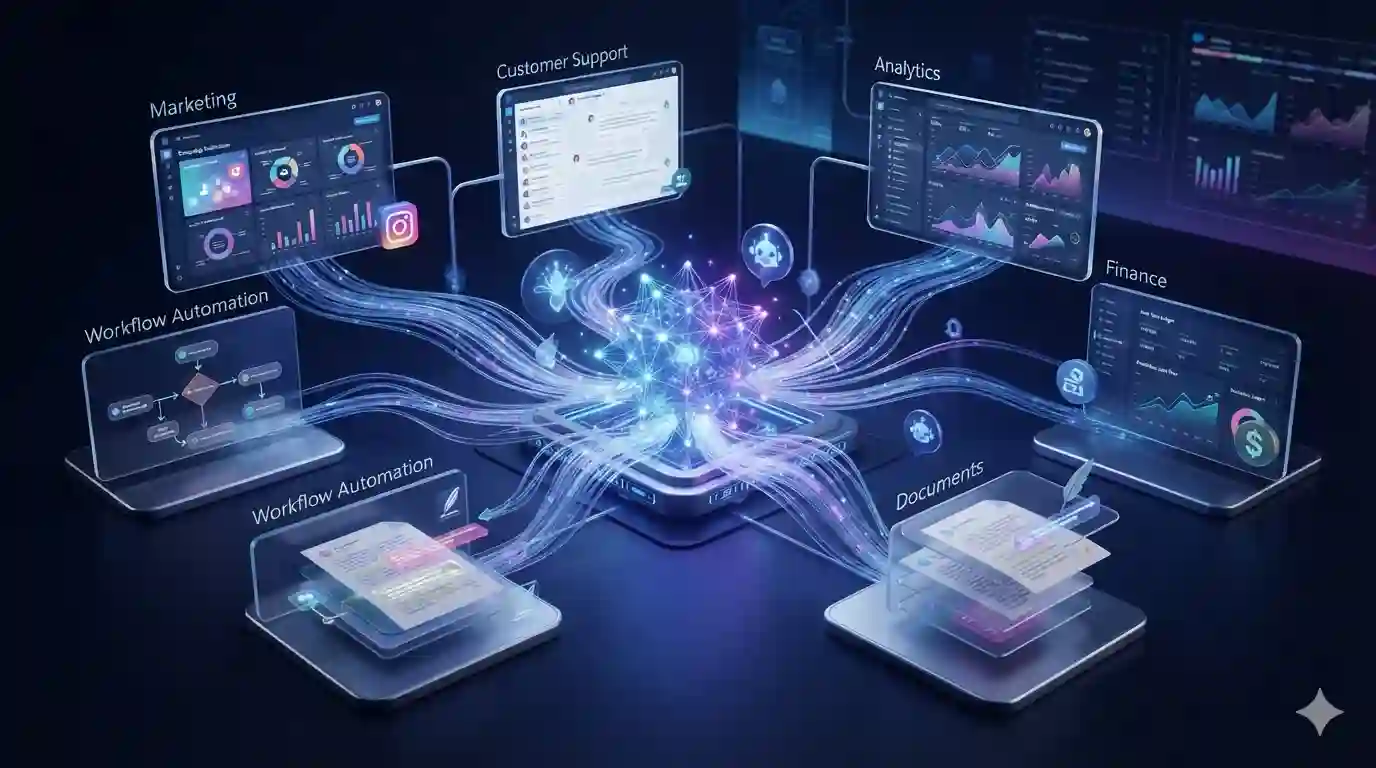
Businesses are another major area of opportunity.
Imagine an AI agent receiving this instruction:
“Analyze our customer feedback from the last month.”
Instead of simply summarizing a document, an agent could potentially:
- Collect the relevant data
- Categorize complaints
- Identify recurring issues
- Analyze trends
- Create a report
- Recommend actions
More advanced systems could connect directly to business software.
This creates the possibility of AI becoming part of everyday business operations rather than remaining a separate chatbot window.
AI Agents for Research
Research is another natural use case.
A research agent can potentially break a large assignment into smaller tasks.
For example:
Goal: Research the AI industry.
The agent could:
- Search multiple sources
- Collect relevant information
- Compare findings
- Identify trends
- Organize sources
- Create a report
This can save significant time.
However, researchers should still verify important information because AI systems can misunderstand sources, make incorrect assumptions or produce inaccurate conclusions.
AI Agents for Marketing
Marketing teams can use agents for many repetitive tasks.
Potential applications include:
Content research
Agents can collect information about topics and competitors.
Content creation
Agents can help draft:
- Blog posts
- Social media posts
- Emails
- Ad copy
- Product descriptions
SEO
Agents can assist with:
- Keyword research
- Content outlines
- Internal-link suggestions
- Competitor analysis
- Content updates
Reporting
Agents can analyze campaign data and prepare summaries.
The biggest opportunity isn’t necessarily replacing marketers.
It is allowing marketers to spend less time on repetitive tasks and more time on strategy and creative decisions.
AI Agents for Personal Productivity
AI agents could also change how individuals manage their daily work.
Imagine telling an AI:
“Prepare my weekly work summary.”
AI agents could also change how individuals manage their daily work. For more useful AI solutions for productivity, research and automation, explore our guide to 25 Best AI Tools to Try in 2026.
A connected agent could potentially gather information from:
- Documents
- Tasks
- Calendar
- Notes
and organize it into a report.
Other possibilities include:
- Meeting preparation
- Research
- Scheduling
- Document organization
- Travel planning
- Personal reminders
- Data analysis
The more tools an AI can safely access, the more useful these workflows can become.
AI Agents and Automation
Traditional automation usually follows predefined rules.
For example:
If X happens → do Y.
AI agents introduce a more flexible approach.
Instead of defining every possible step, you can give the system a goal and allow it to determine some of the steps required to accomplish it.
This is particularly useful when the workflow isn’t perfectly predictable.
However, that flexibility also introduces risk.
An automation following fixed rules is relatively predictable.
An AI agent making decisions dynamically is less predictable.
That’s why agentic systems need appropriate permissions, monitoring and safeguards.
OpenAI has highlighted this issue in its own deployment of coding agents, emphasizing controls around what agents can access, when human approval is required and how actions can be audited.
AI Agents Are Becoming More Multimodal
AI agents aren’t limited to text.
Modern AI systems can increasingly work with:
- Text
- Images
- Audio
- Video
- Documents
- Code
- Structured data
Google’s Gemini 3.5, for example, is explicitly positioned around complex agentic workflows and multimodal capabilities.
This could eventually allow an agent to understand a video, analyze a document, inspect an image and then take an action based on all of that information.
That is much closer to how humans interact with the digital world.
AI Agents and the Future of Work
One of the biggest questions surrounding AI agents is their effect on jobs.
The most likely near-term impact isn’t simply:
AI replaces everyone.
Instead, many jobs may gradually change as AI takes over specific tasks.
For example:
Software developer
Instead of manually writing every line of code, developers may increasingly supervise AI coding agents.
Marketing manager
Instead of manually preparing every report, marketers may ask agents to gather and analyze campaign data.
Researcher
Instead of manually searching hundreds of pages, researchers may delegate parts of the research process to AI.
Business analyst
Instead of manually processing repetitive reports, analysts may use agents for initial analysis.
This could shift the value of human workers toward:
- Strategy
- Judgment
- Creativity
- Communication
- Leadership
- Verification
- Decision-making
The result may be less about AI versus humans and more about humans working with AI systems.
The Rise of Multi-Agent Systems
Another important development is the emergence of multi-agent workflows.
Instead of one AI agent performing everything, multiple specialized agents can potentially collaborate.
For example:
Research Agent
↓
Collects information
Analysis Agent
↓
Analyzes the information
Writing Agent
↓
Creates the report
Review Agent
↓
Checks the result
Human
↓
Provides final approval
This approach could make complex AI workflows more scalable.
OpenAI’s Codex development is one example of the broader move toward multi-agent workflows, while Google is also developing agent-first platforms and experiences.
What Are the Biggest Problems With AI Agents?
AI agents are powerful, but they aren’t magic.
There are several important challenges.
Reliability
An agent can make a wrong decision and continue executing from that mistake.
Security
Giving an AI access to email, files, databases or business systems introduces security risks.
Privacy
Agents may process sensitive information.
Organizations need clear rules about what data AI systems can access.
Cost
Complex agentic workflows may require multiple model calls and external tools.
Hallucinations
AI systems can still generate incorrect information.
Lack of accountability
If an AI agent makes a mistake, organizations need to know:
Who is responsible?
These issues are why governance and human oversight will remain important.
Are AI Agents Safe?
AI agents can be made safer, but safety depends heavily on how they are designed and deployed.
Organizations should consider:
- Permission controls
- Human approval
- Audit logs
- Data isolation
- Monitoring
- Rate limits
- Tool restrictions
- Security testing
- Clear escalation procedures
An agent shouldn’t automatically receive unrestricted access to critical systems simply because it is capable of interacting with them.
The right approach is generally:
Give agents enough access to accomplish their job — but no more than necessary.
The Future of AI Agents
The biggest change may be the gradual transition from:
AI as a tool
to:
AI as a worker inside a workflow.
Instead of opening an AI chatbot whenever you need help, you may increasingly have AI systems operating in the background.
They could:
- Monitor systems
- Research topics
- Write reports
- Review code
- Analyze data
- Handle repetitive tasks
- Prepare documents
- Coordinate workflows
Google’s current Gemini direction illustrates this transition, with the company describing a move toward more agentic experiences and proactive assistance.
OpenAI is pursuing a similar direction with Codex and other agentic systems.
Should You Start Using AI Agents in 2026?
For many people, yes — but start small.
Don’t immediately give an AI agent access to your entire business.
Instead, identify one repetitive workflow.
For example:
Research competitor websites every Monday.
or:
Summarize our weekly customer feedback.
or:
Review new GitHub issues and categorize them.
Then measure:
- Time saved
- Accuracy
- Cost
- Errors
- Human effort required
If the workflow works reliably, expand it.
This approach is much safer than trying to automate everything at once.
AI Agents vs AI Assistants: What’s the Difference?
An AI assistant generally waits for you to ask for something.
ChatGPT remains one of the most widely used AI assistants, offering capabilities for writing, research, coding, analysis and everyday productivity. If you want a deeper look at its features, strengths and limitations, check out our ChatGPT Review 2026 before deciding how it fits into your AI workflow.
An AI agent is designed to take more initiative toward completing a goal.
Think of it this way:
AI Assistant
“Tell me what you want me to do.”
AI Agent
“Give me the goal and I’ll work through the steps.”
The boundary isn’t always perfectly defined, and companies use the terminology differently.
But the overall industry direction is clear:
More AI systems are moving from generating answers toward taking actions.
10 Examples of AI Agent Use Cases
Here are some of the most promising applications:
- Software development
- Customer support
- Market research
- SEO analysis
- Data analysis
- Business reporting
- Marketing automation
- Cybersecurity monitoring
- Document processing
- Personal productivity
As models become more capable and integrations improve, these applications could expand significantly.
Final Verdict
AI agents may become one of the most important AI developments of 2026.
The technology represents a major change in how we interact with artificial intelligence.
Instead of simply asking:
“What do you know?”
we increasingly ask:
“What can you do?”
That distinction matters.
Chatbots made AI accessible to billions of people.
The AI landscape is becoming increasingly competitive, with platforms such as ChatGPT and Gemini expanding beyond traditional chatbot capabilities into more advanced AI and agentic workflows. If you’re comparing the two leading AI platforms, our detailed ChatGPT vs Gemini 2026 comparison examines their features, capabilities, strengths and differences.
AI agents could make AI operational — allowing intelligent systems to participate directly in software development, research, business operations, productivity and automation.
But the most successful organizations won’t simply give AI unlimited control.
They’ll build systems where:
AI handles execution.
Humans provide judgment.
Technology provides the tools.
Governance provides the boundaries.
That’s likely to be the real future of AI agents.
Frequently Asked Questions
What are AI agents?
AI agents are AI-powered systems designed to pursue goals through multiple steps, often using tools, external data and software systems to complete tasks.
What is the difference between AI agents and chatbots?
Chatbots primarily respond to user prompts. AI agents are designed to plan and execute multi-step tasks toward a defined objective.
Are AI agents available in 2026?
Yes. AI agents are already being deployed in areas such as software development, research, productivity and business automation. OpenAI and Google are both actively developing agentic systems.
Can AI agents replace workers?
AI agents can automate individual tasks and workflows, but whether they replace entire jobs depends on the occupation, organization and technology. In many cases, AI is more likely to change how people perform their work.
Are AI agents safe?
AI agents can be deployed safely with appropriate permissions, monitoring, security controls and human oversight. However, autonomous access to important systems introduces additional risks.
What are AI agents used for?
Common applications include coding, research, customer support, data analysis, marketing, business automation and productivity.
Are AI agents better than ChatGPT?
AI agents and ChatGPT aren’t necessarily direct alternatives. ChatGPT can serve as an AI assistant, while agentic capabilities can allow AI systems to perform more complex workflows.
What is agentic AI?
Agentic AI refers broadly to AI systems designed to plan, make decisions and take actions toward goals rather than simply generating a response to a single prompt.