
Quick Take
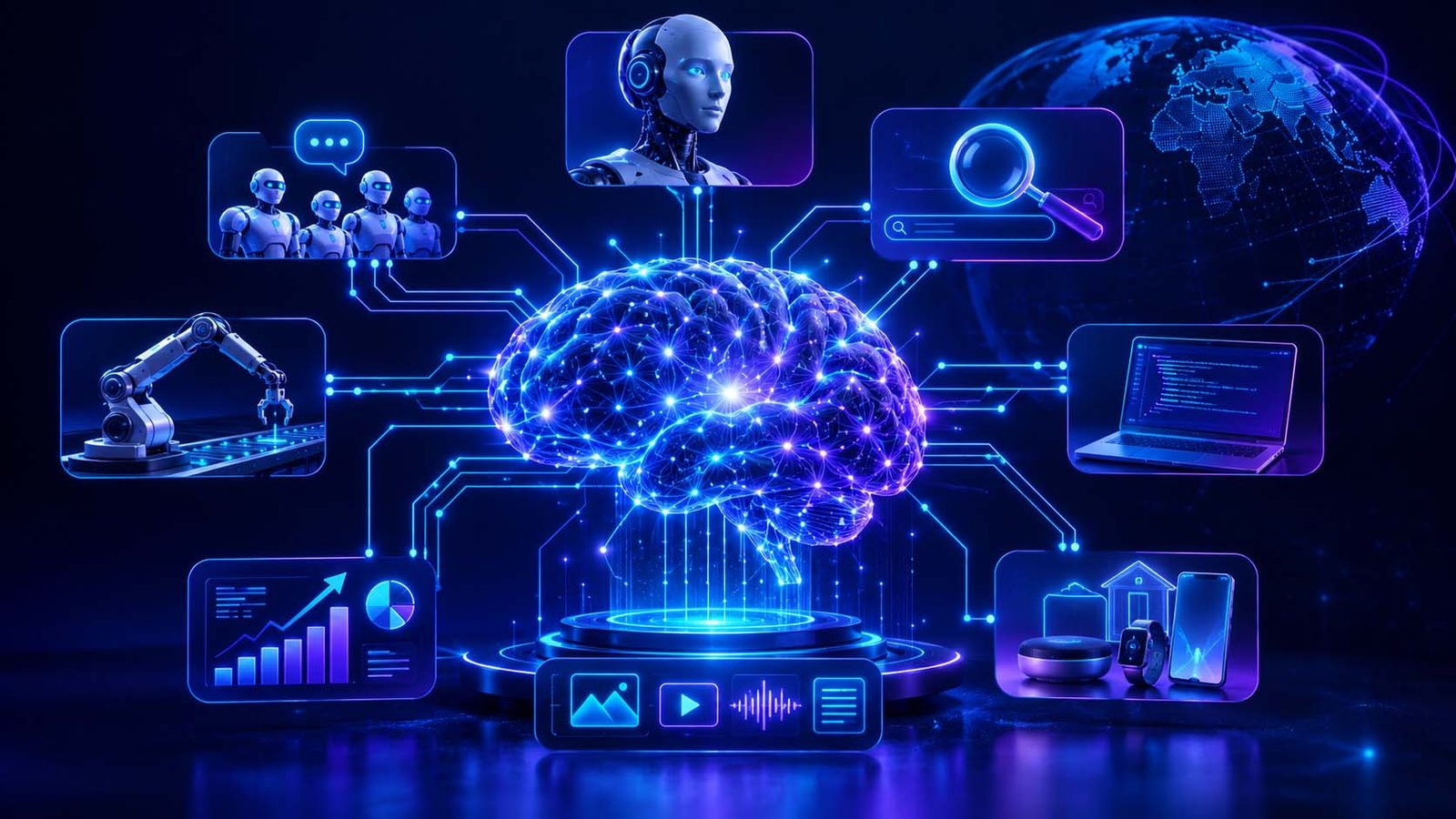
Artificial intelligence is entering a new phase in 2026. The biggest change is not simply that AI models are becoming more capable. AI is increasingly moving from systems that answer questions to systems that can reason, use tools, interact with software and complete multi-step tasks.
At the same time, AI is becoming more deeply integrated into search, business software, coding tools, smartphones and other devices.
The 2026 AI Index from Stanford HAI highlights just how quickly the technology is spreading: organizational AI adoption reached 88% in its latest survey data, while generative AI reached 53% population adoption within three years.
Here are the 10 biggest AI trends shaping 2026.
1. AI Agents Are Moving from Experiments to Real Work

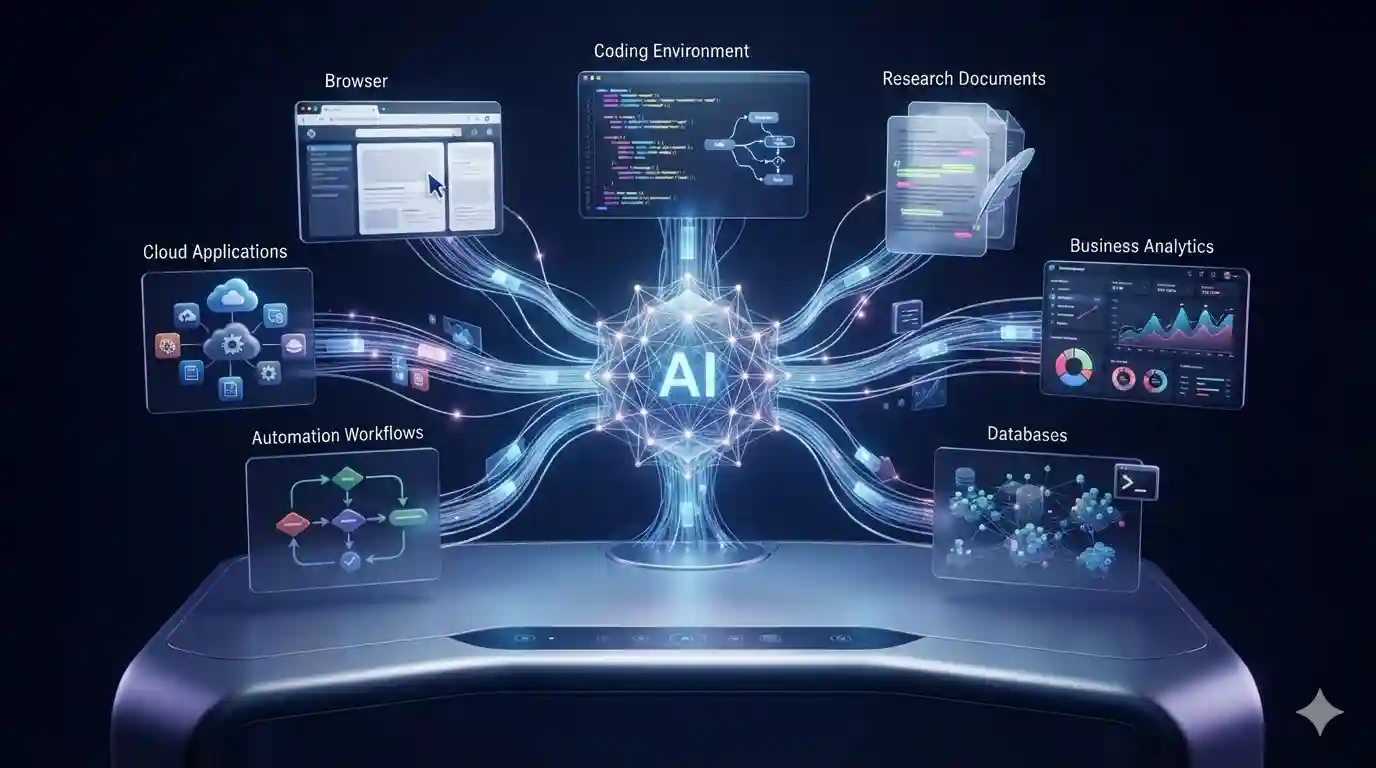
One of the most important AI trends of 2026 is the rise of AI agents.
Traditional chatbots generally work through a simple interaction:
User asks → AI answers.
AI agents are designed to handle something more complicated:
User gives a goal → AI plans → uses tools → performs actions → checks results → continues until the task is complete.
That difference could have a major impact on how people use AI.
OpenAI describes agentic AI as a shift from short interactions toward delegated, longer-horizon tasks. Its June 2026 research on Codex found that users were increasingly asking the system to handle work that could take a person more than an hour, with some tasks extending much longer.
Google is also pushing AI toward computer interaction. Its Gemini 3.5 Flash includes computer-use capabilities designed to allow agents to see, reason and take actions across browser, mobile and desktop environments.
What can AI agents do?
Depending on the system, agents can potentially:
- Research information
- Browse websites
- Analyze documents
- Write and test code
- Manage workflows
- Prepare reports
- Interact with business software
- Process data
- Automate repetitive tasks
- Coordinate multiple tools
This doesn’t mean every AI agent can autonomously complete every task reliably.
That distinction is important.
The technology is moving quickly, but reliability, permissions, security and human oversight remain critical.
Why AI agents matter in 2026
The biggest change may be the transition from:
“Help me do this.”
to:
“Take care of this task and show me the result.”
For businesses, that could eventually change how work is organized.
Instead of employees manually moving information between multiple applications, an agent could potentially coordinate parts of that workflow.
The result is likely to be less about completely replacing people and more about changing what people spend their time doing.
2. Multimodal AI Is Becoming the Default
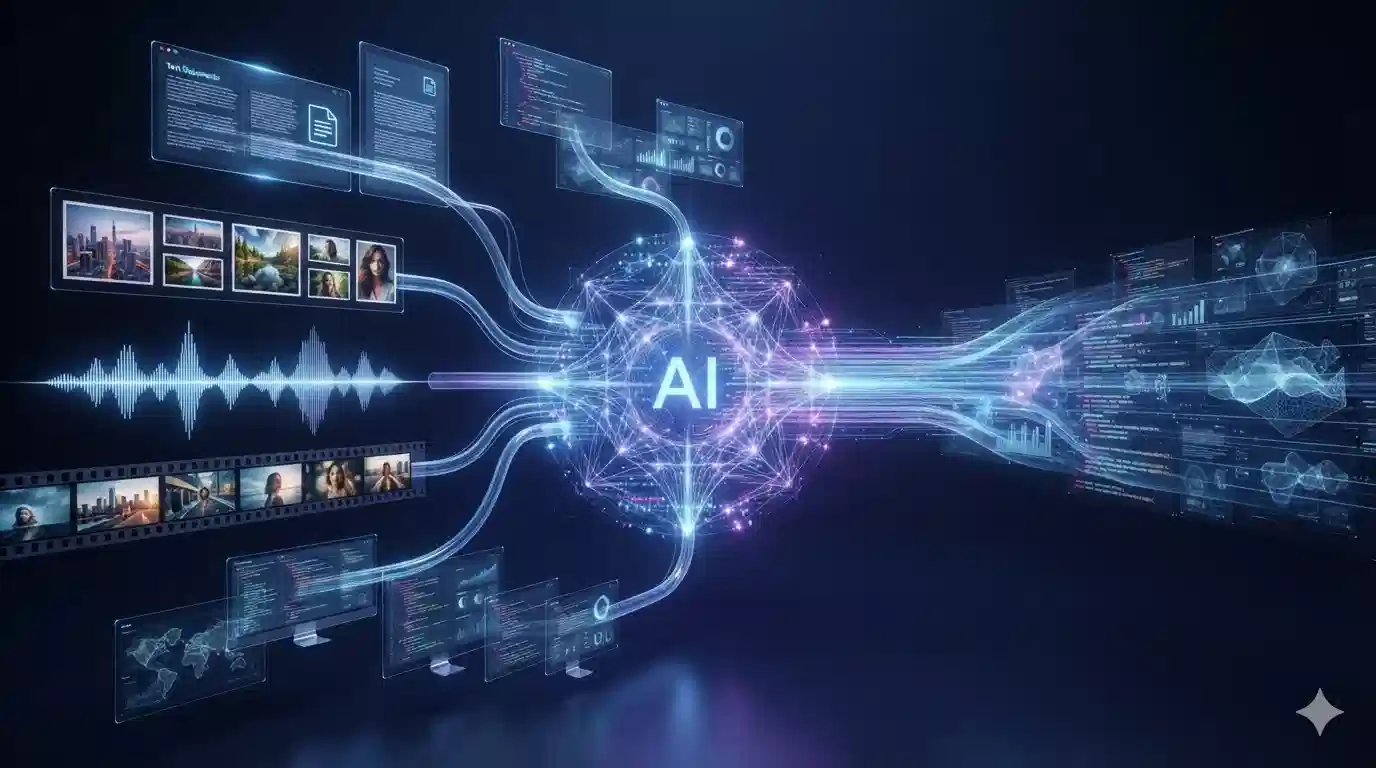
Another major trend is the rapid development of multimodal AI.
Early generative AI products were largely text-based. Users typed prompts and received text responses.
Modern AI systems increasingly work across multiple forms of information:
- Text
- Images
- Audio
- Video
- Documents
- Screens
- Voice
- Structured data
This matters because the real world isn’t text-only.
A person might want an AI system to look at a spreadsheet, listen to a meeting, understand a product image and then produce a report.
That’s a fundamentally different experience from a traditional chatbot.
Google’s 2026 announcements around Gemini Omni emphasize multimodality and the ability to create and work from different types of input.
Multimodal AI applications
We are likely to see more AI systems that can:
See:
Understand images, documents, screenshots and visual environments.
Hear:
Process conversations, meetings and voice instructions.
Watch:
Analyze video and visual sequences.
Speak:
Respond naturally through voice.
Act:
Use tools and software to accomplish tasks.
This convergence could make AI interfaces feel less like software applications and more like general-purpose digital assistants.
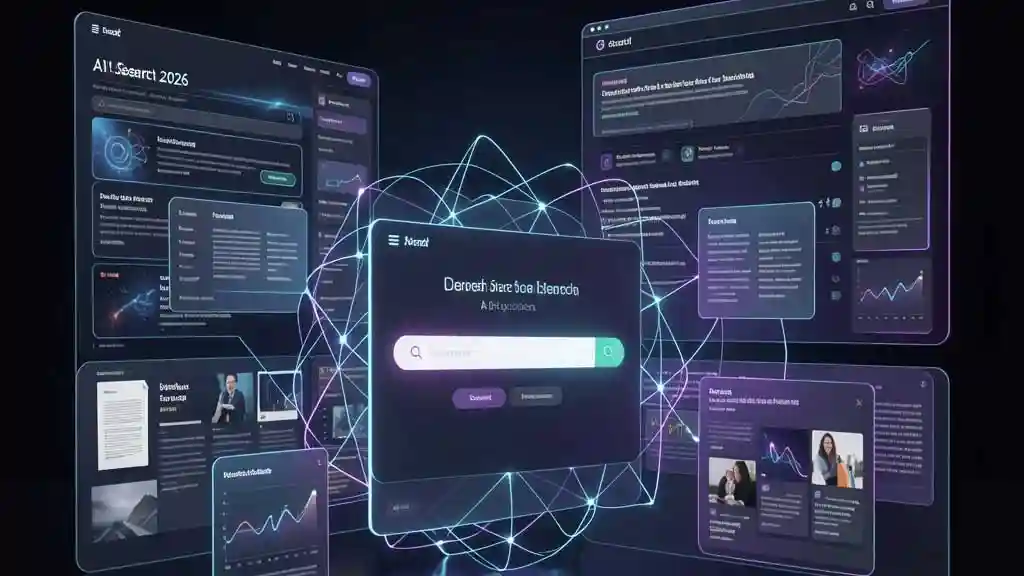
3. AI Search Is Changing How People Find Information

Search is undergoing one of the biggest transformations since the beginning of the web.
Traditional search generally works like this:
Query → search results → websites → user reads information.
AI-powered search increasingly looks more like:
Question → AI interprets intent → searches multiple sources → synthesizes information → provides an answer → links to supporting sources.
Google has been rapidly expanding this direction.
At Google I/O 2026, the company announced new AI capabilities for Search and said its AI Mode had surpassed one billion monthly users. Google also introduced more agentic capabilities and a redesigned AI-powered search experience.
Google has also emphasized showing users original content and relevant website links within AI-powered search experiences.
What does this mean for websites?
This is particularly important for publishers like Future AI Insider.
The future of search isn’t simply about ranking for one keyword.
Websites need to provide information that is:
- Original
- Accurate
- Well researched
- Clearly structured
- Useful
- Trustworthy
- Supported by evidence
- Written by identifiable authors
This creates both a challenge and an opportunity for publishers.
Generic articles that simply repeat information already available across hundreds of websites will become increasingly difficult to differentiate.
Original reporting, expert analysis, first-hand experience and genuinely useful explanations become more valuable.
4. AI Reasoning Is Becoming More Important
AI development is increasingly focused not just on generating fluent text, but on solving harder problems.
This includes:
- Mathematics
- Coding
- Scientific reasoning
- Research
- Planning
- Multi-step problem solving
- Complex decision support
Stanford’s 2026 AI Index reports that frontier model performance continues to improve rapidly, with several models reaching or exceeding human baselines on challenging scientific and reasoning evaluations.
However, benchmark performance needs context.
A model can perform extremely well on a particular evaluation and still make mistakes in real-world situations.
That means the next phase of AI development isn’t simply:
Can the model solve the problem?
It is also:
Can the model solve the problem reliably, consistently and safely?
That distinction will become increasingly important as AI moves into high-stakes environments.
5. AI Coding Is Transforming Software Development

Software development is one of the areas where AI capabilities are advancing particularly quickly.
AI coding tools can already help developers with:
- Code generation
- Debugging
- Refactoring
- Documentation
- Testing
- Code review
- Data transformation
- Application development
The next step is agentic software development.
Instead of asking AI:
“Write this function.”
developers can increasingly ask:
“Build this feature, run the tests, identify the errors and fix them.”
OpenAI’s 2026 research describes Codex users increasingly relying on longer-horizon agentic tasks, including among non-developers.
Stanford’s AI Index also reports a dramatic improvement in performance on SWE-bench Verified, a benchmark designed around real-world software engineering tasks.
What changes for developers?
AI is unlikely to make software engineering disappear overnight.
Instead, the skill profile is changing.
Developers increasingly need to understand:
- System architecture
- Requirements
- Security
- Testing
- Code quality
- AI-assisted development
- Reviewing machine-generated code
The developer may increasingly become the person who directs and validates AI-generated software, rather than manually writing every line.
6. Enterprise AI Adoption Is Moving Beyond Experiments
AI has moved well beyond the early stage of being a technology that only a few companies experiment with.
Stanford’s 2026 AI Index reports that 88% of surveyed organizations used AI in at least one business function, up from 78% in 2024. It also reports that generative AI was used in at least one business function by 79% of respondents.
That doesn’t mean every company has transformed its entire business around AI.
In fact, AI agent deployment remains relatively early across most business functions.
The more realistic picture is:
AI experimentation → AI adoption → workflow integration → agentic automation
Businesses are increasingly looking beyond flashy demonstrations and asking practical questions:
- Does AI save time?
- Does it reduce costs?
- Does it improve customer service?
- Can employees use it safely?
- Can results be measured?
- Can the company integrate it into existing systems?
AI in business
Potential applications include:
Marketing:
Content research, campaign analysis and personalization.
Customer service:
Support automation and knowledge retrieval.
Finance:
Data analysis and reporting.
Human resources:
Recruitment support and employee information systems.
Operations:
Workflow automation and process optimization.
Software:
Coding, testing and documentation.
The winners may not necessarily be companies using the most AI.
They may be companies that use AI most effectively.
7. Smaller and More Efficient AI Models Matter More
For years, AI competition was heavily focused on building increasingly large and capable models.
In 2026, another competition is becoming equally important:
How efficiently can AI intelligence be delivered?
Businesses care about:
- Speed
- Cost
- Latency
- Reliability
- Scalability
- Energy consumption
A model that is slightly less capable but dramatically faster and cheaper can be extremely valuable for a business operating millions of AI interactions.
This is particularly important for AI agents because agents may perform many model calls during a single workflow.
Why efficiency matters
Imagine an AI agent completing a complex task.
It might need to:
- Understand the request.
- Search for information.
- Analyze the results.
- Use another tool.
- Generate an output.
- Check the result.
- Correct an error.
If every step is expensive or slow, the entire workflow becomes less practical.
Therefore, AI’s next competitive advantage isn’t only intelligence.
It is increasingly:
Intelligence + speed + cost + reliability.
Stanford’s 2026 technical analysis notes that competition among leading models is increasingly shifting toward factors such as cost, reliability and domain-specific performance as top systems cluster closely on some measures.
8. AI Is Moving Into Devices and the Physical World

AI is also moving beyond websites and chat applications.
Increasingly, AI is being integrated into:
- Smartphones
- Computers
- Wearables
- Smart glasses
- Vehicles
- Robots
- Industrial equipment
- Cameras
- Household devices
Google’s 2026 announcements illustrate this broader direction, with AI experiences expanding across products and new form factors, including intelligent eyewear.
The combination of AI perception, reasoning and physical systems is especially significant for robotics.
A robot that can simply repeat a programmed sequence is very different from a robot that can:
- Understand its environment
- Interpret spoken instructions
- Recognize objects
- Plan actions
- Adapt to changes
That’s where AI and robotics begin to converge.
The physical AI opportunity
The next generation of AI may therefore not exist only inside a browser.
It may increasingly exist around us.
9. AI Infrastructure, Chips and Energy Are Becoming Strategic Issues

The AI revolution requires enormous infrastructure.
Behind every AI application are:
- Data centers
- GPUs and AI accelerators
- Networking infrastructure
- Storage
- Cooling systems
- Electricity
- Cloud platforms
- Semiconductor supply chains
As AI usage grows, these infrastructure requirements become increasingly important.
Stanford’s 2026 AI Index reports that the United States hosts 5,427 data centers, while AI data-center power capacity has grown substantially. The report also highlights the environmental footprint associated with AI infrastructure.
This creates an important question:
How do we scale AI without allowing infrastructure costs and environmental impacts to grow uncontrollably?
Efficiency becomes critical
Better algorithms and smaller models can reduce the computational resources needed for certain tasks.
That’s one reason model efficiency, specialized hardware and infrastructure optimization are likely to remain major AI trends throughout 2026 and beyond.
The AI race isn’t simply about who builds the smartest model.
It is also about who can run powerful AI at scale.
10. AI Safety, Governance and Transparency Are Becoming More Important
The final trend may be less exciting than AI agents or robotics, but it could be one of the most important.
AI capabilities are advancing quickly.
Governance is trying to keep up.
Stanford’s 2026 AI Index describes a widening gap between AI capabilities and the frameworks available to measure and manage them. It also reports that documented AI incidents increased to 362 in 2025, up from 233 in 2024.
AI systems can create problems involving:
- Hallucinations
- Privacy
- Security
- Bias
- Deepfakes
- Copyright
- Fraud
- Misinformation
- Autonomous actions
Transparency is another growing concern.
Stanford reports that some of the most capable frontier models are also among the least transparent regarding details such as training data, parameters and training processes.
The next AI race isn’t only about capability
Companies and governments will increasingly need to answer:
Can we trust the system?
Can we evaluate it?
Can we understand its limitations?
Can we control what it is allowed to do?
Who is responsible when it makes a mistake?
These questions will become especially important as AI agents gain the ability to take actions rather than simply provide information.
What These AI Trends Mean for Businesses
For businesses, 2026 is becoming a year of moving from AI experimentation toward AI integration.
The most useful approach isn’t necessarily to deploy an AI agent everywhere.
Instead, businesses should identify repetitive or information-heavy processes where AI can produce measurable improvements.
Examples include:
- Customer support
- Data analysis
- Research
- Marketing
- Software development
- Internal knowledge management
- Document processing
- Reporting
- Workflow automation
The best starting point is usually a specific problem rather than a generic goal of “using AI.”
For example:
“Reduce the time required to prepare weekly sales reports.”
is a much better AI project than:
“We need to implement AI.”
What These Trends Mean for Consumers
Consumers are likely to experience AI increasingly as a feature inside products, rather than as a separate AI website.
Instead of opening an AI application every time they need help, people may increasingly encounter AI through:
- Search
- Smartphones
- Browsers
- Office applications
- Shopping
- Cameras
- Vehicles
- Wearables
The interface may become less important.
The user may simply tell a system what they want and let AI determine which tools are needed.
That is one of the biggest shifts happening in AI.
What Could Define the Next Stage of AI?
Looking beyond the current developments, several trends could become particularly important.
1. AI agents become everyday productivity tools
Instead of using AI only for individual questions, people will increasingly delegate complete workflows.
2. AI search becomes more action-oriented
Search may increasingly help users complete tasks rather than simply find information.
3. Multimodal interaction becomes normal
Text, voice, images and video will increasingly become interchangeable ways of interacting with AI.
4. AI moves deeper into operating systems
AI assistants could become a core layer connecting applications, files and services.
5. AI-generated software becomes easier to create
People without traditional programming backgrounds will increasingly be able to build useful applications through natural-language instructions.
6. Business AI becomes more focused on measurable ROI
Companies will increasingly ask whether AI actually improves productivity, revenue or customer experience.
7. Reliability becomes a competitive advantage
As AI becomes more capable, simply producing impressive outputs won’t be enough.
Businesses will want systems that are predictable, secure and controllable.
The Future of AI Is Becoming More Agentic, Multimodal and Embedded
The biggest AI trend of 2026 may not be one particular model launch.
It is the broader transition taking place across the industry.
AI is moving from a technology people primarily chat with toward a technology that can increasingly reason, interact with software, search for information, create content, write code and take actions.
At the same time, AI is becoming embedded into the products and services people already use.
The numbers show how quickly adoption is happening. Stanford’s 2026 AI Index reports 88% organizational AI adoption and 53% population adoption of generative AI within three years.
But the next phase will not be defined only by capability.
Cost, reliability, safety, transparency, infrastructure and governance will matter just as much.
For businesses, the opportunity is to identify where AI can create measurable value.
For consumers, the opportunity is to learn how to work effectively with increasingly capable AI systems.
And for the technology industry, 2026 may prove to be an important transition point between AI as a tool and AI as an active digital collaborator.
Follow Future AI Insider for the latest AI news, tools, reviews, tutorials and emerging technology trends.
Frequently Asked Questions
What is the biggest AI trend in 2026?
One of the biggest AI trends in 2026 is the shift toward agentic AI. AI systems are increasingly designed to handle multi-step tasks, use tools and interact with software rather than simply answer individual questions. OpenAI and Google are both developing systems that emphasize longer-horizon and computer-interaction capabilities.
Are AI agents becoming mainstream?
AI agent adoption is growing, but enterprise deployment remains relatively early. Stanford’s 2026 AI Index reports that organizational AI adoption reached 88%, while agent deployment was still in the single digits across nearly all business functions measured.
How is AI changing search in 2026?
AI is making search more conversational, multimodal and task-oriented. Google has expanded AI Mode and introduced more agentic capabilities into Search, allowing users to ask more complex questions and interact with AI-powered search experiences.
Will AI replace jobs in 2026?
AI is more likely to change many tasks within jobs than to eliminate every occupation outright. The effects are uneven across industries and workers, and the long-term labor-market impact remains uncertain. Stanford’s 2026 AI Index reports measurable effects in some labor-market segments while emphasizing the complexity of the transition.
What AI skills will be important in 2026?
Important skills include AI literacy, prompt and workflow design, data analysis, critical evaluation of AI outputs, automation, cybersecurity and the ability to integrate AI into existing workflows. Technical professionals will also benefit from understanding AI-assisted software development and agentic systems.