

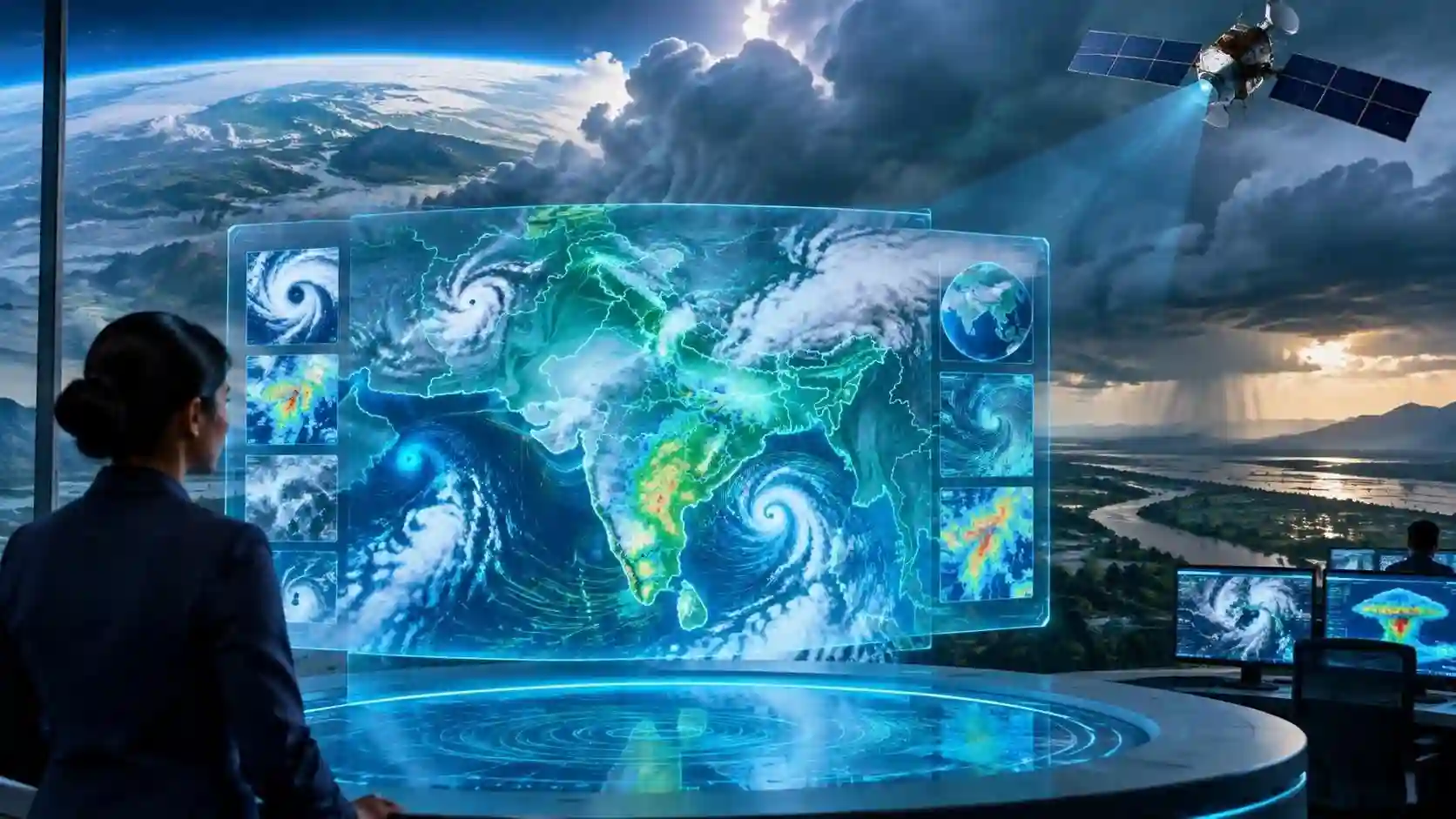
AI weather forecasting is changing how meteorologists analyse the atmosphere, estimate rainfall and prepare for high-impact events. Machine-learning systems can learn patterns from decades of weather data and generate forecasts quickly, while newer hybrid approaches combine AI with established physics-based models. In 2026, these methods are moving beyond research demonstrations and becoming part of a wider forecasting ecosystem.
The opportunity is especially important across South Asia. The summer monsoon affects agriculture, water supplies, transport, energy demand and public safety. Better predictions of heavy rainfall, dry spells and cyclone movement could help communities prepare earlier. But AI forecasts are not automatically accurate at every location or for every extreme event. They must be tested against real observations and interpreted by meteorological experts.
What is AI weather forecasting?
AI weather forecasting uses machine learning to estimate future atmospheric conditions from historical weather observations, satellite measurements, radar, ocean data and previous forecast records. Instead of solving every atmospheric equation in the same way as a traditional numerical weather prediction system, a trained model learns statistical and physical patterns in large datasets and uses them to predict future states.
Some systems produce forecasts for temperature, pressure, wind and precipitation. Others generate ensembles: multiple plausible forecasts that communicate uncertainty rather than presenting one outcome as certain. AI is also used after a forecast is generated, for example to correct systematic biases, downscale information to a local area or translate technical output into decision support.
How machine learning models predict the weather
1. Learning from historical weather data
Training datasets can include atmospheric reanalysis, weather-station readings, satellite observations, radar estimates and records from numerical forecast systems. The model learns relationships between the current atmospheric state and what happened next in comparable situations. Data quality, geographic coverage and the way observations are represented all influence the result.
2. Predicting atmospheric changes
Once trained, a model receives a representation of current weather conditions and predicts a later atmospheric state. Forecasting systems may make repeated predictions to extend the forecast horizon. Small errors can accumulate over successive steps, which is one reason long-range weather prediction remains difficult even with powerful models.
3. Producing ensembles and probabilities
The atmosphere is chaotic: small differences in initial conditions can lead to substantially different outcomes. Ensemble forecasting addresses this by generating multiple plausible scenarios. A useful forecast might communicate a probability of heavy rainfall over a region rather than claiming that a precise amount will fall at one exact point. Probabilities help planners compare risk, but they must be calibrated and explained clearly.
4. Combining AI with physics-based models
Traditional numerical weather prediction (NWP) models simulate atmospheric processes using physical equations and observations. AI models learn patterns from data and can be faster to run for some forecasting tasks. Hybrid systems combine these strengths: machine learning may improve a physical model’s output, correct known biases, or help create more useful probability estimates. In practice, meteorological agencies can compare several systems rather than relying on one model.
Important AI weather models and approaches in 2026
The research landscape includes systems such as GraphCast, Pangu-Weather, FourCastNet, Aurora, GenCast and the European Centre for Medium-Range Weather Forecasts’ AI Forecasting System (AIFS). They differ in architecture, training data, forecast variables, resolution, ensemble design and intended use. Their published results are not directly interchangeable: a model that performs well on global medium-range scores may still struggle with local rainfall extremes or a particular monsoon region.
One important development is machine-learning post-processing. A 2026 Nature study on probabilistic bias correction showed that learning from historical forecast errors can improve subseasonal forecasts from both AI and dynamical systems. The approach targets predictable biases in forecast distributions rather than attempting to replace the underlying weather model. This is a practical example of AI improving the reliability of an existing forecasting pipeline.
Why South Asian monsoon forecasting is a critical test
The South Asian monsoon is shaped by interactions among land, ocean and atmosphere, including moisture transport, topography, large-scale circulation and local convective storms. Rainfall can vary sharply over short distances. A forecast that captures the broad monsoon pattern may still miss a localized cloudburst, underestimate an extreme downpour or place a cyclone track incorrectly.
A 2026 observation-focused assessment called MAUSAM evaluated several leading AI weather prediction systems during the South Asian monsoon using hundreds of weather stations, rain gauges and satellite imagery. The study found meaningful skill across a range of variables, while also identifying weaknesses in fine-scale features, extreme precipitation and cyclone-track prediction. It reported that errors measured against real observations could be substantially larger than errors measured against reanalysis, highlighting why forecasts must be checked against ground truth.
For Pakistan, India, Bangladesh, Nepal and Sri Lanka, this distinction matters. National and regional forecasting services need models that are evaluated against local station networks, river-basin measurements, radar where available and satellite observations. Local terrain, urban growth and data gaps can affect how well a global model translates into a useful district-level warning.
Where AI weather forecasting can make a difference
1. Heavy rainfall, floods and early warnings
AI can help identify patterns associated with intense rainfall and support rapid analysis of satellite or radar imagery. Short-range nowcasting is particularly relevant for thunderstorms and rapidly developing storms. Forecast information can support emergency teams, drainage operators and local authorities, but a warning system also needs clear thresholds, reliable communications and a plan for action.
2. Agriculture and irrigation planning
Farmers use weather information to plan sowing, irrigation, fertilizer application, spraying and harvest operations. More useful rainfall probabilities and temperature outlooks can help farmers compare options and prepare for heat or dry spells. Forecasts should be delivered in locally understandable formats and combined with crop stage, soil conditions and agricultural advice. See our guide to AI in agriculture in 2026 for more on precision farming and smart irrigation.
3. Cyclone tracking and coastal preparedness
AI-based guidance can provide another perspective on storm development and possible tracks. Coastal authorities can use forecast ensembles to assess a range of scenarios, prepare shelters and coordinate response resources. Because track and intensity errors can have serious consequences, official warnings should continue to rely on expert assessment of multiple models and observations.
4. Heatwaves, energy demand and public health
Temperature forecasts can help utilities anticipate cooling demand and help cities prepare for periods of dangerous heat. Health agencies can use heat-risk outlooks to plan public information, check on vulnerable residents and coordinate cooling facilities. The value depends on forecasts being localized enough to reflect urban heat, humidity and nighttime temperatures.
5. Water management and hydropower
Reservoir operators and water managers need to balance flood risk, irrigation demand, drinking-water supply and power generation. Rainfall and temperature outlooks can inform planning over different time horizons. AI forecasts should be combined with catchment conditions, river observations, reservoir levels and established safety rules; they should not be treated as a substitute for hydrological modelling.
What recent research tells us
| Research or programme | Key finding | Practical significance |
|---|---|---|
| MAUSAM monsoon assessment, July 2026 | Compared seven AI prediction systems with station, rain-gauge and satellite observations during the South Asian monsoon; identified skill as well as errors in extreme rainfall and cyclone tracks. | Regional, observation-based testing is essential before operational use. |
| Nature study on subseasonal forecasting, 2026 | Probabilistic bias correction improved forecast distributions for weeks three and four, addressing predictable systematic errors. | AI can improve forecasts through post-processing, not only by replacing the core model. |
| ECMWF AI Weather Quest, 2026 | Benchmarked machine-learning approaches in an operational-style competition and found that performance varied between data-driven, hybrid, post-processing and dynamical methods. | Independent comparison is more useful than relying on a single headline score. |
| Royal Meteorological Society, October 2026 | Argued that operational acceptance requires more than skill scores: forecasters need diagnostic understanding, confidence and effective communication. | Human expertise and explainability remain central in safety-critical forecasting. |
Benefits and limitations of AI weather prediction
Potential benefits
- Speed: some AI forecasts can be generated with lower computational cost and shorter runtimes than traditional workflows.
- More forecast options: machine learning can support ensembles, post-processing and specialized regional applications.
- Improved use of data: models can learn patterns across large historical datasets and multiple observation sources.
- Decision support: calibrated probabilities can help agriculture, energy, transport and emergency planners assess risk.
- Complementary forecasts: AI output can add another source of guidance alongside physical models and expert analysis.
Important limitations
- Extreme-event errors: rare, high-impact rainfall and storm events may be underpredicted or misplaced.
- Regional bias: global averages can hide weak performance in mountainous, coastal or data-sparse regions.
- Compounding errors: repeated forecast steps can amplify small errors, particularly at longer lead times.
- Data dependence: gaps or biases in observations and training datasets can affect reliability.
- Limited explainability: forecasters may not always be able to diagnose why a model produced a particular output.
- Operational readiness: a strong research benchmark does not automatically mean a system is dependable enough for public warnings.
How meteorological agencies should evaluate AI forecasts
Forecast evaluation should use more than one headline accuracy score. Agencies should compare predictions with independent observations, examine performance by region and season, and test how well systems handle heavy rainfall, heatwaves and cyclone events. They should also measure calibration: when a system predicts a 70% chance of an event across many comparable cases, that event should occur at roughly the stated frequency.
Operational testing should include data outages, model updates, unusual weather regimes and communication workflows. Forecasters need to know when a model is outside its reliable operating range, how to compare conflicting guidance and when to override an automated output. Public warnings should remain clear, consistent and accountable.
What AI weather forecasting means for Pakistan and South Asia
For Pakistan and neighboring countries, the most useful progress may come from combining global AI guidance with stronger local observations. Weather stations, river gauges, weather radar, satellite data and well-maintained historical records help identify regional model errors. Investments in data sharing, technical capacity and warning communication are as important as choosing a new algorithm.
Forecasts also need to reach people in ways they can use. Farmers may need district-level rainfall probabilities and planting guidance; city authorities may need short-lead flood alerts; utilities may need heat and demand outlooks; and disaster agencies may need ensemble scenarios with clear uncertainty. A technically advanced model has limited public value if its output is not translated into timely, trusted decisions.
The future: hybrid, probabilistic and more locally evaluated systems
The next phase of AI weather forecasting is unlikely to be a simple contest in which one AI model replaces every traditional forecast system. Progress is more likely to come from hybrid modelling, better observations, calibrated ensembles, regional adaptation and post-processing that corrects predictable errors. AI may also help meteorologists inspect large volumes of data and communicate forecast uncertainty more effectively.
For the public, the most meaningful measure of progress is not how quickly a model produces a global map. It is whether forecasts provide earlier, more dependable and understandable guidance for decisions that protect lives, livelihoods and infrastructure. AI can strengthen weather forecasting, but trust will depend on transparent evaluation, human expertise and continuous verification against what actually happens.
Frequently asked questions
What is AI weather forecasting?
AI weather forecasting uses machine-learning models to predict future atmospheric conditions from historical forecasts and weather observations. It can also improve existing forecasts through bias correction, downscaling and probabilistic post-processing.
Is AI more accurate than traditional weather forecasting?
It depends on the model, forecast variable, lead time, region and evaluation method. AI systems can perform very well on some global benchmarks, while traditional physics-based models or hybrid approaches may be stronger for other tasks. Local observation-based verification is essential.
Can AI predict monsoon rainfall?
AI models can forecast broad monsoon patterns and rainfall-related variables, but research has identified remaining challenges with localized heavy rainfall and cyclone tracks. Forecasts should be evaluated using regional stations, rain gauges and satellite observations.
Can AI predict floods and extreme weather?
AI can support rainfall prediction, storm monitoring and risk analysis, but it cannot guarantee that every flood or extreme event will be predicted accurately. Effective early warning also requires hydrological information, local monitoring, clear thresholds and reliable communication.
What is the difference between weather forecasting and climate prediction?
Weather forecasting estimates atmospheric conditions over hours to days and, with lower confidence, weeks. Climate prediction examines longer-term patterns and statistics over seasons to decades. Both use Earth-system data, but they answer different questions and require different evaluation methods.
Will AI replace meteorologists?
AI is more likely to become another tool in meteorologists’ workflows. Human forecasters remain important for interpreting unusual events, assessing model disagreement, communicating uncertainty and making accountable decisions during high-impact weather.
Sources and further reading
- Journal of Advances in Modeling Earth Systems: MAUSAM — An Observations-Focused Assessment of Global AI Weather Prediction Models During the South Asian Monsoon (2026)
- Nature: Advancing subseasonal forecasting with machine learning (2026)
- ECMWF: The AI Weather Quest — machine-learning subseasonal prediction (2026)
- Weather: From scores to causality and confidence — operational acceptance of AI weather forecasts (2026)
- ECMWF: Powering the AI weather revolution — from ERA5 to AI-ready pipelines (2026)