

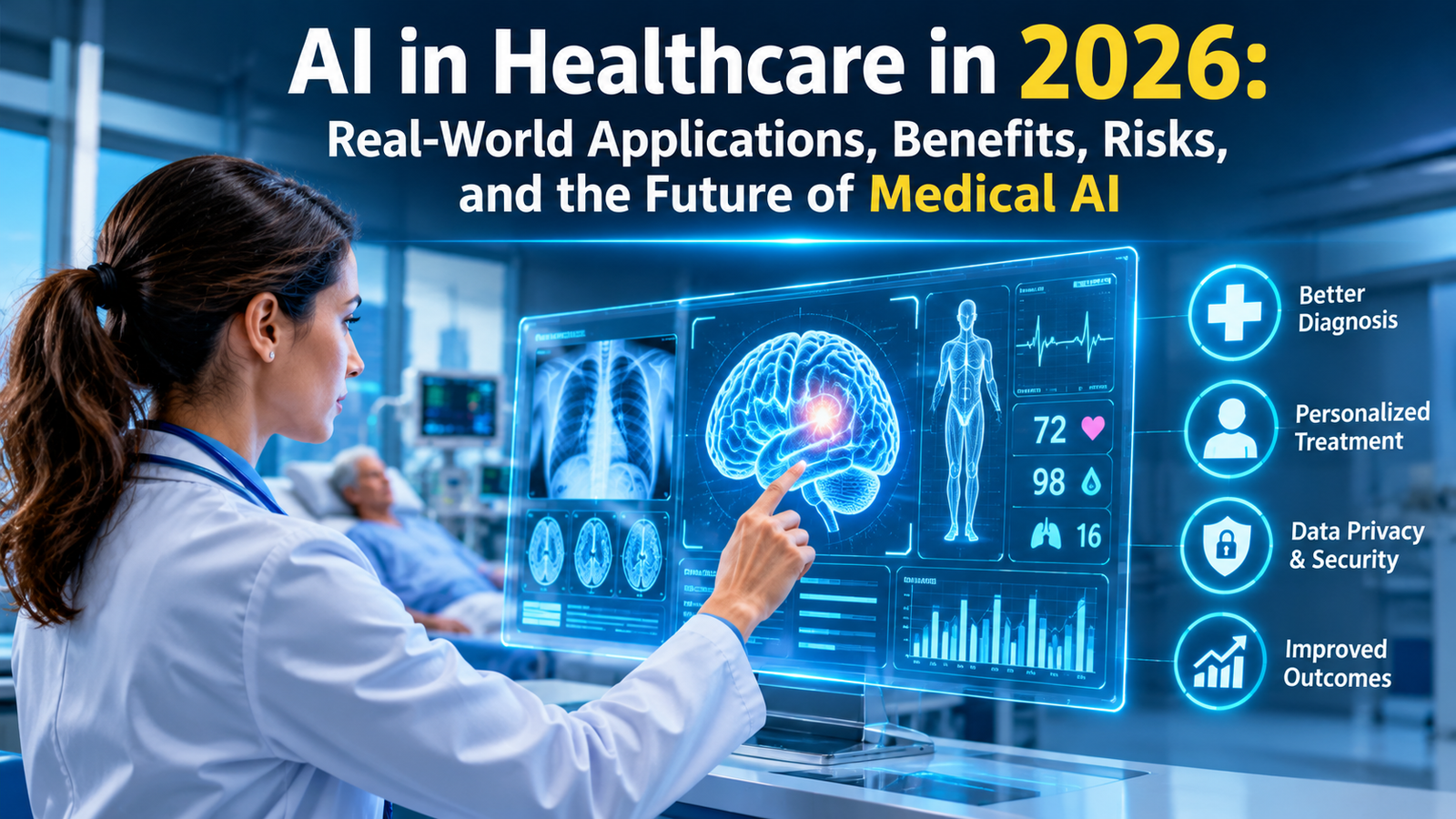
Artificial intelligence is becoming part of everyday healthcare, from systems that help radiologists review medical images to tools that summarize clinical notes and support hospital operations. In 2026, the most important question is no longer whether AI can perform impressive demonstrations. It is whether a specific system improves care safely, reliably and fairly when used by real clinicians and patients.
AI in healthcare includes a wide range of technologies: machine-learning models that detect patterns in scans, prediction systems that estimate clinical risk, natural-language tools that work with medical records, and generative AI assistants that help people navigate information. These tools have different purposes, evidence requirements and levels of risk. A system that drafts an appointment summary should not be evaluated in the same way as software that influences a cancer diagnosis.
This guide explains where medical AI is being used, what benefits are realistic, where the evidence remains limited, and how healthcare organizations can manage privacy, bias, safety and regulation. It is an overview of technology and policy, not personal medical advice.
What is AI in healthcare?
AI in healthcare refers to software that uses statistical learning, pattern recognition, language models or other computational methods to perform tasks involving health information. Depending on its design, it may classify an image, predict a risk, extract information from a record, recommend a next step for professional review, or generate a draft response.
The term covers several distinct categories:
- Predictive machine learning: estimates the likelihood of an outcome, such as deterioration or readmission, from available data.
- Medical imaging AI: analyzes X-rays, CT scans, MRI, ultrasound or retinal images to flag patterns for trained professionals.
- Clinical decision support: organizes evidence or patient information to help clinicians consider possible actions.
- Natural-language processing: extracts, classifies or summarizes information in clinical notes and other medical documents.
- Generative AI: creates text or other outputs, such as draft documentation, patient-friendly explanations or research summaries.
- Operational AI: supports scheduling, staffing, coding, supply planning and other administrative processes.
Real-world applications of AI in healthcare
1. Medical imaging and earlier detection
Medical imaging is one of the most established areas for clinical AI. Algorithms can examine images for features associated with conditions such as diabetic retinopathy, certain cancers, fractures or signs of stroke. In some workflows, software prioritizes scans that may need urgent review; in others, it highlights regions that a radiologist or specialist can inspect.
The potential benefit is not simply replacing a reader. AI may help reduce repetitive work, draw attention to subtle findings, improve consistency or shorten the time before a high-priority case is reviewed. Actual performance depends on the specific device, image quality, patient population, clinical setting and how the result is integrated into a professional workflow.
The US Food and Drug Administration maintains a public list of AI-enabled medical devices authorized for marketing in the United States. The agency reported that more than 1,600 such devices had been authorized as of September 2026. This is evidence of a growing regulated product category, not proof that every product is suitable for every hospital or patient group. See the FDA’s AI-enabled medical devices resource.
2. Clinical decision support and risk prediction
Predictive systems can combine vital signs, laboratory results, medical history and other signals to estimate the risk of events such as clinical deterioration. A hospital may use an alert to prompt a clinician to reassess a patient, review a care plan or check whether additional monitoring is needed.
These tools must be evaluated in the environment where they will operate. A model trained in one hospital may behave differently in another because patient populations, equipment, coding practices and clinical routines vary. An alert that is too sensitive can create alarm fatigue; one that misses important cases can create false reassurance. Clinical teams need clear escalation rules and a way to report unexpected behavior.
3. Documentation, medical coding and administrative work
Generative AI and speech technologies are being tested and deployed to help clinicians draft visit notes, summarize conversations, prepare referral letters and organize information from electronic health records. Administrative teams may also use AI to classify documents, support coding review, answer routine operational questions and reduce repetitive data entry.
These applications can be attractive because they may reduce time spent on tasks that do not require a clinician’s full attention. However, an AI-generated note can omit context, misattribute a statement or introduce a plausible but incorrect detail. Human review remains essential before a record is finalized, a code is submitted or information is shared with a patient.
4. Personalized treatment and precision medicine
AI can help researchers and care teams analyze combinations of clinical, imaging, genomic and lifestyle data. In some settings, these analyses may support risk stratification, identify patterns relevant to treatment selection or help researchers understand why patients respond differently to a therapy.
Personalized medicine is not the same as allowing an algorithm to choose treatment independently. Treatment decisions involve clinical evidence, patient preferences, contraindications, costs and uncertainty. AI outputs should be considered alongside validated guidelines and professional judgment, not as a substitute for them.
5. Drug discovery and biomedical research
Researchers use AI to search scientific literature, analyze biological data, identify potential drug targets, predict molecular properties and prioritize experiments. These methods can help narrow a large search space and generate hypotheses that would be difficult to explore manually.
A promising computational result is only an early stage. Candidate treatments still require laboratory work, preclinical assessment, clinical trials and regulatory review. For a wider look at this research landscape, see our guide to AI for scientific discovery in 2026.
6. Patient support and access to health information
Patient-facing AI tools can help people find information, prepare questions for appointments, understand general health terminology or navigate a provider’s administrative services. Conversational interfaces may also make some digital services easier to use for people who find traditional forms difficult.
The risk is that a fluent answer may sound more certain than the evidence supports. A general-purpose chatbot may not know a person’s complete medical history, may misunderstand symptoms or may produce inaccurate advice. Patient-facing systems should make their limitations clear, protect sensitive data and direct urgent or complex concerns to appropriate healthcare professionals or emergency services.
7. Hospital operations and population health
Hospitals and health systems can use analytics to forecast demand, plan staffing, identify bottlenecks, manage inventory and coordinate appointments. Public-health teams may analyze aggregated information to monitor trends or allocate resources. These uses can improve operational planning, although the quality of the output depends on data completeness, governance and local context.
Benefits: where healthcare AI can make a difference
The strongest case for AI is usually a clearly defined task with measurable value, reliable data and meaningful human oversight. Potential benefits include:
- Faster review: prioritizing selected cases or helping staff locate relevant information sooner.
- More consistent workflows: applying the same screening or documentation process across large volumes of work.
- Reduced administrative burden: drafting routine documentation and organizing records for human approval.
- Research acceleration: helping scientists search large datasets and prioritize experiments.
- Improved access: making some health information and administrative services easier to navigate.
- Better resource planning: forecasting demand and identifying operational bottlenecks.
These are potential benefits, not automatic outcomes. A tool can be technically accurate yet fail to improve care if it adds extra steps, creates too many alerts, performs poorly for a subgroup or is not trusted by the people expected to use it. Healthcare organizations should measure outcomes such as time saved, error rates, patient experience and clinical impact rather than relying on product demonstrations alone.
Risks and challenges of medical AI
Accuracy, hallucinations and automation bias
AI systems can make mistakes, including confident errors. Generative models may invent references or clinical details; prediction systems may miss unusual cases; image models may fail when scans differ from their training data. Staff can also become over-reliant on automated recommendations, especially when a system is presented as authoritative.
Mitigation requires task-specific validation, clear uncertainty communication, independent checks for high-impact decisions and training that encourages staff to challenge outputs. A human approval step is useful only when the reviewer has enough time, information and authority to disagree.
Bias and unequal performance
A model can perform differently across age groups, sexes, ethnic groups, languages, disability status or care settings. Bias may enter through unrepresentative training data, historical inequalities in healthcare access, inconsistent labels or the choice of outcome used during development. A system that works well in one population may not generalize to another.
Organizations should test performance across relevant patient groups, document limitations, involve affected communities and monitor outcomes after deployment. If a system is not validated for a particular population or use, that limitation should be visible to clinicians and decision-makers.
Privacy, security and data governance
Health records contain highly sensitive information. Sending patient data to an external AI service can create risks involving unauthorized access, retention, secondary use, cross-border transfers and accidental disclosure. Connected systems can also expand the attack surface for ransomware, account compromise and data theft.
Before adoption, providers should understand where data are processed, who can access them, how long they are retained, whether they are used to train models and how deletion or incident response works. Apply least-privilege access, encryption, audit logging, vendor review and appropriate data minimization. Our article on AI agent security explains why connected tools and permissions require careful control.
Reliability, integration and accountability
A model may lose accuracy as clinical practice, devices, patient populations or data formats change. This is known as performance drift. Poor integration can also place recommendations in the wrong part of a workflow or make important information hard to find. Healthcare organizations need named owners for system performance, incident handling, updates and clinical escalation.
How medical AI is regulated in 2026
Regulation depends on the country, intended purpose and functionality of the product. In the United States, the FDA regulates medical devices, including certain software functions that meet the legal definition of a device. The agency uses risk-based pathways such as 510(k), De Novo and premarket approval, depending on the product and its characteristics. Not every software tool that mentions health is automatically a regulated medical device.
The FDA’s digital-health guidance list includes a final Clinical Decision Support Software guidance dated January 29, 2026, alongside guidance on AI-enabled device software and predetermined change control plans. In August 2026, the agency also published a discussion paper seeking feedback on possible approaches to generative-AI-enabled medical devices. The discussion paper is for stakeholder input and should not be mistaken for final binding guidance. Review FDA digital-health guidance and the FDA discussion paper on generative AI-enabled devices.
Internationally, the World Health Organization has emphasized ethics, human rights, transparency and accountability in AI for health. Its 2025 guidance on large multimodal models discusses the opportunities and limitations of systems that process multiple kinds of input. A 2026 WHO report on AI-related health research calls for stronger ethics review and oversight, including attention to fairness, privacy, power imbalances and the needs of low- and middle-income countries. Read WHO guidance on large multimodal models and the 2026 report on ethics review and oversight.
For providers operating across borders, compliance may involve medical-device rules, privacy laws, professional standards, cybersecurity obligations, procurement requirements and local health-data policies. A vendor’s claim that a product is “AI-powered” or “clinically validated” is not a substitute for checking its intended use, evidence and regulatory status.
How hospitals and clinics should evaluate AI tools
A practical evaluation process starts with the problem, not the technology. Before buying or building a system, a healthcare organization should:
- Define the use case: specify the task, intended users, patient group and decision the system may influence.
- Classify the risk: determine whether the tool is administrative, informational, clinical decision support or a medical device.
- Review evidence: request independent validation, relevant clinical studies, subgroup results and known limitations.
- Test locally: assess performance with representative data and workflows before broad deployment.
- Protect information: review data flows, contracts, retention, access controls and security practices.
- Keep human accountability: define who reviews outputs, handles exceptions and makes final clinical decisions.
- Monitor continuously: track errors, drift, subgroup performance, incidents and patient or staff feedback.
- Plan for change: document model updates, revalidation triggers, rollback procedures and vendor exit arrangements.
A pilot should have measurable success criteria. For example, a documentation assistant might be evaluated on clinician editing time, note completeness, error frequency and user satisfaction. An imaging tool might be assessed on sensitivity, specificity, false-positive burden, workflow impact and performance across patient groups. The relevant measures depend on the clinical task.
What the future of medical AI may look like
The next phase is likely to involve more multimodal systems that can work with text, images, audio and structured records, as well as more specialized models designed for particular clinical tasks. AI assistants may become more deeply integrated into scheduling, documentation and information retrieval. Research systems may help scientists connect evidence across publications, datasets and experiments.
However, capability alone will not determine adoption. The 2026 review “State of clinical AI in 2026” in BMJ Digital Health highlights a gap between model performance on controlled benchmarks and the evidence needed for safe implementation in real clinical workflows. It emphasizes prospective evaluation, human-AI collaboration, equity and post-deployment monitoring. Read the BMJ review.
A likely direction is assistive AI: systems that help clinicians find information, reduce repetitive work and notice patterns, while leaving accountable professionals in control of consequential decisions. The most successful deployments may be those that solve narrow, high-value problems reliably rather than attempting to automate an entire care pathway at once.
Frequently asked questions
How is AI used in healthcare in 2026?
AI is used to support medical imaging, clinical risk prediction, documentation, research, patient information services and hospital operations. The level of evidence and regulatory oversight varies by application.
Can AI diagnose diseases?
Some regulated AI-enabled medical devices can analyze images or other clinical inputs to support detection or diagnosis for specific intended uses. Their outputs must be interpreted within the validated workflow and should not be treated as a universal replacement for professional assessment.
Does AI replace doctors and nurses?
Current healthcare AI is generally best understood as task-specific assistance. It can help with analysis, documentation and operations, but clinical care also requires examination, communication, judgment, accountability and understanding of a patient’s circumstances.
Is it safe to enter medical information into an AI chatbot?
Do not assume that a general chatbot is an approved medical service or that information entered into it receives healthcare-grade privacy protections. Review the service’s data policy and avoid sharing identifiable health information unless the provider and use have been appropriately approved by your healthcare organization.
What are the biggest risks of AI in healthcare?
Major risks include inaccurate outputs, bias, privacy breaches, cybersecurity incidents, poor integration, automation bias and performance changes after deployment. These risks require validation, governance and ongoing monitoring.
How can hospitals choose a reliable AI tool?
Hospitals should define the use case, check regulatory status, review independent evidence, test the system locally, assess privacy and security, train users and monitor performance after deployment. Procurement should include clear responsibilities for updates and incidents.
The bottom line
AI in healthcare has moved beyond experimentation in several areas, particularly medical imaging, workflow support and research. But a promising model is not automatically a safe or effective clinical tool. Real progress depends on evidence in real settings, representative data, privacy protection, clear accountability and meaningful human oversight.
For hospitals, clinicians and technology companies, the goal should be practical improvement: better-supported decisions, less avoidable administrative work and more reliable services without compromising patient safety or trust. Explore more developments in our guides to AI for scientific discovery, AI agent security and AI data centers and infrastructure.
Sources and further reading
- US FDA: Artificial Intelligence-Enabled Medical Devices
- US FDA: Guidances with Digital Health Content
- US FDA: Considerations for the Regulation of Generative AI-Enabled Medical Devices (2026 discussion paper)
- World Health Organization: Ethics and Governance of AI for Health — Large Multimodal Models
- World Health Organization: Artificial Intelligence-Related Health Research — Ethics Review and Oversight (2026)
- BMJ Digital Health: State of Clinical AI in 2026