
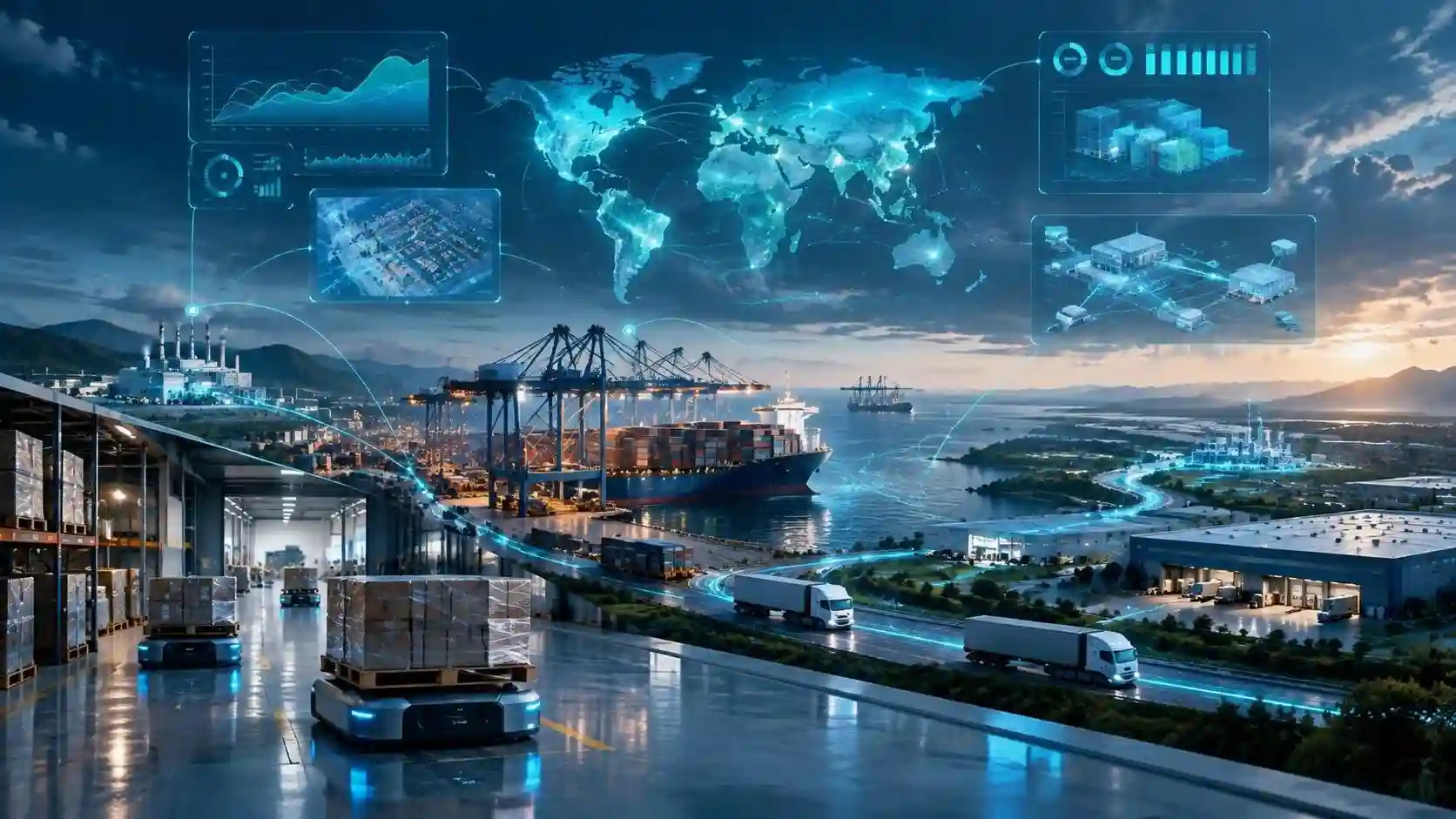
Global supply chains rarely fail because of one dramatic event. More often, small problems build quietly: a supplier misses a delivery, demand changes, a shipment is delayed, or inventory sits in the wrong warehouse. In 2026, artificial intelligence is helping businesses detect these signals earlier and coordinate better responses across procurement, planning, warehousing, and transportation.
AI in supply chain management is moving beyond dashboards and isolated forecasts. Machine-learning models can estimate demand and lead times, optimization systems can compare routes and inventory decisions, and newer agentic tools can coordinate selected tasks under defined rules. The practical opportunity is not to remove people from supply chains. It is to give planners better information, faster scenario analysis, and more time to handle exceptions.
What AI means for supply chain management in 2026
A modern supply chain connects suppliers, factories, warehouses, carriers, retailers, customers, and financial systems. AI adds a layer of prediction and decision support across those connections. It can combine historical transactions with live signals such as orders, inventory scans, traffic, weather, port activity, supplier updates, and market conditions.
The quality of the result depends on data freshness, integration, and the decision being supported. A forecast is useful only when planners can act on it. A digital twin is valuable only when its model reflects real operations. An autonomous workflow needs clear permissions and a way for people to intervene.
1. Demand forecasting and demand sensing
Traditional forecasts often rely heavily on historical sales and seasonal patterns. Machine-learning systems can consider a wider range of variables, including promotions, pricing, weather, local events, online search activity, and changes in customer behaviour. Demand sensing updates the picture more frequently as new signals arrive.
For example, a distributor may see a sudden rise in orders from several retailers. An AI model can compare that signal with inventory, promotion calendars, and regional trends to estimate whether the increase is temporary or likely to continue. Planners can then adjust replenishment before shelves run empty or excess stock accumulates.
Forecasts should be evaluated by product, location, and time horizon. A single overall accuracy score can hide serious errors in fast-moving or high-margin products. Businesses should track forecast bias, error by category, stockouts, service levels, and the financial impact of forecast changes.
2. Inventory optimization and replenishment
AI can help estimate how much stock to hold, where to position it, and when to reorder. Instead of applying one fixed safety-stock rule everywhere, systems can account for demand volatility, supplier reliability, lead-time variation, storage costs, and service targets.
This is especially useful for businesses managing many products across multiple locations. A model may recommend moving inventory closer to a region where demand is rising, while protecting a minimum buffer for products with uncertain replenishment times. The recommendation still needs to respect warehouse capacity, transport costs, cash constraints, and contractual commitments.
3. Smarter transportation and logistics
Transportation decisions change throughout the day. Traffic, weather, fuel costs, vehicle availability, border delays, and port congestion can all affect delivery plans. AI-assisted route optimization can combine these signals to compare delivery sequences, estimate arrival times, and identify alternatives when a route becomes unreliable.
For fleet operators, machine learning can also help predict vehicle maintenance needs from service records and sensor data. For freight teams, anomaly detection can flag unusual delays or cost changes. These tools work best when connected to reliable shipment events and when dispatchers can override a recommendation for safety, customer, or operational reasons.
4. Supplier risk and early-warning systems
A supply chain is only as resilient as the visibility it has into its dependencies. AI systems can combine supplier performance, delivery history, financial indicators, geopolitical developments, weather exposure, and public disruption notices to help teams identify emerging risks.
These signals should be treated as indicators, not automatic proof that a supplier will fail. A risk score can be wrong because data is incomplete, outdated, or biased toward suppliers that are easier to monitor. Procurement teams should verify important alerts, document their reasoning, and maintain alternative sourcing plans for critical materials.
5. Digital twins for scenario planning
A supply chain digital twin is a digital representation of some part of a real supply network. It may model facilities, inventory, routes, suppliers, production capacity, and the relationships between them. When updated with operational data, it can help teams test “what if” questions before changing the real system.
A planner could simulate a port closure, a supplier outage, a sudden demand increase, or a warehouse capacity constraint. Different scenarios can be compared for cost, delivery time, inventory requirements, and service impact. Research published in 2026 describes digital twins as useful for decision problems such as production planning, routing, resource allocation, disruption management, and inventory control, while also highlighting integration and validation challenges.
A digital twin should not be treated as a perfect copy of reality. Its usefulness depends on the accuracy of source data, the assumptions built into the model, and regular comparisons between simulated and actual outcomes.
6. Agentic AI and supply chain workflows
Agentic AI systems can plan and carry out sequences of tasks using connected software tools. In a supply chain setting, an agent might monitor delayed purchase orders, gather updated supplier information, draft an exception report, or propose a revised delivery plan. With carefully limited permissions, it may also update low-risk records or initiate an approval workflow.
Gartner identified agentic AI, collaborative multi-agent systems, physical AI, intelligent simulation, and decision governance among the supply chain technology trends for 2026. The important distinction is between suggesting an action and being authorized to execute it. Changing a delivery note is not the same as approving a high-value purchase, changing a supplier, or committing a company to a new contract.
Businesses should begin with bounded tasks, role-based access, approval thresholds, action logs, and a clear stop mechanism. Human review should remain mandatory for high-impact, costly, or difficult-to-reverse decisions.
Where AI can deliver value—and where it can disappoint
AI can improve visibility and speed, but it does not automatically create a better supply chain. A 2026 Boston Consulting Group report on supply chain planning found that many organizations were still experimenting rather than scaling AI broadly. Demand forecasting was among the more established applications, while more advanced AI and agentic use cases remained less widely deployed in the survey.
This gap matters. A more accurate forecast may not reduce costs if purchasing rules, supplier contracts, warehouse capacity, or planning processes prevent the business from acting on it. A sophisticated model can also create more work if employees do not trust its recommendations or cannot understand why an alert was generated.
Key challenges businesses must address
- Fragmented data: Supplier, inventory, transport, and sales records may use different formats or identifiers.
- Weak data quality: Missing timestamps, inaccurate stock counts, and outdated lead times undermine model outputs.
- Limited explainability: Planners need to understand the factors behind recommendations, especially when service or safety is affected.
- Cybersecurity: Connected systems create additional access points and dependencies that need monitoring.
- Integration costs: Connecting models to ERP, warehouse, transport, and procurement platforms can be harder than building a pilot.
- Change management: Teams need training, clear accountability, and a process for challenging incorrect recommendations.
- Over-automation: High-impact decisions should not be delegated simply because a workflow can technically be automated.
How to implement AI in a supply chain: a practical roadmap
Step 1: Choose one measurable problem. Start with a recurring issue such as forecast error, excess inventory, late deliveries, or manual exception handling. Avoid beginning with a company-wide “AI transformation” without a defined operational goal.
Step 2: Establish a reliable baseline. Record current forecast accuracy, stockout rates, inventory turns, on-time delivery, expedite costs, and planner workload. Baselines make it possible to distinguish genuine improvement from a convincing demonstration.
Step 3: Prepare and connect the data. Standardize product, supplier, location, and shipment identifiers. Define who owns each dataset, how frequently it updates, and how errors are corrected.
Step 4: Run a controlled pilot. Test the model on a limited product group, region, or workflow. Compare its recommendations with existing planning methods and keep a human decision-maker responsible.
Step 5: Measure business outcomes. Evaluate not only model accuracy but also service levels, working capital, total landed cost, waste, resilience, and time saved. Include the cost of integration, monitoring, and ongoing model maintenance.
Step 6: Scale with governance. Expand only after the pilot demonstrates repeatable value. Set access controls, approval limits, audit logs, incident procedures, and periodic reviews for model drift and supplier or process changes.
What AI-driven supply chains could look like next
The direction of travel is toward more connected planning: systems that detect a disruption, estimate its likely impact, compare response options, and coordinate approved actions across teams. Digital twins can support scenario testing, specialized models can improve domain-specific decisions, and agents can help manage repetitive workflows.
That future will depend as much on trustworthy data, interoperability, workforce skills, and clear governance as on model capability. The strongest supply chains will not be the ones that automate every decision. They will be the ones that combine machine speed with human judgment and can recover quickly when assumptions prove wrong.
Frequently asked questions
How is AI used in supply chain management?
AI is used for demand forecasting, inventory optimization, route planning, supplier-risk monitoring, predictive maintenance, digital-twin simulations, and selected workflow automation.
Can small businesses use AI in their supply chains?
Yes. Smaller businesses can start with forecasting, reorder recommendations, shipment visibility, or automated reporting. A focused tool that solves one costly problem is often more practical than building a complex AI platform.
Will AI replace supply chain managers?
AI can automate analysis and routine coordination, but people remain essential for negotiation, supplier relationships, exception handling, ethical decisions, and accountability for business outcomes.
What is a supply chain digital twin?
It is a digital model of a supply chain or part of it, updated with operational data so teams can simulate scenarios and evaluate decisions before applying them in the real world.
What is the biggest barrier to AI adoption in supply chains?
Common barriers include fragmented data, legacy-system integration, unclear ownership, limited skills, and difficulty translating model predictions into operational decisions.
Research and further reading
- Gartner: Top Supply Chain Technology Trends for 2026
- SAP and Kühne Logistics University: Supply Chain 2035
- Boston Consulting Group: Supply Chain Planning 2026
- Digital Twins for Real-Time Decision-Making in Supply Chain Management and Logistics (2026)
- OECD: Strengthening Supply Chains through Efficiency, Resilience, AI and Environmental Performance
- DHL Logistics Trend Radar 8.0: AI and the Future of Logistics
Related reading: AI in Retail in 2026, Industrial AI in Manufacturing, and AI in Agriculture.