
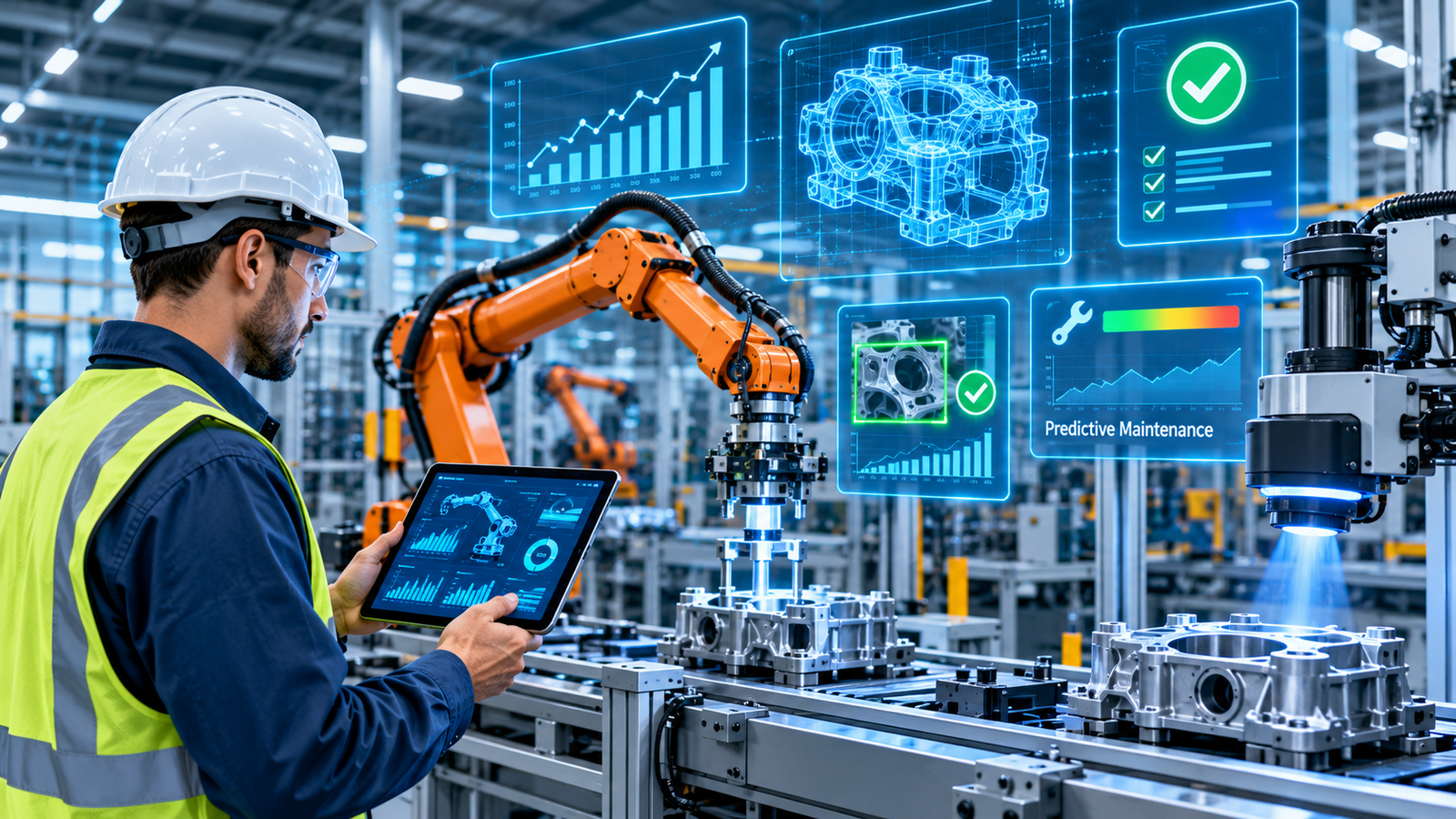
Industrial AI is changing how manufacturers plan production, inspect products, maintain equipment and manage supply chains. In 2026, factories are moving beyond isolated automation projects toward connected systems that use machine learning, computer vision, generative AI and robotics to improve real-world operations. The opportunity is not simply to make machines smarter: it is to make production more reliable, efficient, safe and adaptable.
Yet moving an AI model from a successful pilot into a dependable factory process is difficult. Industrial data can be fragmented, equipment may use incompatible control systems, and an incorrect recommendation can affect product quality or worker safety. This guide explains the most practical applications of AI in manufacturing, the technology behind them, the risks to manage and a step-by-step adoption plan.
What is industrial AI in manufacturing?
Industrial AI is the use of artificial intelligence and machine learning in factories, production systems and industrial supply chains. It combines data from machines, sensors, cameras, enterprise software and human operators to identify patterns, predict outcomes and support decisions.
Different AI technologies perform different jobs. Traditional machine-learning models can forecast equipment failures or estimate process quality. Computer vision can inspect products and detect defects. Generative AI can help engineers search technical documentation, summarise maintenance histories or query production data in natural language. Robotics and physical AI can use perception and planning to interact with equipment and materials in the physical world.
Industrial AI is not the same as simply installing a robot or connecting a machine to the internet. Its value comes from turning reliable operational data into useful predictions or actions that fit the factory’s safety and control requirements.
How manufacturers use AI in 2026
1. Predictive maintenance and equipment reliability
Unplanned equipment failures can interrupt production, delay orders and increase repair costs. Predictive maintenance uses sensor readings and equipment history to estimate when a machine may need attention. Models can analyse vibration, temperature, pressure, current, acoustic signals and operating cycles to identify patterns associated with wear or abnormal behaviour.
Instead of maintaining every asset on a fixed schedule, teams can prioritise inspections based on condition and risk. Maintenance staff can receive earlier warnings, compare similar machines and plan spare parts before a failure occurs. Predictions should be treated as decision support rather than certainty: technicians still need to verify alerts, and critical equipment requires safe fallback procedures.
2. Automated quality inspection
Computer vision systems can examine products as they move along a production line. Cameras and trained models may identify scratches, cracks, missing components, incorrect assembly, surface defects or packaging errors. Compared with manual inspection alone, automated systems can inspect consistently at high speed and flag unusual items for a human quality specialist.
Reliable inspection depends on representative training images, controlled lighting, camera calibration and clear defect definitions. A model may miss a new defect type or produce false alarms when materials, suppliers or production conditions change. Manufacturers should measure both missed defects and false rejections, maintain human review for uncertain cases and periodically test the system against new production batches.
3. Production planning and process optimisation
Manufacturing schedules must account for machine capacity, labour availability, raw materials, maintenance windows, energy costs and delivery commitments. AI models can help forecast demand, identify bottlenecks, recommend production sequences and simulate the effects of changing constraints.
Process optimisation can also help operators tune variables such as temperature, pressure, speed or material mix. The objective is to improve yield, cycle time and consistency without violating engineering limits. Recommendations should be validated against process knowledge and approved operating envelopes before they are allowed to influence controls.
4. Supply chain and inventory management
Manufacturers need visibility across suppliers, warehouses, transport networks and production sites. AI can combine historical orders, lead times, inventory levels and external signals to identify shortages, forecast demand and highlight potential delivery disruptions. It can also support warehouse slotting, route planning and replenishment decisions.
Forecasts are only as useful as the data behind them. Supplier information may be delayed or incomplete, and sudden geopolitical, weather or logistics events can make historical patterns unreliable. Teams should use scenario planning, monitor forecast errors and retain alternative sourcing and inventory plans for critical components.
5. Energy efficiency and sustainable production
Energy-intensive factories can use AI to analyse consumption by machine, production line or shift. Models may detect unusual demand, forecast energy needs, identify inefficient operating patterns and recommend when to run flexible processes. AI can also support monitoring of water use, material waste and emissions-related operational data.
Energy recommendations must respect production requirements and equipment limits. A lower-energy schedule is not an improvement if it causes defects, unsafe conditions or missed delivery commitments. Manufacturers should track energy per good unit produced alongside quality and throughput rather than optimising electricity use in isolation.
6. Worker safety and human-machine collaboration
Computer vision and sensor analytics can help identify unsafe conditions, restricted-zone entry, missing protective equipment or unusual movement around machinery. AI-enabled robots and collaborative systems can also take on repetitive, heavy or hazardous tasks, allowing workers to focus on supervision, setup and problem-solving.
Safety monitoring must be designed carefully. Camera systems can create privacy concerns, and automated alerts should not replace required physical safeguards, training or established safety procedures. Workers should understand what is monitored, how data is used and how to report errors. Safety-critical decisions need tested controls and accountable human oversight.
7. Engineering, maintenance knowledge and generative AI
Generative AI assistants can help engineers search manuals, maintenance logs, standard operating procedures and technical reports. They can summarise previous incidents, draft work instructions, translate technical material and help new employees find relevant documentation. When connected to approved industrial data, these assistants can make information easier to locate across complex operations.
These systems should retrieve answers from approved sources and show where the information came from. A language model can invent a procedure, overlook a safety warning or rely on an outdated manual. It should not independently change a programmable logic controller, disable a safety interlock or approve a maintenance procedure without the appropriate engineering controls.
What the 2026 research says about industrial AI adoption
Recent research points to growing interest in industrial AI, but also highlights a gap between successful experiments and scaled deployment:
- NIST’s 2026 smart manufacturing roadmap identifies industrial data, sensing, autonomous systems, digital twins, robotics, logistics and sustainable manufacturing as important AI and machine-learning directions. It also stresses the need for trustworthy, explainable and reliable operation in high-stakes industrial environments.
- Deloitte’s 2026 manufacturing survey reports that 84% of surveyed manufacturers say AI is already generating measurable value, while only around 20% of use cases have been scaled. The report points to implementation cost, skills, change management, compliance and data quality as barriers.
- Cisco’s 2026 State of Industrial AI research describes adoption across process automation, supply-chain optimisation, automated quality inspection, energy optimisation, predictive maintenance, worker safety and robotics. Its manufacturing report lists process automation and supply-chain/logistics optimisation among the leading use cases surveyed.
- A 2026 review of human–AI-assisted digital twins finds growing research interest in systems that combine simulation, AI reasoning and human collaboration, while noting that many studies remain at laboratory validation rather than mature industrial deployment.
Survey results describe the organisations and methods studied; they should not be interpreted as a guarantee that every factory will achieve the same outcomes. The practical lesson is to measure value in a specific production environment and plan for deployment, not just a successful demonstration.
Technologies behind the AI-powered factory
Industrial IoT sensors and connected equipment
Industrial Internet of Things (IIoT) devices collect information from machines and production environments. Sensors can measure temperature, vibration, pressure, energy use and equipment status. Gateways and industrial networks transmit selected data to edge systems or central platforms for analysis.
Edge AI and cloud platforms
Edge AI runs models close to the equipment, which can reduce latency and keep some data on site. This is useful when a production line needs fast inspection or when connectivity to a cloud service is limited. Cloud platforms can provide greater computing capacity for training, fleet-wide analysis and combining data across multiple facilities. Many factories use a hybrid approach.
Digital twins and simulation
A digital twin is a digital representation of a physical asset, process or facility that can be updated using operational data. When combined with AI, simulation can help engineers test production changes, explore failure scenarios, optimise layouts or estimate the effect of new operating settings before making changes on the factory floor.
A digital twin is not automatically an accurate mirror of reality. Its usefulness depends on model assumptions, data quality, update frequency and validation against actual equipment behaviour. Human expertise remains important when interpreting simulations and deciding whether a proposed change is safe.
Robotics and physical AI
Industrial robots already perform structured tasks such as welding, painting, assembly and material handling. Newer AI capabilities can improve perception, adaptability and the ability to work with less rigidly programmed environments. Mobile robots can move materials, while machine-vision systems help robots locate and handle objects.
For a broader explanation of embodied systems, see our guide to Physical AI and robotics in 2026. The key distinction is that this article focuses on the wider factory operating system: data, quality, maintenance, planning and human oversight as well as robots.
Benefits manufacturers can measure
AI projects should be linked to operational key performance indicators (KPIs). Depending on the use case, manufacturers may track:
- Overall equipment effectiveness (OEE): availability, performance and quality across production assets.
- Unplanned downtime: lost production time caused by unexpected equipment interruptions.
- First-pass yield: the share of products that meet quality requirements without rework.
- Scrap and rework rates: material and labour lost to defective or nonconforming products.
- Cycle time and throughput: how long production takes and how much good output is delivered.
- Energy intensity: energy consumed per unit of good production.
- Schedule adherence: the extent to which production meets the approved plan.
- Safety indicators: hazards detected, near misses and corrective actions, interpreted alongside established safety measures.
Establish a baseline before introducing AI. Compare results with a suitable control period or production line where possible, and account for changes in product mix, demand, staffing and equipment. This helps distinguish the model’s contribution from other operational changes.
Challenges and risks of AI in manufacturing
Fragmented data and legacy equipment
Factories often contain equipment from different generations and suppliers. Data may be stored in separate systems, use inconsistent labels or lack the context needed to train reliable models. Before buying an AI platform, map the data sources, interfaces, ownership and quality requirements for the chosen use case.
Cybersecurity and IT/OT convergence
Connecting operational technology (OT) to enterprise IT and cloud services can create new pathways for cyber incidents. A compromised account or poorly secured remote connection could affect production availability or equipment safety. Manufacturers should segment networks, manage identities and remote access, patch systems where feasible, monitor industrial traffic and test incident-response plans. AI systems should receive only the permissions they need.
Reliability, drift and changing conditions
Models can degrade when raw materials, suppliers, equipment, lighting or production recipes change. A vision model trained on one product line may not perform well on another. Teams need ongoing performance monitoring, retraining criteria, version control and a safe way to revert to manual or conventional processes.
Worker trust, skills and change management
AI can change established roles and workflows. Operators may distrust alerts that are frequently wrong, while engineers may resist systems that do not explain their recommendations. Involve frontline staff in selecting use cases, testing interfaces and defining escalation rules. Training should explain both what the system can do and where it can fail.
Safety, accountability and compliance
In a factory, a bad recommendation can damage equipment, affect product quality or put people at risk. Define which actions AI may recommend, which actions it may perform and which require human approval. Keep safety interlocks and emergency-stop functions independent of general-purpose AI. Document validation, responsibilities and incident procedures in line with applicable standards and local regulations.
How to implement AI in a factory: a practical roadmap
A focused implementation programme is usually more effective than launching many disconnected pilots. Use the following steps to move from an operational problem to a production-ready solution:
- Start with a costly, measurable problem. Choose an issue such as repeated machine downtime, high defect rates or unstable production scheduling.
- Build a baseline. Record current performance, costs, process variation and the operational conditions that influence the KPI.
- Check data readiness. Confirm that relevant sensor, inspection, maintenance or production data is available, labelled and reliable enough for the task.
- Choose the simplest suitable approach. A conventional predictive model or rules-based system may be more appropriate than a large language model or autonomous agent.
- Run a controlled pilot. Test on a limited line, machine or shift with operators and engineers involved. Keep existing safety and quality procedures in place.
- Validate failure modes. Test false alarms, missed defects, unusual materials, sensor outages, network interruptions and other edge cases.
- Integrate with factory workflows. Define how alerts reach operators, how work orders are created and who approves recommendations or actions.
- Secure and monitor the deployment. Apply network segmentation, access controls, logging, model monitoring and rollback procedures.
- Scale only after evidence. Document the result, reusable architecture, training requirements and support model before expanding to other lines or sites.
Which manufacturing AI project should you start with?
| Factory challenge | Potential AI application | First metric to track |
|---|---|---|
| Unexpected machine failures | Predictive maintenance | Unplanned downtime |
| Defects discovered late | Computer-vision inspection | Defect escape and false-reject rates |
| Frequent schedule changes | Production planning and forecasting | Schedule adherence |
| Material shortages | Supply-chain forecasting | Stockouts and inventory days |
| High energy use | Energy analytics and optimisation | Energy per good unit |
| Hard-to-find technical knowledge | Grounded engineering assistant | Time to find verified information |
This is a starting guide, not a universal ranking. The best first project is the one with a clear owner, accessible data, manageable risk and a result the factory can measure.
The future of AI in manufacturing
Industrial AI is likely to become more connected to simulation, robotics and production software. Digital twins may help teams evaluate changes before applying them, while more capable vision and robotics systems could handle a wider range of tasks. Generative AI may make industrial information easier to access, and specialised models may support engineering and maintenance work.
However, the future factory will not be defined by autonomy alone. Manufacturers will need systems that remain dependable under changing conditions, work securely with existing equipment and support the people responsible for production. The organisations most likely to benefit are those that combine good engineering, reliable data, workforce expertise and carefully governed AI.
Frequently asked questions about AI in manufacturing
What is AI used for in manufacturing?
Manufacturers use AI for predictive maintenance, automated quality inspection, production planning, supply-chain forecasting, energy optimisation, worker-safety support, robotics and technical knowledge search.
How does AI improve manufacturing quality?
Computer-vision systems can inspect products for visible defects, while predictive models can identify process conditions associated with quality problems. Results should be validated against human inspection and actual defect outcomes.
What is predictive maintenance in a smart factory?
Predictive maintenance analyses equipment condition and operating data to estimate when maintenance may be needed. It helps teams prioritise inspections and plan repairs before some failures occur, but predictions are not guarantees.
What is a digital twin in manufacturing?
A digital twin is a digital representation of a physical machine, process or facility that can be updated with operational data. It can support monitoring, simulation and analysis of possible production changes.
Is AI expensive for small manufacturers?
Costs vary with sensors, integration, software, data preparation and support. Smaller manufacturers can begin with a narrow use case using existing machine data or a limited inspection station, then expand only when the business case is demonstrated.
Can AI replace factory workers?
AI and robotics can automate some repetitive or hazardous tasks, but manufacturing still depends on human judgement, maintenance, engineering, supervision and exception handling. In many settings, the more realistic outcome is a change in tasks and skills rather than the complete removal of people.
What is the biggest risk of industrial AI?
There is no single risk for every factory. Common concerns include poor data, unreliable predictions, cybersecurity weaknesses, unsafe automation, model drift and unclear accountability. Risk increases when AI is allowed to influence physical processes without adequate validation and safeguards.
Further reading and research
- NIST: 2026 Roadmap on Artificial Intelligence and Machine Learning for Smart Manufacturing
- Deloitte: AI in Manufacturing 2026 – From pilot value to scaled industrial impact
- Cisco: 2026 State of Industrial AI Report for Manufacturing
- The International Journal of Advanced Manufacturing Technology: Human–AI-Assisted Digital Twins for Advanced Manufacturing
- Cisco: Industrial AI Moves into Physical Operations
For related topics, read our guides to Physical AI and robotics, AI infrastructure and data centers and AI agent security.
Bottom line: AI can help manufacturers improve quality, reduce downtime, plan production and use resources more efficiently. The real challenge is turning promising pilots into reliable factory capabilities. Start with a measurable operational problem, validate the system in real conditions and scale only when performance, safety and accountability are clear.