
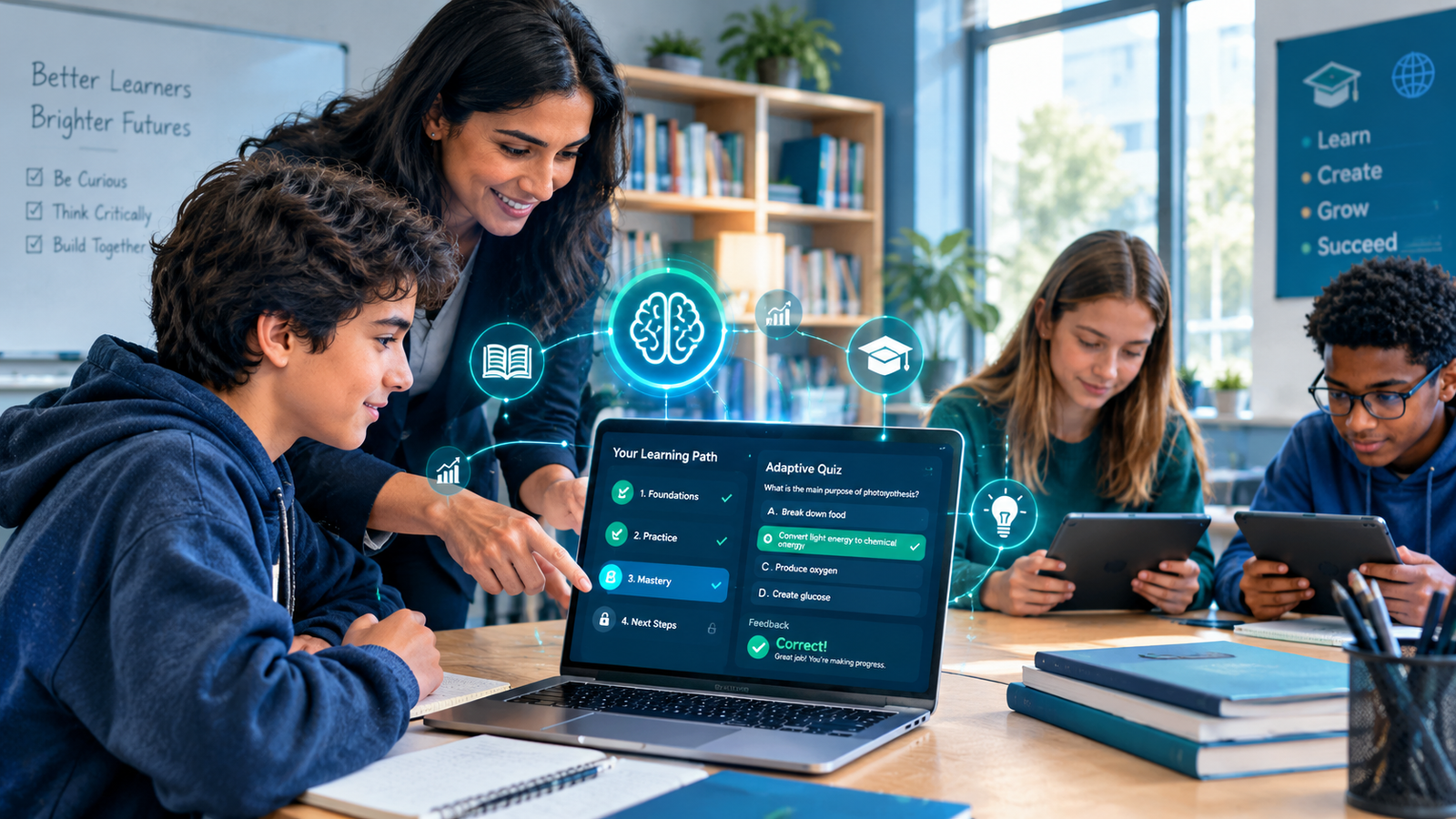
Artificial intelligence is changing how students study, how teachers prepare lessons and how education providers manage learning. In 2026, AI tools can explain difficult concepts, generate practice questions, translate learning materials, provide feedback and help educators adapt resources for different needs. But faster answers do not automatically create deeper understanding. The real value of AI in education depends on whether it strengthens learning, supports teachers and protects students.
Schools, universities and training providers are now moving beyond experimentation. They are developing policies for generative AI, reviewing assessment methods, training educators and deciding which tools are appropriate for different age groups. At the same time, research is showing that outcomes vary widely: an AI tutor that guides a learner through a problem is very different from a chatbot that simply supplies the answer.
This guide explores AI in education in 2026, including personalized learning, AI tutors, teacher productivity, assessment, accessibility, risks and practical implementation. It focuses on responsible uses that help people learn rather than replace the thinking that education is meant to develop.
What is AI in education?
AI in education refers to software that uses machine learning, language models, speech recognition, computer vision or related techniques to support teaching, learning and education administration. Some systems adapt practice activities to a learner’s progress. Others answer questions, generate lesson materials, provide writing feedback, translate content or analyze patterns in institutional data.
Common categories include:
- Adaptive learning platforms: adjust the pace, difficulty or sequence of activities based on learner responses.
- AI tutors: provide explanations, questions, hints and guided practice in a conversational format.
- Generative AI assistants: help draft, explain, summarize, translate or brainstorm learning materials.
- Automated feedback tools: offer suggestions on writing, coding, quizzes or practice exercises.
- Teacher support tools: help educators plan lessons, create differentiated resources and organize routine work.
- Education analytics: help institutions understand attendance, course engagement, resource needs and other patterns.
How AI is being used in education in 2026
1. Personalized learning and adaptive practice
Students do not all learn at the same pace. An adaptive platform can use responses to identify topics that may need more practice and recommend an appropriate next activity. A learner who understands fractions but struggles with percentages, for example, may receive additional exercises on the missing concept rather than repeating an entire unit.
Generative AI can also rephrase an explanation, offer a simpler example or create practice questions at different levels. Used carefully, this can make learning materials more responsive to individual needs. Teachers still need to check that explanations are accurate, aligned with the curriculum and suitable for the learner’s age and background.
2. AI tutors and study assistants
AI tutors can answer questions at any time, explain a concept in more than one way and guide students through practice. Better educational designs do not immediately reveal the final answer. They ask the learner to explain their thinking, offer a hint, identify a misconception and encourage another attempt.
This distinction matters. A chatbot that completes a homework task may improve the submitted work without improving the student’s understanding. A tutor designed around questioning and feedback is more likely to keep the learner actively involved. Even then, results depend on the subject, the student’s age, the quality of the system and how it is used.
3. Lesson planning and teaching resources
Teachers can use AI to brainstorm lesson structures, generate examples, create quizzes, adapt reading passages, draft rubrics and prepare discussion prompts. A teacher working with a mixed-ability class might ask for several versions of a reading activity, then review and adjust them for the actual students.
The advantage is speed and flexibility, not automatic instructional quality. AI-generated resources may contain factual errors, stereotypes, unsuitable language or questions that do not test the intended skill. Educators should treat generated material as a first draft and retain responsibility for the final lesson.
4. Feedback on writing, languages and coding
AI can provide formative feedback while students are still working. Writing tools may flag unclear sentences, suggest an outline or explain grammar. Language-learning systems can simulate conversations and offer pronunciation practice. Coding assistants can explain error messages, suggest debugging steps or provide examples of programming concepts.
Feedback should help students improve their own work rather than silently rewrite it for them. Teachers can ask learners to explain which suggestions they accepted, which they rejected and why. This makes the AI interaction part of the learning process instead of an invisible shortcut.
5. Accessibility, translation and inclusive learning
Speech-to-text, text-to-speech, captioning, translation and reading-support tools can make some learning materials easier to access. AI may help convert information into different formats, simplify complex language or support learners who are studying in a second language.
These tools can improve access, but they are not equally reliable across languages, accents, dialects and disability needs. Institutions should test them with the people who will use them and provide alternatives when automated output is inaccurate or inaccessible. AI should not become a reason to reduce human support or specialist accommodations.
6. Assessment and academic integrity
Generative AI challenges assessments that rely mainly on take-home essays or generic written answers. Institutions are responding with more in-class writing, oral explanations, project demonstrations, supervised practical work, drafts and reflective accounts of the learning process.
AI can help educators draft question banks or provide preliminary feedback, but automated grading requires careful validation. A score should not be treated as objective simply because a computer produced it. Students need transparent rules about permitted AI assistance, disclosure and how suspected misuse is handled. AI-detection scores alone are not reliable proof that a student cheated.
7. Administration and education management
Education providers may use AI to classify support requests, answer routine questions, help schedule activities, summarize feedback and analyze resource demand. Analytics can help identify patterns that deserve attention, such as a course where many students stop participating.
These signals should prompt human investigation, not automatic judgments about a student’s ability, motivation or future. Attendance and engagement data can be incomplete or misleading, especially when learners face connectivity, health, family or accessibility challenges.
What does the research say about AI and learning?
The evidence in 2026 is growing, but it does not support a simple claim that AI always improves education. The OECD’s Digital Education Outlook 2026 reports that generative AI can scale personalized support and improve feedback, while warning that students who rely on tools that provide direct answers may perform better on a task without developing equivalent understanding. The report highlights structured tutoring approaches and teacher-guided use as more promising than unrestricted answer generation. Read the OECD Digital Education Outlook 2026.
A November 2026 review from Stanford University’s SCALE initiative examined causal research on AI in K–12 education. It identified 52 relevant causal papers in its evidence base, up from 20 in the March 2026 review. Its summary finds that AI appears more promising when students use it to understand new material, practice or receive feedback than when they use it to offload academic work. However, outcomes remain mixed and the number of studies in many school settings is still limited. Read Stanford’s November 2026 evidence review.
The practical lesson is to evaluate learning, not just convenience. Faster homework completion, polished essays or more completed exercises do not necessarily mean students have retained knowledge or developed independent skills. Good evaluation should include unaided understanding, transfer to new problems, student confidence and the quality of classroom interaction.
Benefits of AI in education
When a tool is matched to a clear educational purpose and reviewed by educators, potential benefits include:
- More responsive practice: students can receive additional examples and explanations when they need them.
- Timely feedback: learners can identify errors and revise work before a final assessment.
- Teacher time savings: AI can help draft routine materials and reduce repetitive preparation tasks.
- Multiple ways to learn: a concept can be explained through text, examples, audio or guided questions.
- Language and accessibility support: translation, captions and reading assistance can lower some barriers.
- Research and creativity: students can use AI to brainstorm, compare ideas and explore questions when they verify the output.
- Operational insight: institutions can use data analysis to identify service gaps and plan resources.
These benefits are not guaranteed. A poorly designed tool can distract students, increase workload for teachers or make it harder to understand what a learner can do independently. The best measure of success is whether it improves learning or teaching outcomes without creating unacceptable costs or risks.
Risks and challenges of AI in education
Overreliance and weaker independent thinking
If students routinely ask AI to solve problems, write essays or summarize every reading, they may miss the effort through which knowledge is built. This can create a gap between the quality of work produced with assistance and what the student can explain or do independently.
Teachers can reduce this risk by asking for reasoning, intermediate drafts, oral explanations, source checks and unaided practice. AI should scaffold thinking, not remove the need to think.
Incorrect information and fabricated sources
Generative AI can produce confident but incorrect explanations, calculations, quotations or references. Students may not yet have the subject knowledge to recognize an error. Important facts should be checked against course materials, trusted publications and teacher guidance.
Student privacy and data protection
Student records can include names, grades, disability accommodations, behavioral information and other sensitive details. Before using an AI service, institutions should understand what data it collects, where it is processed, who can access it, how long it is retained and whether it may be used to train models. Avoid entering identifiable student information into unapproved public tools.
Bias and unequal access
AI systems can reflect gaps and biases in their training data. They may perform less well for certain languages, accents, cultural contexts or disability-related needs. Students also have unequal access to reliable devices, connectivity and paid services. If schools assume everyone has the same access, AI adoption can widen existing gaps rather than close them.
Academic integrity and unclear rules
Students may not know whether using AI for brainstorming, editing, translation or coding is allowed. Institutions should explain what is permitted for each assignment and how assistance should be acknowledged. Policies should distinguish legitimate support from submitting generated work as one’s own, and provide fair processes for reviewing concerns.
Teacher workload and professional judgment
AI can save time on some tasks, but checking generated materials, learning new platforms and managing student use also require effort. Teachers should be involved in selecting tools and setting policy. AI should complement professional expertise rather than impose automated decisions about students or instruction.
How schools and universities can adopt AI responsibly
A useful AI strategy starts with educational goals, not a shopping list of applications. Schools and universities can follow these steps:
- Identify the learning problem: decide whether the priority is feedback, accessibility, lesson preparation, tutoring or administration.
- Choose age-appropriate tools: check age requirements, content controls, safeguarding features and suitability for the learner group.
- Involve teachers and students: include classroom experience in evaluation, procurement and policy decisions.
- Review privacy and security: assess data collection, retention, access, vendor terms and incident response before accounts are created.
- Set clear usage rules: explain what students may use AI for, when disclosure is required and which tasks must be completed independently.
- Train educators: provide practical training on prompting, verification, bias, assessment design and responsible classroom use.
- Run a limited pilot: test a specific tool with defined goals and a manageable group before expanding it.
- Measure real learning: compare understanding, retention, quality of feedback, teacher workload and student experience—not only speed.
- Monitor and revise: review incidents, unequal outcomes, tool updates and feedback, and stop using systems that do not meet standards.
UNESCO’s guidance on generative AI in education and research recommends a human-centred approach, with attention to privacy, age-appropriate use, inclusion and the development of educator capacity. Its later work on AI and the right to education also emphasizes that digital learning must protect access, equity, quality and learners’ rights. Read UNESCO’s guidance for generative AI in education and UNESCO’s overview of AI and the right to education.
What the future of AI in education may look like
The next stage may bring more specialized AI tutors built around particular subjects, curricula and teaching methods. Multimodal systems could combine text, diagrams, speech and images to support different kinds of explanation. Smaller models may also make some learning features available on local devices or in environments with limited connectivity.
Assessment is also likely to evolve. Instead of judging only a final answer, educators may place more emphasis on the process: how a student frames a question, evaluates evidence, revises a draft, explains a solution and applies knowledge to a new situation. AI literacy—the ability to understand, question and responsibly use AI—will become an important part of digital literacy.
However, education is a human relationship as well as an information process. Encouragement, trust, classroom discussion, mentorship and professional judgment cannot be reduced to automated responses. The strongest future is likely to be one in which AI handles selected support tasks while teachers remain central to learning design and student development.
Frequently asked questions
How is AI used in education in 2026?
AI is used for personalized practice, tutoring, lesson preparation, writing and coding feedback, translation, accessibility, assessment support and education administration. The value depends on the quality of the tool and how it is integrated into teaching.
Can AI improve student learning?
It can support learning when it provides useful explanations, guided practice and feedback that keeps students actively involved. Evidence remains mixed, and tools that simply provide answers can improve task completion without improving independent understanding.
Will AI replace teachers?
AI can assist with selected tasks, but teachers provide context, motivation, relationships, classroom management and professional judgment. A more realistic direction is AI-supported teaching rather than fully automated education.
Is it safe for children to use AI tutors?
Safety depends on the student’s age, the service’s design, data practices, content controls and adult supervision. Schools and families should review age limits and privacy terms, avoid sharing sensitive information and ensure that AI use is appropriate for the learner.
Does AI make cheating easier?
AI can generate answers and assignments, which makes some forms of academic misconduct easier. Clear assignment rules, process-based assessment, oral explanations and explicit AI literacy can help institutions respond more effectively than relying only on automated AI detectors.
What are the biggest risks of AI in education?
Key risks include overreliance, inaccurate information, student-data exposure, bias, unequal access, unclear academic-integrity rules and excessive dependence on automated feedback or grading.
How should teachers use AI responsibly?
Teachers can use AI to draft resources, generate practice questions and offer feedback, while checking accuracy, protecting student data and making learning goals explicit. Students should be encouraged to explain and verify AI-assisted work.
The bottom line
AI in education in 2026 offers useful ways to personalize practice, support teachers, improve accessibility and provide timely feedback. But the technology does not guarantee better learning. Students need opportunities to think independently, educators need control over instructional decisions, and institutions need safeguards for privacy, fairness and academic integrity.
The most valuable education tools will not simply produce answers faster. They will help learners ask better questions, understand difficult ideas, practice new skills and develop the judgment to evaluate information. AI should strengthen the work of teachers and students—not replace the learning process itself.
Explore related coverage on AI productivity, AI agents and AI for scientific discovery.