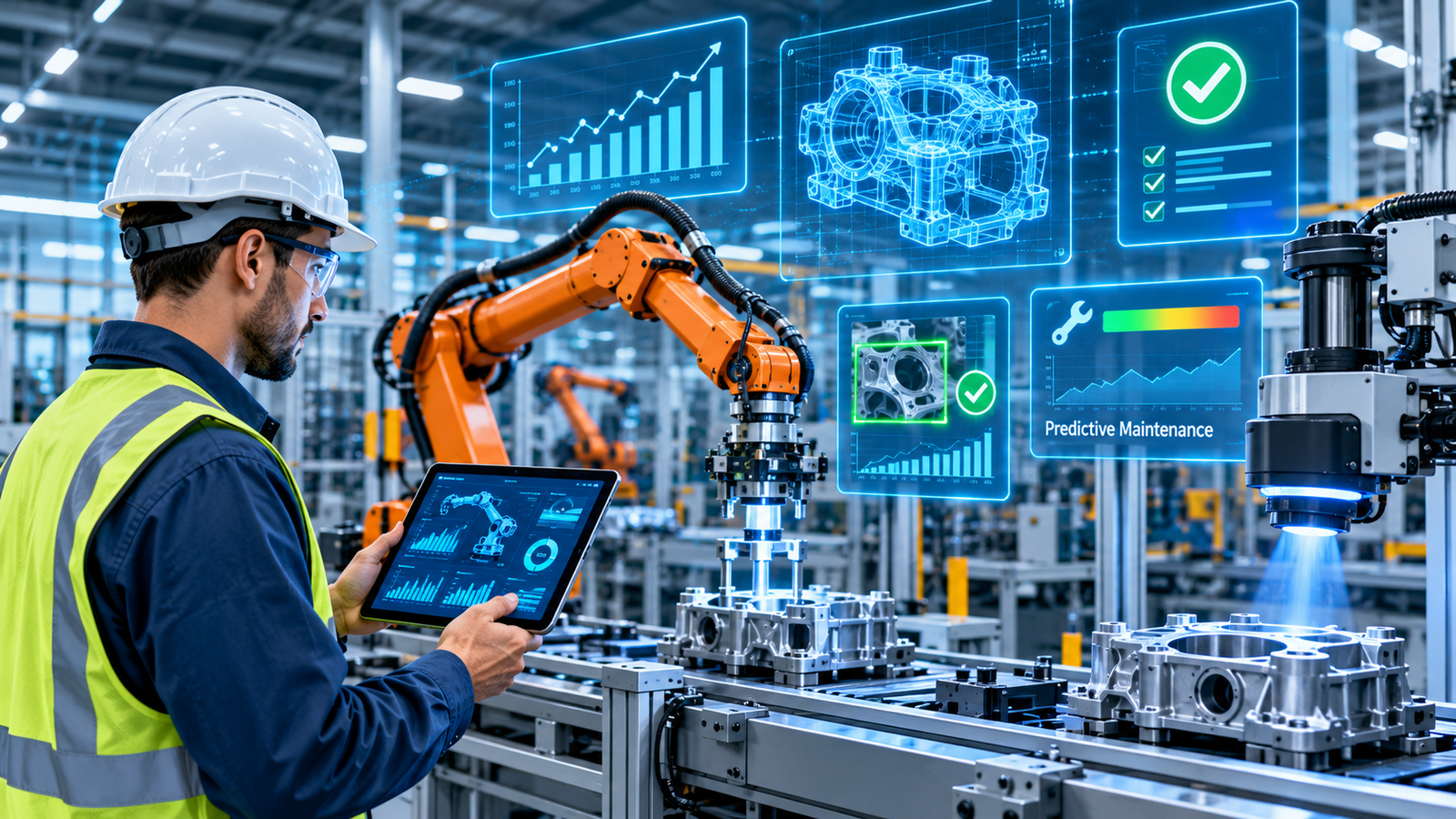

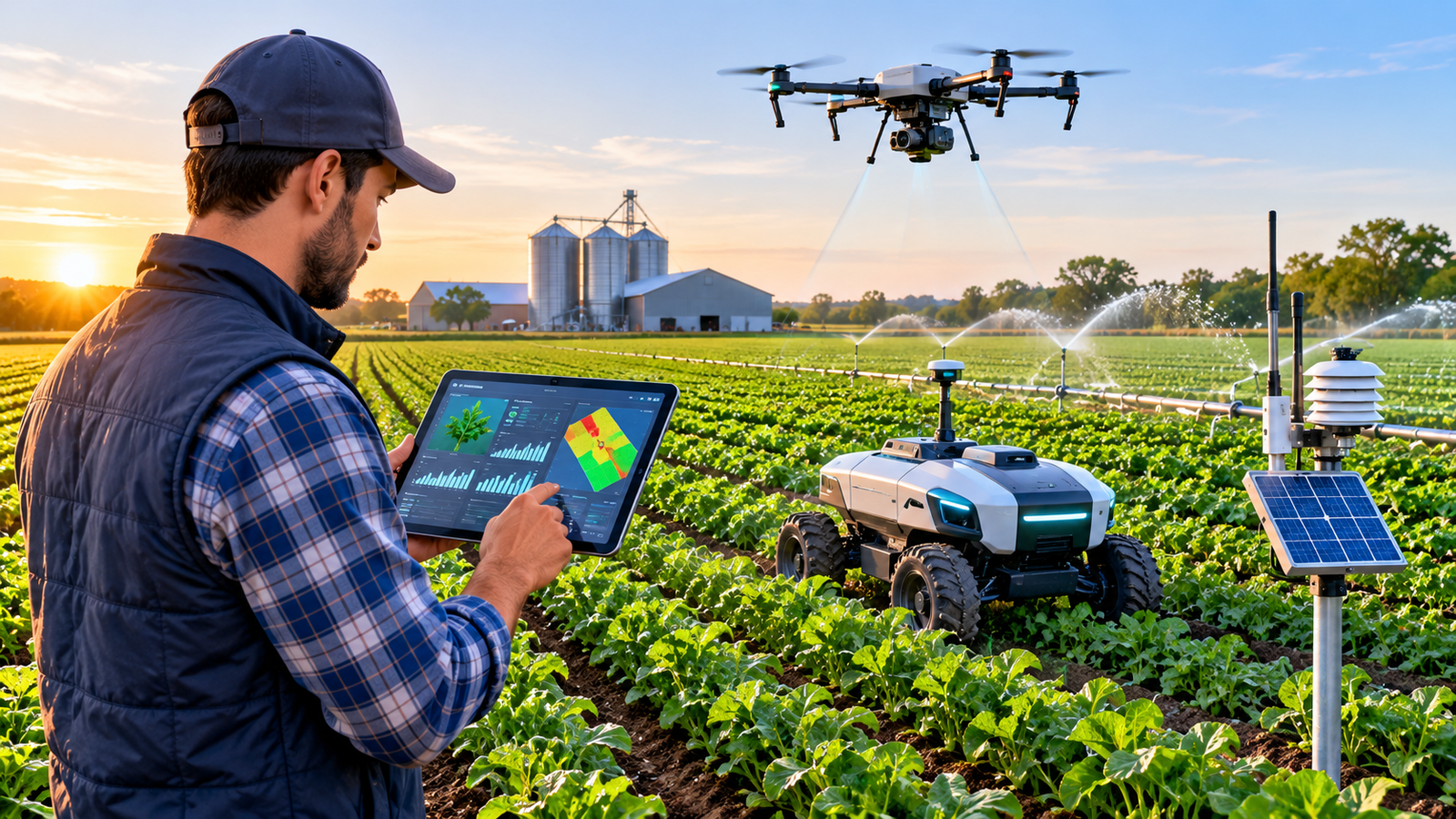
AI in agriculture is moving from isolated crop-recognition experiments toward connected systems that combine field sensors, satellite imagery, weather data, farm machinery and decision-support software. In 2026, these tools are helping farmers monitor crop health, plan irrigation, identify pests, estimate yields and manage inputs with greater precision. Drones, smart equipment and agricultural robots are extending those capabilities from analysis into field operations.
The opportunity is important, but AI is not a substitute for agronomic knowledge or good farm management. Recommendations depend on reliable data, local conditions and the ability to act on them. A model trained on one crop, soil type or climate may perform poorly elsewhere. The strongest projects combine technology with local expertise, field validation and a clear measure of economic or environmental value.
What is AI in agriculture?
AI in agriculture refers to the use of machine learning, computer vision, remote sensing, predictive analytics, generative AI and autonomous systems across crop production and farm management. These technologies process information from sources such as soil probes, weather stations, farm machinery, satellite images, drones, cameras and historical records.
Some tools identify patterns or make predictions. Others provide recommendations, generate reports or control connected equipment. For example, a crop-monitoring model might flag a section of a field with unusual plant stress. A decision-support system can combine that signal with soil moisture and weather forecasts to suggest an inspection or irrigation adjustment. More advanced systems may coordinate several steps, but important decisions still need oversight and a way to verify the result.
How AI is used in agriculture in 2026
1. Precision farming and field-level decisions
Precision agriculture uses information about where and when field conditions vary to guide farm operations. AI can combine satellite or drone imagery, soil maps, crop history, weather and equipment data to identify differences within a field. Instead of treating every hectare as identical, a farmer can investigate specific zones and adjust planting, fertilizer or irrigation decisions where the evidence supports it.
Variable-rate machinery can apply different amounts of seed, fertilizer or other inputs across mapped areas. The value depends on the quality of the underlying maps, calibration of equipment and whether the crop responds as expected. A prescription map should be checked against field observations rather than followed blindly.
2. Smart irrigation and water management
AI-supported irrigation systems combine soil-moisture sensors, weather forecasts, crop stage, evapotranspiration estimates and irrigation history to help determine when and how much to water. This can reduce unnecessary irrigation, support more consistent crop conditions and help farmers respond to heat or changing rainfall.
Water recommendations are highly local. Soil texture, rooting depth, crop variety, slope, irrigation method and sensor placement all affect the result. A sensor reading from one location may not represent an entire field. Farmers should compare model recommendations with field checks and use local agronomic guidance, especially when water stress could damage a high-value crop.
3. Pest, weed and crop-disease detection
Computer vision models can inspect leaf, fruit and canopy images for visual signs associated with disease, pest damage, nutrient deficiency or weed pressure. Images may come from a smartphone, field camera, drone or robot. Earlier identification can help farmers investigate a problem before it spreads, although a model’s prediction is not always a confirmed diagnosis.
Targeted spraying systems can combine cameras and AI to distinguish crop plants from weeds or identify specific treatment zones. This may reduce blanket application in suitable settings. Before acting, farmers should confirm the identification, follow product labels and local regulations, and consider beneficial organisms, resistance management and worker safety.
4. Soil health and nutrient management
AI models can combine soil tests, field history, topography, weather and crop observations to support nutrient planning and identify areas that may need closer examination. They can help organize sampling plans, estimate nutrient demand and compare management scenarios. Remote sensing can indicate crop stress, but it does not directly replace laboratory soil analysis.
Good nutrient management requires an understanding of soil chemistry, crop requirements, timing and local environmental conditions. Models should support appropriate testing and agronomic advice rather than encourage fertilizer application based on an unexplained score.
5. Yield forecasting and harvest planning
Yield prediction systems use historical production, crop variety, planting dates, weather, soil conditions, remote sensing and in-season observations to estimate likely output. These estimates can help farmers plan labor, storage, transport, contracts and market decisions.
Forecasts should be updated as the season develops and presented with uncertainty ranges where possible. A single number can create false confidence, particularly when weather events, disease outbreaks or market disruptions change the outlook. Farmers should understand which data influenced the estimate and how often it is refreshed.
6. Drones, satellites and remote sensing
Satellite imagery provides broad, repeated views of vegetation and land conditions. Drones can collect higher-resolution images over selected fields and may carry RGB, multispectral or thermal sensors. AI helps process these images to map crop variability, identify potential stress and prioritize areas for ground inspection.
Remote sensing is most useful when it leads to a practical decision. A vegetation index can highlight a change, but it may not explain whether the cause is water stress, disease, soil variation or another factor. Ground-truthing—checking representative locations in the field—is essential before expensive or irreversible action.
7. Agricultural robots and autonomous machinery
Robotic platforms can support crop scouting, mechanical weeding, targeted spraying, planting, sampling and selected harvesting tasks. AI helps machines interpret camera and sensor input, navigate rows, identify objects and adapt to changing field conditions. Smaller electric robots may be suitable for particular high-value crops or operations where precise, repeated work matters.
Autonomous field systems still face uneven terrain, dust, rain, changing light, obstacles, connectivity gaps, maintenance and safety requirements. A robot that works in a demonstration plot may not deliver the same reliability across a full season. Farmers should evaluate total ownership cost, service support, spare parts, operator training and the cost of downtime—not just the advertised level of autonomy.
8. Greenhouses and controlled-environment agriculture
Greenhouses and indoor farms can provide relatively structured environments for AI-supported control. Sensors monitor temperature, humidity, light, carbon dioxide, nutrient solution and other variables. Models can help predict plant growth, identify stress and adjust ventilation, lighting or irrigation within configured limits.
Because energy, equipment and maintenance costs can be high, operators need to measure whether automated control improves yield, quality or resource efficiency enough to justify the investment. Models also need to account for crop variety, growth stage and the specific design of the facility.
9. Livestock health and welfare monitoring
AI can analyse information from cameras, microphones, wearables and environmental sensors to help identify changes in animal movement, feeding, temperature or behavior. These signals may help farmers decide which animals need inspection and improve monitoring across larger herds.
Automated alerts should not replace veterinary assessment. Sensor performance, animal identification, false alarms, welfare standards and data security all matter. A system should make it easier to notice potential problems and act promptly, not create an excuse to reduce direct observation and care.
10. Farm planning assistants and agentic AI
Generative AI assistants can help farmers search technical guidance, summarize records, translate information, draft reports and interpret equipment documentation. Agriculture-focused agents are an emerging area: they may gather weather information, query farm records, compare crop-management options and coordinate tasks across connected tools.
A recent review in npj Sustainable Agriculture describes agentic AI applications spanning crop-management decisions, agricultural robotics, breeding and research. The field is promising, but robustness, interoperability, data governance and trust remain open challenges. An assistant should make the source of its advice visible and distinguish established agronomic recommendations from uncertain suggestions.
What recent 2026 research says
Research published in 2026 shows progress toward integrated agricultural AI, while also emphasizing the gap between laboratory performance and dependable farm deployment. The findings below cover different research designs and should not be treated as directly comparable adoption statistics.
| Research | What it found or examined | Why it matters |
|---|---|---|
| UN Scientific Advisory Board brief, November 2026 | Reviews AI across agricultural planning, resource use, crop and livestock monitoring, breeding and agrifood systems. It notes that evidence of scaled productivity and sustainability gains, especially for smallholders, remains limited. | Promising use cases need field evidence and equitable access. |
| npj Sustainable Agriculture, 5 November 2026 | Reviews emerging agentic AI in agriculture, including crop decisions, robotics, phenomics and breeding, while identifying interoperability, robustness and governance challenges. | Farm AI is beginning to move from prediction toward coordinated workflows. |
| Systematic review of 95 studies, published August 2026 | Finds strong research activity in environmental monitoring, protected cultivation, pest and disease detection, and sensor-based systems. It highlights limited external validation and real-world scaling. | High reported model accuracy does not automatically prove reliable farm performance. |
| Nature Communications, 2 November 2026 | Assesses the economics and environmental impacts of battery-powered agricultural robots across selected crops and operating scenarios. | Robot value depends heavily on the tasks performed and reductions in variable inputs and labor. |
The broader outlook also matters. The OECD-FAO Agricultural Outlook 2026-2035 emphasizes productivity, market uncertainty and climate-related pressures on agricultural systems. AI can contribute to productivity, but technology alone cannot remove the effects of weather volatility, input costs, trade disruption or unequal access to infrastructure.
Benefits of AI in agriculture
- More precise resource use: better-informed irrigation, nutrient and crop-protection decisions can reduce unnecessary inputs in suitable conditions.
- Earlier warning: image and sensor analysis can help identify crop stress, pests or disease for timely inspection.
- Improved planning: forecasts can support planting, labor, storage, harvest and logistics decisions.
- Less repetitive monitoring: drones, cameras and connected equipment can help cover large areas more consistently.
- Operational support: assistants can make technical information and farm records easier to search and summarize.
- Potential resilience gains: combining local observations with weather and crop data may help farmers compare responses to changing conditions.
Challenges and risks farmers should consider
Data quality and model generalization
Farm data is often incomplete, inconsistent or collected with different devices and methods. Crop images vary with lighting, camera angle, growth stage and local conditions. A model trained on one region may not work well with another crop variety or climate. Validate systems locally and keep a way to report incorrect recommendations.
Cost, connectivity and maintenance
Sensors, drones, robots, software subscriptions and connectivity can create costs beyond the initial purchase. Remote farms may have unreliable mobile coverage or limited access to technicians. Compare total cost of ownership, including installation, training, repairs, data charges, batteries and replacement parts.
Farmer data ownership and privacy
Farm platforms may collect field boundaries, yields, input use, machinery activity, financial information and operational schedules. Farmers should understand who can access the data, whether it is shared with third parties, how long it is retained and whether it can be exported or deleted. Contract terms should make data rights and portability clear.
Safety and accountability
Autonomous machinery and automated spraying can affect workers, animals, neighboring properties and the environment. Define safe operating zones, emergency stops, supervision requirements and maintenance procedures. The farm operator and equipment provider should understand who is responsible when a system makes an unsafe recommendation or takes an unexpected action.
Digital skills and unequal access
Small farms may have limited budgets, technical support or time to manage complex systems. Tools designed for large commercial operations may not fit small plots, mixed crops or local languages. Practical training, simple interfaces, offline capability, cooperative services and affordable equipment can make adoption more inclusive.
How small and medium-sized farms can start using AI
A farm does not need to purchase autonomous machinery to benefit from AI. Start with one recurring decision that is difficult, costly or time-consuming, then test whether better information changes the outcome.
- Choose one practical problem. Examples include irrigation timing, disease scouting, yield estimation or record keeping.
- Establish a baseline. Record current water use, input costs, crop losses, labor time or forecast accuracy before testing a new tool.
- Check local suitability. Confirm that the tool supports your crop, language, region, farm size, connectivity and equipment.
- Start with accessible data. Use existing weather information, field records, soil tests or smartphone images before investing in a large sensor network.
- Run a limited trial. Compare an AI-supported plot or workflow with normal practice where it is safe and practical to do so.
- Verify recommendations. Check model output with field observations and qualified local agronomic advice.
- Calculate the full economics. Include hardware, software, maintenance, training, labor and the value of any measurable improvement.
- Protect farm data. Review privacy terms, user permissions, data export options and vendor access before connecting operational systems.
- Expand only when results justify it. Keep records of what worked, where the system failed and what conditions affect its reliability.
How to measure whether agricultural AI is working
Measure outcomes that matter to the farm, not just the number of images analysed or alerts generated. Useful indicators include yield per hectare, water productivity, fertilizer use per unit of output, pesticide use, crop loss, labor hours, machinery downtime, forecast error, quality grade and net operating margin.
Environmental measures should be considered alongside financial outcomes. A system may reduce water use but increase energy consumption, or improve yield while increasing total input use. Evaluate the full production system and compare results over a meaningful period, accounting for weather and differences between fields or seasons.
The future of AI in agriculture
Future agricultural systems are likely to combine multimodal foundation models, field sensors, satellite data, digital twins, edge AI and more capable robots. Instead of using separate tools for every task, farmers may increasingly interact with integrated systems that connect crop observations, weather forecasts, machinery and farm records.
Agentic AI could help coordinate multi-step activities, such as identifying a field anomaly, retrieving relevant crop guidance, proposing an inspection route and preparing a work order. But safe deployment requires permissions, reliable data, clear explanations and human approval for actions that could affect crops, people or the environment.
The most useful advances will be those that work outside controlled demonstrations. That means models validated across crops and regions, affordable tools for smaller farms, local-language support, dependable maintenance and evidence that benefits persist across seasons. AI can become an important part of modern agriculture when it strengthens—not replaces—the knowledge and decisions of farmers.
Frequently asked questions
What is AI in agriculture?
AI in agriculture uses machine learning, computer vision, sensors, remote sensing and automation to support crop monitoring, irrigation, pest detection, yield forecasting, farm planning and selected machinery operations.
How does AI help farmers?
AI can help farmers identify crop stress, plan water and nutrient use, estimate yields, monitor livestock and organize field operations. Its value depends on local accuracy, usable recommendations and measurable improvements in farm outcomes.
Can AI reduce water use in farming?
AI-supported irrigation can combine soil moisture, crop stage and weather data to guide watering decisions. It may reduce unnecessary irrigation in suitable systems, but sensors must be placed correctly and recommendations checked against local soil and crop conditions.
Can small farmers afford AI technology?
Some tools, such as smartphone-based crop information, weather services and basic planning assistants, may be accessible without major equipment purchases. More advanced sensors, drones and robots require a careful cost-benefit assessment. Shared services and cooperatives may help spread costs.
Are agricultural robots widely used?
Robots are being tested and deployed for selected tasks such as scouting, weeding, spraying and harvesting. Adoption varies by crop, region and farm economics. Reliability, maintenance, safety and total ownership cost remain important barriers to broader use.
What are the main risks of AI in agriculture?
Risks include inaccurate predictions, poor performance across different environments, high costs, weak connectivity, data ownership concerns and unsafe automation. Farmers should validate tools locally, protect operational data and keep human oversight for important decisions.
Will AI replace farmers?
AI is more likely to support and automate selected tasks than replace the experience and judgement needed to run a farm. Farmers remain responsible for interpreting local conditions, managing people and equipment, and deciding how to respond to changing circumstances.
Sources and further reading
- UN Scientific Advisory Board: AI Integration in Agrifood Systems (November 2026)
- npj Sustainable Agriculture: Agentic AI in Transforming Agriculture (5 November 2026)
- Artificial Intelligence in Modern Agriculture: A Systematic Review (2026)
- Nature Communications: Techno-Economic and Environmental Assessment of Battery-Powered Farming Robots (2 November 2026)
- OECD-FAO Agricultural Outlook 2026-2035
- IFPRI: Global Agrifood Systems Outlook to 2050 (September 2026)
- Systematic Literature Review of AI and IoT-Enabled Crop Farming (2026)