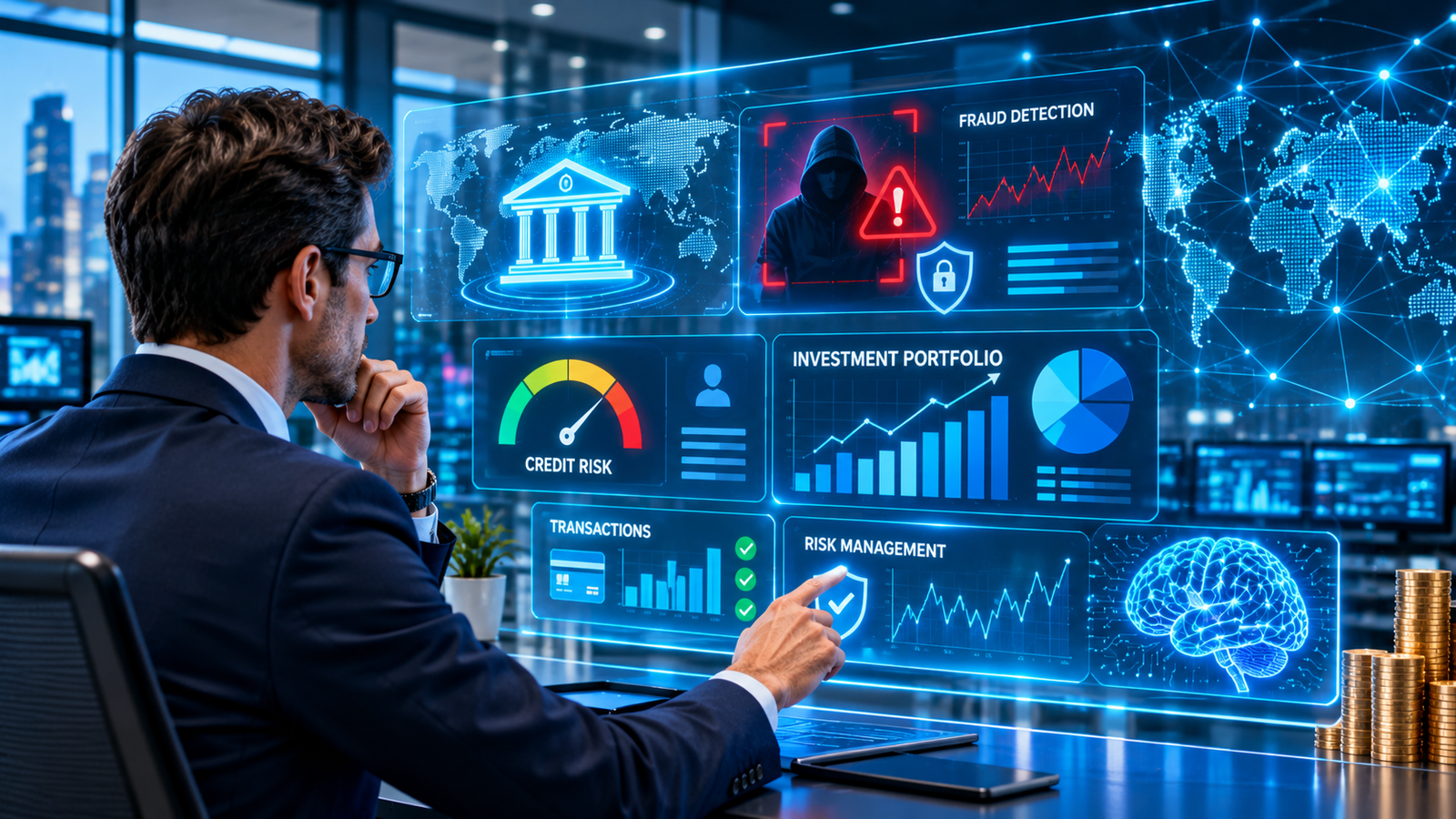

AI in cybersecurity is changing how organizations detect threats, investigate incidents and protect digital systems. Security teams use machine learning to identify suspicious activity, generative AI to summarize alerts and threat intelligence, and automation to help coordinate response. Attackers are also using AI to create more convincing social engineering, accelerate reconnaissance and target the AI systems businesses are adopting.

The important shift is not that every cyberattack has become fully autonomous. Rather, AI can make familiar tactics faster, more scalable and easier to tailor. It can also help defenders process more security signals, prioritize risk and reduce repetitive work. The result is an environment where reliable identity controls, good telemetry, human judgement and tested response processes matter more than ever.
What is AI in cybersecurity?
AI in cybersecurity is the use of machine learning, statistical models, natural language processing, generative AI and automated agents to support the protection of networks, endpoints, applications, identities, data and cloud environments. These systems can classify events, detect unusual patterns, summarize evidence, recommend actions and, within carefully defined limits, carry out defensive tasks.
There are three connected dimensions. First, organizations must secure the AI systems they build or adopt. Second, they can use AI to strengthen cyber defense. Third, they must prepare for attackers who use AI to improve phishing, impersonation, vulnerability research and other malicious activity. NIST’s Cyber AI Profile organizes its work around these related areas: secure AI systems, defend with AI and thwart AI-enabled attacks.
How AI is changing cyber threats in 2026
Recent threat research points to an acceleration of existing attack methods rather than a complete replacement of them. Microsoft’s 2026 Digital Defense Report describes AI as both a force multiplier for attackers and a new target that organizations must protect. Google’s Threat Intelligence Group has also documented adversaries moving from basic prompting toward more automated, agent-assisted workflows.
AI-generated phishing and social engineering
Generative AI can help criminals produce fluent messages, translate them, tailor them to a job role and imitate the tone of a trusted organization. This makes poorly written messages less useful as a warning sign. Attackers can also use publicly available information to personalize requests and create believable business email compromise or supplier impersonation attempts.
Defenses should therefore focus on verifying requests, not simply judging how an email reads. Confirm payment changes through a known, independent contact channel. Use phishing-resistant multifactor authentication where possible, protect email accounts and train staff to report unusual requests even when the wording looks authentic.
Voice and video deepfake impersonation
Synthetic audio and video can make a fraudulent call appear to come from an executive, colleague, supplier or family member. A convincing voice is not proof of identity. High-risk actions—such as transferring funds, sharing credentials, changing bank details or approving sensitive access—should require an established verification process that does not rely on the same call or message that made the request.
Faster reconnaissance and vulnerability exploitation
AI tools can help attackers research exposed systems, understand software, write scripts and organize information about potential weaknesses. This may reduce the time needed for some stages of an intrusion. Google Threat Intelligence reported in 2026 that it had observed an AI-assisted campaign progressing from cloud compromise to an agent-enabled credential-harvesting operation in under six hours. The practical lesson is to shorten exposure windows through asset visibility, patch prioritization and continuous monitoring.
AI-assisted malware development and evasion
AI can assist with code explanation, debugging and testing, including in malicious workflows. Government Accountability Office reporting in November 2026 described cases where AI was used to improve the reach or precision of cyberattacks, including a reported malware-testing framework designed to refine evasion techniques. This does not mean that every malware family is independently reasoning or that AI makes traditional defenses obsolete. Endpoint protection, application control, secure configuration and behavior monitoring remain important.
Attacks against AI systems and data
AI applications introduce assets that need protection: prompts, model endpoints, training and retrieval data, vector databases, plugins, extensions, credentials, model files and connected tools. Attackers may try to extract sensitive information, manipulate outputs, poison data sources or exploit weak integrations. A company can therefore face both AI-enabled attacks against its conventional systems and attacks that target the AI services themselves.
How defenders use AI in cybersecurity
1. Threat detection and anomaly analysis
Machine-learning systems can compare activity with normal patterns across endpoints, networks, cloud services and user accounts. They may identify unusual login locations, abnormal data transfers, unexpected process behavior or suspicious access sequences. These signals help analysts find activity that rule-based detection might miss, but an anomaly is not automatically an attack. Context and investigation remain essential.
2. Security operations center (SOC) triage
Security teams often receive more alerts than they can investigate immediately. AI assistants can group related events, summarize alert histories, explain why a detection fired and retrieve relevant internal procedures. This can reduce repetitive reading and help analysts focus on the highest-risk incidents.
Good triage tools show the evidence behind a recommendation, preserve links to original logs and clearly communicate uncertainty. Analysts should be able to inspect the underlying events rather than accept a generated summary as the complete record.
3. Malware and suspicious-file analysis
AI can help classify files, compare behavior patterns, summarize sandbox results and connect indicators across incidents. It can also assist analysts in understanding unfamiliar code or scripts. Defensive analysis should take place in controlled environments, with clear separation between untrusted samples and production systems.
4. Vulnerability prioritization and exposure management
Organizations often have long lists of software vulnerabilities. AI-supported tools can help correlate vulnerability information with asset importance, internet exposure, known exploitation activity and compensating controls. This helps teams prioritize remediation based on likely business impact instead of relying only on a severity score.
AI should support, not replace, a defensible patching process. Confirm asset ownership, validate findings, test fixes and document exceptions. A model that misidentifies a critical server or overlooks an exposed system can create a false sense of security.
5. Incident response and investigation
During an incident, AI can help assemble timelines, summarize endpoint and identity events, search documentation and draft reports. It may recommend containment steps based on an approved playbook. High-impact actions—disabling accounts, isolating business-critical servers, deleting files or changing firewall rules—should require explicit authorization and a tested rollback path.
6. Identity and access protection
AI can detect unusual account behavior, identify risky access patterns and help teams review large numbers of permissions. However, identity remains a foundational control plane. Use phishing-resistant MFA or passkeys, remove unnecessary privileges, protect administrator accounts and manage machine identities, service accounts and AI agents with the same discipline as human users.
7. Security awareness and fraud prevention
AI can help create realistic training scenarios, identify suspicious communication patterns and support fraud investigations. Training should teach employees to verify unusual requests, use reporting channels and follow approval procedures. It should not depend on spotting awkward grammar or obvious visual errors in synthetic media.
AI cybersecurity tools and technology categories
Organizations do not necessarily need a separate AI security product for every task. Many established security platforms already incorporate machine learning or generative AI features. The right choice depends on existing systems, data access, staff skills, regulatory requirements and the security problem being solved.
| Technology category | Typical AI role | What to evaluate |
|---|---|---|
| Endpoint detection and response (EDR/XDR) | Behavior analysis, suspicious process detection and investigation summaries | Endpoint coverage, telemetry quality, false positives and response controls |
| Security information and event management (SIEM) | Alert correlation, query assistance and event summarization | Log coverage, retention, integrations and evidence traceability |
| Identity threat detection | Unusual login, privilege and account activity detection | Identity coverage, MFA integration and response safeguards |
| Cloud security platforms | Misconfiguration discovery, exposure analysis and workload monitoring | Cloud coverage, asset context and remediation workflow |
| Email security | Phishing classification, impersonation signals and malicious-link detection | Detection quality, business email compromise controls and reporting |
| Threat intelligence tools | Entity extraction, campaign correlation and research summarization | Source quality, freshness and analyst verification |
| AI security gateways | Prompt filtering, data-loss controls and model-use monitoring | Coverage across AI applications, policy accuracy and privacy |
What 2026 cybersecurity research is showing
Several 2026 reports illustrate why organizations need to address both sides of AI security. Survey results reflect the respondents and methods of each publisher; they should not be treated as universal measurements of every organization.
| Source | Reported finding | Practical implication |
|---|---|---|
| SANS 2026 AI in Cybersecurity | 78% of surveyed organizations reported confirmed or suspected AI-enabled attacks in the prior year; 63% of practitioners reported shortcomings in AI threat detection and response. | Adoption is rising, but validation and governance need to keep pace. |
| Microsoft Digital Defense Report 2026 | Highlights AI as a force multiplier for attacks and a target in its own right, with identity and trusted access remaining central to defense. | Secure identities, AI assets and the data connected to them. |
| Google Cloud / Mandiant AI Risk and Resilience 2026 | Describes adversarial use of agentic workflows, indirect prompt injection and AI supply-chain risks. | Monitor agent behavior, tool access and dependencies. |
| U.S. Government Accountability Office, Nov. 20, 2026 | Concludes that AI can magnify attack speed and precision while creating challenges for testing and safe adoption of defensive tools. | Evaluate AI security products in controlled environments and establish governance. |
Risks of using AI for cybersecurity
False positives and missed threats
Detection models can flag legitimate activity or fail to identify a new attack. If analysts become overwhelmed by inaccurate alerts, they may ignore important warnings. Measure precision, recall, false-positive rates and missed incidents, and test performance against realistic data before relying on a system.
Hallucinations and misleading summaries
Generative AI may invent details, misread log fields or confidently summarize incomplete evidence. Treat generated explanations as hypotheses. Require source references, preserve original telemetry and make it easy for analysts to verify claims.
Prompt injection and unsafe tool use
AI assistants may process untrusted emails, documents, web pages or tickets that contain malicious instructions. If the assistant can also access sensitive data or execute tools, manipulated content may influence its actions. Separate untrusted content from system instructions, restrict tool permissions, validate inputs and require human approval for sensitive operations. This is especially important for agentic systems.
Sensitive data exposure
Security investigations can contain credentials, customer records, source code, network diagrams and incident details. Sending this material to an unapproved AI service may create a data-protection incident. Define approved tools, configure retention and training settings appropriately, redact secrets and apply data-loss prevention controls.
Model and software supply-chain risk
AI applications rely on models, libraries, plugins, data sources, extensions and cloud services. A compromised dependency or malicious extension can undermine an otherwise trusted system. Maintain an inventory of components, verify provenance, monitor updates, scan dependencies and limit access to production environments.
Over-automation and unclear accountability
Automated containment can disrupt critical operations if a model misclassifies an event. Define which actions may run automatically, which require approval and which are prohibited. Assign a named owner to each workflow and keep an auditable record of recommendations, decisions and actions.
A practical roadmap for adopting AI in cybersecurity
- Identify a specific security problem. Start with alert triage, phishing analysis, vulnerability prioritization or investigation summaries—not an ambition to automate the entire SOC.
- Map data and access. Identify which logs, identities, endpoints, cloud services and sensitive records the AI system can reach.
- Set measurable baselines. Record current mean time to detect, mean time to respond, alert volume, false positives, investigation effort and coverage gaps.
- Choose a controlled pilot. Use a limited environment, approved data and a defined set of tasks. Begin in read-only or recommendation mode.
- Test with realistic scenarios. Evaluate normal activity, known attacks, unusual edge cases, prompt injection attempts and incomplete evidence.
- Apply least privilege. Give AI assistants and agents only the data and tools required for their task. Separate test and production credentials.
- Define human approval points. Require authorization for account disablement, data deletion, external communications, firewall changes and other high-impact actions.
- Monitor performance continuously. Track drift, false positives, missed threats, unexpected tool calls, data access and user feedback.
- Document and improve. Keep playbooks, owners, escalation paths, audit logs and rollback procedures current as the system and threat landscape change.
How to measure AI cybersecurity performance
Security teams should measure outcomes rather than counting AI-generated summaries or automated actions. Useful indicators include mean time to detect, mean time to respond, time to contain, percentage of high-risk assets covered, vulnerability exposure time, phishing-report rates, alert precision, analyst hours saved and the number of incidents involving unauthorized AI access.
Measure operational safety as well. Track false containment actions, incorrect recommendations, policy violations, data exposure events and the proportion of AI-generated findings that analysts can verify. A system that responds quickly but creates business outages or misses important threats is not a successful security investment.
The future of AI in cybersecurity
AI will likely become more deeply integrated into security operations, software development and identity management. Agents may help correlate incidents across systems, investigate routine alerts and coordinate approved playbooks. Attackers will continue to experiment with AI for social engineering, research and automation, while defenders improve detection and response.
The most important capability will be controlled speed. Organizations need to detect and respond quickly without allowing automated systems to exceed their authority. That requires reliable identity, strong data governance, clear policies, continuous testing and people who understand both the technology and the business consequences of security decisions.
AI does not replace the fundamentals of cybersecurity. Secure configuration, timely patching, backups, least privilege, multifactor authentication, network segmentation, incident response planning and employee awareness remain essential. AI can make these practices more effective when it is integrated carefully and measured honestly.
Frequently asked questions
What is AI in cybersecurity?
AI in cybersecurity uses machine learning, generative AI and automation to detect threats, analyze security data, prioritize vulnerabilities and support incident response. It also includes protecting AI systems and defending against attacks that use AI.
How is AI used to detect cyberattacks?
AI models analyze activity across endpoints, networks, cloud platforms and identities to identify unusual patterns. They can correlate alerts and help analysts investigate suspicious behavior, but findings need validation against original evidence.
Are cybercriminals using AI?
Yes. Research published in 2026 describes AI being used to improve phishing and impersonation, assist reconnaissance and support more automated attack workflows. The extent and sophistication vary; many incidents still rely on familiar weaknesses such as stolen credentials and unpatched systems.
Can AI replace cybersecurity analysts?
No. AI can automate selected repetitive tasks and help analysts process information, but human expertise remains important for context, risk decisions, incident coordination and accountability. Poorly governed automation can create additional risk.
What are the biggest risks of AI cybersecurity tools?
Key risks include inaccurate alerts, hallucinated analysis, prompt injection, sensitive-data exposure, compromised dependencies, excessive permissions and unsafe automated actions. Testing, least privilege, human approval and auditability help manage these risks.
How can a small business use AI for cybersecurity?
A small business can start with AI features already included in reputable email, endpoint and identity security products. Enable multifactor authentication, maintain backups, update software, train staff to verify unusual requests and use approved tools that do not expose confidential data.
What is the difference between AI security and AI in cybersecurity?
AI security focuses on protecting AI models, data, applications and connected tools from misuse or attack. AI in cybersecurity is broader: it includes using AI to defend traditional IT systems, protecting AI systems themselves and preparing for AI-enabled threats.
Sources and further reading
- Microsoft: Digital Defense Report 2026
- SANS Institute: 2026 AI in Cybersecurity Research
- Google Cloud / Mandiant: AI Risk and Resilience in 2026
- Google Threat Intelligence Group: From Prompting to Autonomy (September 2026)
- U.S. Government Accountability Office: AI and Cybersecurity (November 20, 2026)
- NIST: Cybersecurity Framework Profile for Artificial Intelligence (Cyber AI Profile)
- NIST IR 8607: Cyber AI Profile Workshop Summary Report (August 2026)
- CrowdStrike: 2026 Threat Hunting Report