
AI in retail is moving beyond product recommendations and customer-service chatbots. In 2026, retailers are using artificial intelligence to improve product discovery, forecast demand, reduce fraud, support store teams and connect online and physical shopping. At the same time, AI shopping assistants are beginning to influence how consumers compare products and decide where to buy.
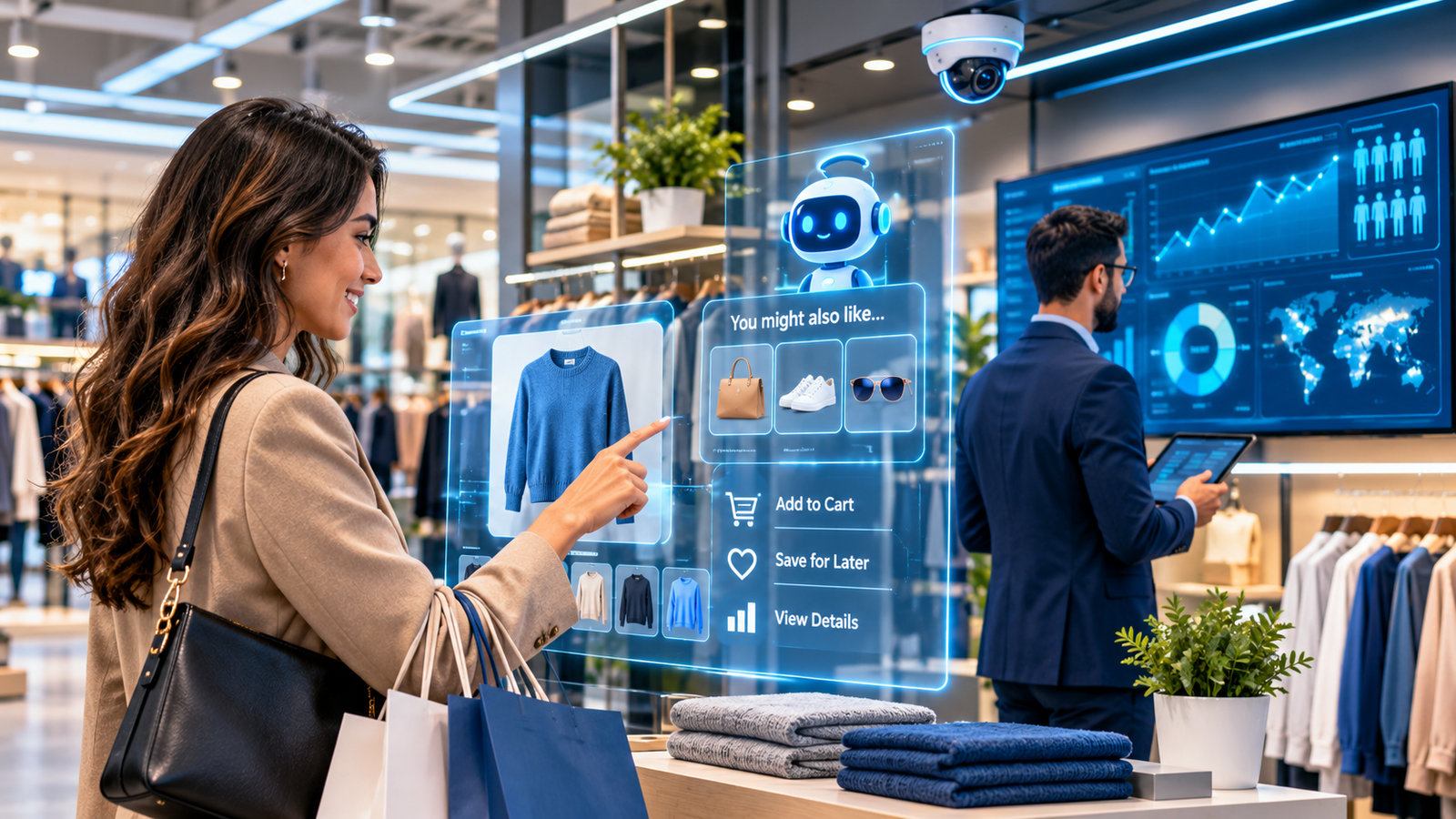
The opportunity is not simply to add AI to every customer interaction. Retailers need to identify where better predictions, faster decisions or more useful assistance create measurable value. They also need accurate product data, secure systems and transparent practices that preserve customer trust.
What is AI in retail?
AI in retail refers to the use of machine learning, computer vision, natural language processing, generative AI and increasingly agentic systems across merchandising, ecommerce, stores, supply chains and customer service. These technologies analyse large volumes of information, identify patterns, generate content or recommendations, and help people make operational decisions.
Traditional retail analytics often describes what happened: which products sold, which stores missed targets or how much stock remains. Predictive AI estimates what may happen next, such as future demand or the likelihood of a stockout. Generative AI can create product descriptions or answer questions, while AI agents can coordinate multi-step tasks under defined permissions.
How retailers are using AI in 2026
1. Personalized recommendations and product discovery
Recommendation systems use signals such as product views, searches, purchase history, preferences and context to rank products that may be relevant to a shopper. Retailers apply them to homepages, search results, product pages, email campaigns and in-store digital experiences.
Generative AI adds conversational discovery. A customer might describe a need in ordinary language—such as a lightweight laptop for university, a gift under a set budget or an outfit for a particular occasion—and receive a shortlist with explanations. The system is more useful when it can retrieve accurate, current product attributes, availability, delivery details and return policies rather than inventing answers.
2. AI shopping assistants and agentic commerce
Shopping assistants help customers research products, compare specifications, interpret reviews and find deals. More advanced agents may perform several steps, such as checking stock, comparing options, building a basket or arranging a reorder. These capabilities are developing, and retailers should distinguish between an assistant that recommends an action and an agent that is authorised to take it.
The National Retail Federation’s January 2026 consumer study with IBM found that 41% of surveyed consumers used AI assistants to research products, 33% to look for reviews and 31% to search for deals. The same study highlighted privacy concerns: 83% of consumers reported overlapping concerns about privacy, misuse or unwanted marketing. These findings suggest that AI can influence discovery, but trust and control remain essential.
3. Demand forecasting and inventory management
Forecasting models combine historical sales with factors such as seasonality, promotions, local events, weather, pricing and supply constraints. Better forecasts can help retailers decide how much stock to order, where to position it and when to replenish shelves.
AI can also flag unusual demand patterns, identify products at risk of selling out and help planners compare possible scenarios. Forecasts are not guarantees: sudden trends, incomplete data, supplier delays and major events can still produce errors. Human review and clear exception handling are important, especially for high-value or perishable inventory.
4. Dynamic pricing and promotion planning
Pricing systems can analyse demand, inventory, competitor signals, product lifecycle and promotion performance to recommend price changes or campaign adjustments. Used carefully, this can help retailers reduce excess stock and improve the relevance of promotions.
However, automated pricing can create customer backlash if it appears unfair, discriminatory or unpredictable. Retailers should define pricing rules, test for unintended outcomes, comply with local competition and consumer-protection laws, and retain approval controls for sensitive changes.
5. Customer service and employee assistance
AI assistants can answer routine questions about order status, store hours, product specifications, delivery and returns. When connected to approved systems, they can retrieve order information or help staff locate policies. Generative AI can also summarise customer conversations and draft responses for an employee to review.
The best service design makes escalation easy. A chatbot should recognise uncertainty, avoid making promises it cannot fulfil and transfer complex or emotionally sensitive cases to a person with the conversation context intact.
6. Computer vision and smarter physical stores
Computer vision can help analyse shelf availability, detect misplaced products, monitor queues and identify operational exceptions. Store analytics may combine camera-derived counts with point-of-sale and inventory data to understand traffic patterns and improve staffing or layout decisions.
These systems require careful privacy design. Retailers should assess whether a use case can be achieved with aggregated counts or less intrusive sensors, provide appropriate notices, limit retention and access, and follow applicable surveillance and data-protection rules. Facial recognition and identification create additional risks and should never be treated as a routine extension of basic store analytics.
7. Fraud detection, payments and loss prevention
Machine-learning models can identify suspicious payment patterns, account takeovers, unusual returns and potentially fraudulent transactions. They can score risk in real time and route uncertain cases for additional checks. The objective is to reduce losses without blocking legitimate customers.
False positives matter: a customer incorrectly flagged may abandon a purchase or lose access to an account. Retailers should monitor model performance across customer groups, provide review and appeal routes where appropriate, and avoid relying on a single opaque score for consequential decisions.
8. Supply chain and logistics optimization
AI can support supplier-risk monitoring, warehouse slotting, route planning, shipment visibility and replenishment decisions. Predictive systems help teams anticipate delays or shortages, while optimization models compare delivery routes and resource constraints. In complex operations, AI agents may help gather information and propose responses, but major supplier, safety and spending decisions still need accountable human owners.
9. Product content and retail marketing
Generative AI can draft product descriptions, translate catalog content, create campaign variations, classify product attributes and assist with creative production. This can make large catalogs easier to maintain, especially when product information arrives from many suppliers.
Human review remains necessary for factual accuracy, brand voice, accessibility, legal claims and image rights. A product description must not promise a feature that the item does not have, and generated imagery should not misrepresent the actual product.
What 2026 retail research tells us
Recent industry studies show both growing investment and a gap between experimentation and operational impact. The findings below come from different surveys with different samples and definitions, so they should not be compared as if they were one unified measurement.
| Research | Finding | What it suggests |
|---|---|---|
| TCS Global Retail Outlook 2026 | 51% of surveyed retailers prioritised chatbots or virtual assistants; 42% cited inventory and demand forecasting, and 42% supply-chain optimisation. | Retail AI priorities span customer interaction and core operations. |
| NVIDIA State of AI in Retail and CPG 2026 | 47% said their organisations were using or assessing AI agents; 20% reported active deployment. | Agentic AI is gaining attention, but broad deployment remains early. |
| Deloitte 2026 Retail Industry Global Outlook | 64% reported current use of AI for fraud detection and cybersecurity in its surveyed sample. | Risk and security are established operational use cases. |
| NRF and IBM consumer study, January 2026 | 41% of surveyed consumers used AI assistants to research products. | AI is becoming part of product discovery for a meaningful share of shoppers. |
These figures are useful signals, not universal benchmarks. Retailers should use their own baseline data to determine whether an AI deployment improves conversion, availability, service quality or operating cost.
Benefits of AI in retail
- More relevant discovery: shoppers can find products that better match their needs and constraints.
- Improved availability: stronger forecasts can reduce stockouts and excess inventory.
- Faster service: routine questions can be answered quickly, with staff focusing on more complex issues.
- Operational efficiency: teams can automate repetitive analysis, catalog work and selected workflows.
- Better decisions: managers can use timely signals to plan promotions, staffing and replenishment.
- Omnichannel consistency: connected data can help align online, mobile and physical store experiences.
Risks and challenges retailers must manage
Customer privacy and consent
Personalization often relies on customer data. Retailers need a clear purpose for collecting and using it, appropriate consent or other lawful grounds, data minimisation, retention limits and controls over third-party access. Privacy notices should explain the experience in plain language rather than hiding important details in lengthy terms.
Accuracy, bias and explainability
AI systems can generate incorrect product information, recommend unsuitable items or perform unevenly across customer groups. Retailers should test systems on representative cases, track errors, make important recommendations explainable where practical and provide human review for decisions that materially affect customers.
Cybersecurity and third-party exposure
AI integrations may connect to customer records, payment workflows, inventory systems and internal documents. Poor access controls, prompt injection, insecure plugins or excessive agent permissions can expose sensitive information or trigger unauthorised actions. Apply least privilege, separate environments, log important actions and require confirmation before agents make purchases, issue refunds or change high-impact records.
Legacy systems and fragmented data
Product catalogs, point-of-sale platforms, warehouse systems and ecommerce databases may use inconsistent identifiers or outdated information. An AI assistant cannot reliably answer whether an item is available if its source systems disagree. Data quality and integration work often matter more than choosing a sophisticated model.
Customer trust and human choice
Some shoppers prefer familiar search, reviews and direct assistance. AI should be an additional route to a good experience, not an obstacle placed between a customer and a person. Make it clear when customers are interacting with AI, allow them to verify important details and preserve non-AI ways to browse and buy.
How retailers can implement AI: a practical roadmap
- Start with a business problem. Choose a measurable issue such as stockouts, long service queues, inaccurate forecasts or time-consuming catalog updates.
- Establish a baseline. Record current cost, service levels, error rates, conversion, availability or staff time before introducing a model.
- Check data readiness. Confirm that product, customer and inventory data are accurate, current, permissioned and accessible through governed interfaces.
- Choose the simplest suitable technology. A forecasting model, search improvement or staff copilot may solve the problem without an autonomous agent.
- Set boundaries and owners. Define who is accountable, which data the system may access, what actions it can take and when approval is required.
- Pilot in a controlled environment. Test with a limited product range, store group or service queue before expanding.
- Evaluate outcomes and side effects. Measure business impact alongside accuracy, fairness, privacy incidents, customer complaints and staff feedback.
- Train employees. Explain how to use the system, verify its output, escalate problems and report unexpected behaviour.
- Scale only when evidence supports it. Expand gradually, monitor performance as conditions change and maintain a rollback plan.
How to measure retail AI performance
Choose metrics that connect the AI system to the business outcome. Useful measures include forecast error, inventory turnover, stockout rate, markdown rate, average handling time, first-contact resolution, conversion rate, return rate, fraud losses, false-decline rate and employee time saved. Customer satisfaction and privacy or security incidents should be monitored alongside financial measures.
A pilot that increases click-through rates but also increases returns may not be successful. Similarly, a chatbot that handles more conversations is not necessarily improving service if customers have to repeat themselves when transferred to an employee. Evaluate the full journey rather than a single attractive metric.
The future of AI in retail
Retail is likely to become more conversational and more automated, but not every purchase will be delegated to an AI agent. Customers may use AI to shortlist products, compare specifications and manage repeat purchases while still choosing to visit stores, read independent reviews or complete checkout themselves.
For retailers, product information quality will become increasingly important because both people and AI systems need reliable descriptions, specifications, prices, stock status and policies. Connected systems may make it easier for AI agents to coordinate tasks across ecommerce, merchandising and supply chains, but governance will determine how safely those capabilities can be used.
The retailers most likely to benefit are not necessarily those that deploy the largest number of AI tools. They are the ones that solve specific customer and operational problems, build trustworthy data foundations, protect customer choice and continuously measure results.
Frequently asked questions
What are the most common uses of AI in retail?
Common uses include product recommendations, conversational shopping assistants, demand forecasting, inventory management, customer service, fraud detection, pricing support, computer vision in stores and supply-chain optimisation.
How does AI improve the retail customer experience?
AI can help shoppers discover relevant products, compare options, get answers to routine questions and receive more consistent service across channels. The experience depends on accurate data, transparent recommendations and easy access to human support.
Can small retailers use AI?
Yes. Small retailers can begin with accessible tools for product descriptions, customer-service drafts, sales analysis, basic demand planning and marketing. They should review outputs, avoid sharing sensitive customer information with unapproved tools and select solutions that fit their existing systems.
What is agentic commerce?
Agentic commerce describes shopping experiences in which AI agents can help perform multi-step tasks such as researching products, comparing offers, building baskets or completing purchases when authorised. It is important to distinguish between suggestions and actions that an agent is actually permitted to execute.
What are the biggest risks of AI in retail?
Key risks include customer-data exposure, inaccurate recommendations, biased outcomes, insecure integrations, opaque pricing, over-automation and loss of customer trust. Retailers should use governance, testing, least-privilege access and human oversight to reduce these risks.
Will AI replace retail employees?
AI is more likely to automate selected tasks and change some roles than to remove the need for retail employees altogether. Human judgement, service recovery, product expertise, relationship building and store operations remain important. Training helps employees use AI as a support tool.
Sources and further reading
- National Retail Federation and IBM: Own the Agentic Commerce Experience (2026)
- National Retail Federation: Managing and Governing Agentic AI in Retail (March 2026)
- NVIDIA: State of AI in Retail and Consumer Packaged Goods, 2026 Trends
- Deloitte: 2026 Retail Industry Global Outlook
- TCS: Perceptive Retail — The TCS Global Retail Outlook
- Attentive: 2026 State of AI in Retail Report